

French vandals face compensation under Senate-backed riot bill
The proposal follows unrest that authorities say caused several hundred million euros of damage to shops and public buildings.
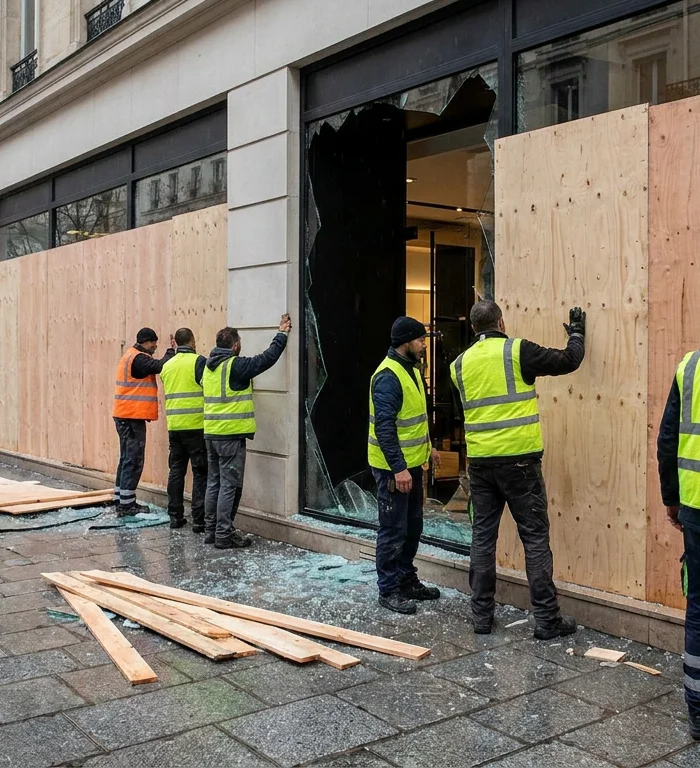
French Senate’s law committee approved on Wednesday a riot-damage bill that could make convicted vandals pay up to €10,000, RFI reported in an Oct. 23 news report.
The individual €10,000 cap contrasts with authorities’ estimate of several hundred million euros in total damage from last weekend’s unrest, leaving any single penalty far below the reported public and private losses.
Prime Minister Sébastien Lecornu has called the legislation “absolutely essential”, saying taxpayers should not be repeatedly asked to cover damage from protests that turn violent.
The government approved the bill in mid-September after violence following Paris Saint-Germain’s Champions League victory in late May. It is now presenting the measure as a response to violence during recent protests over living costs and the condition of schools in several French cities.
The Senate committee, controlled by an alliance of right-wing and centrist politicians, cleared the draft before a Senate debate scheduled for Oct. 27. The upper house moved further right after September’s senatorial elections, which gave the National Rally its first Senate group.
The bill’s most disputed provision would create collective civil liability, meaning a person could be ordered to pay compensation if they belonged to a group responsible for damage, even without being found to have caused it personally. Compensation could go to the state, victims or insurers on the same financial terms as for those who carried out the damage.
Left-wing politicians criticised the draft. Mathilde Panot, head of the France Unbowed group in the National Assembly, called it “a weapon of mass repression against all demonstrations”. Her colleague Clémence Guetté said it “establishes a presumption of guilt”.
Marine Le Pen, the National Rally presidential candidate, welcomed the proposal. “Anyone who destroys a town hall must know that they will pay for it for the rest of their life,” she said. “And in the case of minors, it will be their parents who pay.”
RFI reported that legal experts have questioned whether collective liability would comply with constitutional principles, including individual responsibility and the presumption of innocence. French law says people can be held criminally responsible only for their own actions, while the 1789 Declaration of the Rights of Man and of the Citizen protects the presumption of innocence.
Aurélien Martini, a deputy public prosecutor and representative of a leading magistrates’ union, pointed to the difficulty of identifying who belonged to a group. “Determining that someone was indeed part of a group is already very difficult,” he said, citing the challenge of distinguishing between masked demonstrators dressed in black.
The committee also backed amendments expanding the social benefits that could be seized if compensation is not paid, including family allowances and housing benefit. Senators supported an additional measure allowing foreign nationals convicted of certain serious offences linked to urban violence to face a ban on remaining in France.
The financial design leaves a practical question unresolved. Martini cited the Oct. 17 torching of Limoges town hall, where damage is expected to run into millions, and questioned whether a convicted suspect could pay such a sum.
On Oct. 27, senators are scheduled to debate the draft bill. The immediate test is whether the upper house keeps the €10,000 compensation cap and the principle that people convicted of vandalism can be required to pay the state, victims or insurers.
The same debate can show whether senators amend the collective-liability provision. The checkable issue is whether the text still allows someone linked to a group responsible for damage to be ordered to pay even without personally causing it.
Senators can also revisit committee-backed measures on seizing social benefits and imposing an additional ban on remaining in France for foreign nationals convicted of certain serious offences tied to urban violence.
Source: news report, RFI, Oct. 23, 2026
More stories
- Major emitters face climate-health gap in 132-plan review
- Lockheed Martin sets F-35 framework for at least 850 jets
- Tesla profit drops 43% despite $1.5bn cash flow
- Abu Dhabi crown prince brings 60-member delegation to Greece
- Oil prices rise after reported attack on Saudi oil field
- Tesla cuts spending plan to $20 billion amid AI overhaul
- Aemet warns of 300 l/m² from Storm Adam
- UN envoy presses Cyprus leaders on measures after two-year impasse
Latest news
- Malawi judge faces scrutiny over $150,000 Land Cruiser ruling
- India caps margins on 137 cancer drugs
- EU shoppers face smaller products at unchanged prices
- Pasithea plans NF1 data update from 18 patients
- Steward AI trader limits live-test loss to 0.3%
- UN climate fund earmarks $20m for Nepal flood recovery
- Gemini flags 69% of held-out thermal-video falls
- Ethiopia's coffee sector faces $453m EU export risk