

EU shoppers face smaller products at unchanged prices
A Euronews explainer says shrinkflation has become more common since Europe’s 2022 inflation surge, prompting national labelling rules and EU scrutiny.
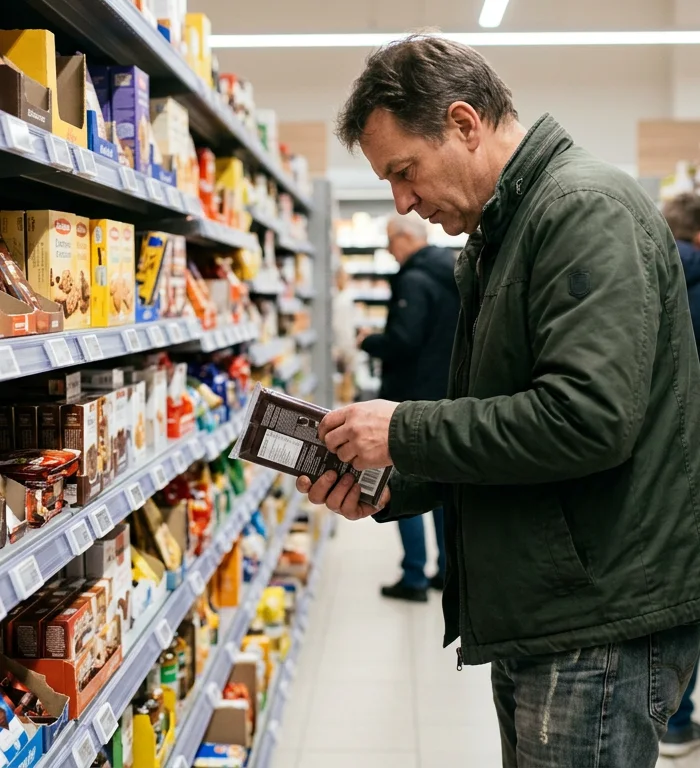
European shoppers are paying unchanged prices for smaller everyday products, a practice called shrinkflation, a Euronews news article reported on Oct. 23, citing 100g chocolate bars cut to 90g.
The squeeze matters because food and non-alcoholic drink prices across the EU rose roughly 33% from 2021 to 2025, while a 2025 European Commission report said 74% of consumers had noticed downsized products without lower prices.
Shrinkflation refers to manufacturers cutting the weight, volume or number of items in a product while leaving the shelf price unchanged. It can affect goods ranging from chocolate to toothpaste, according to the Euronews article.
“[Shoppers] purchase the same product in the same packaging, but will buy less for the same price,” said Loïc de Hults, a senior associate at law firm CMS Belgium.
The practice predates the recent inflation period, but the Euronews article said it has become more visible in Europe since the 2022 price surge. In one French syrup example from 2019, bottles were cut from 750ml to 600ml, and consumer group Foodwatch later reported a per-litre price increase of more than 37%.
Germany has also seen disputes over reduced formats. Euronews cited one brand that cut chocolate bars from 100g to 90g, leading to a May 2026 court ruling against the company, and another that introduced 75g bars in 2026 rather than its usual 100g size.
Retailers and manufacturers link the practice to higher costs. “Some manufacturers have been looking at reducing the packaging and the quantities to maintain prices, instead of increasing them,” said Christel Delberghe, director general of EuroCommerce, which represents European retailers and wholesalers.
Leena Whittaker, EuroCommerce’s director of competitiveness, said higher costs move through the supply chain. “Cost increases are being passed on through the chain overall,” she said. “If the costs of energy, inputs, production, and processing increase [...], prices will go up.”
Consumer groups want stricter disclosure rules, but EU-wide law does not ban shrinkflation as a separate practice. Current EU rules require net quantities on food packaging and unit prices per kilogram or litre, while the Unfair Commercial Practices Directive prohibits misleading practices.
De Hults said existing consumer law can already cover some cases. “There is already a general prohibition of misleading practice. And in in Germany, for instance, the court of [Hamburg] considered that reducing the volume of a product and keeping the same packaging without correctly informing the consumer is a misleading practice.
So, this is already covered by European law,” he said.
The issue has reached Brussels. On July 15, 2025, the European Parliament’s Internal Market and Consumer Protection Committee held a public hearing on shrinkflation and dynamic pricing, after which lawmakers questioned whether existing consumer protections were sufficient.
The European Commission defended the current framework, according to Euronews, pointing to mandatory quantity labels and unit pricing and saying national authorities are responsible for enforcement. It also said it would keep monitoring the market.
Several member states have moved faster. France has required supermarkets larger than 400 square metres since July 2024 to warn shoppers for two months when a product shrinks and its unit price rises, with fines of up to €15,000. Austria introduced similar rules in April 2026 for larger supermarkets and health and beauty shops when the unit price increases by at least 3%.
Brussels has pushed back against at least one national approach. In March 2025, the Commission opened proceedings against Italy over rules requiring manufacturers to place warning labels on reduced-size products, arguing that such labels could hinder trade between EU countries and suggesting shelf notices instead.
Source: news article, Euronews, Oct. 23, 2026
More stories
- Malawi judge faces scrutiny over $150,000 Land Cruiser ruling
- UN climate fund earmarks $20m for Nepal flood recovery
- Ethiopia's coffee sector faces $453m EU export risk
- EU faces Vietnam rights test over $57.9bn trade gap
- Albania lawmakers clash over policing of student protests
- Policy Alert seeks Nigeria hearing over $50bn offshore plan
- Boko Haram ceasefire tests Nigeria’s back-channel talks
- Dangote refinery IPO opens $1.6 billion retail offer