US considers deploying 3,000 airborne troops as Iran targets regional military bases
US weighs sending up to 3,000 82nd Airborne troops as Iran says it hit Israel and US bases; Kuwait reports airport fuel tank fire.
Cuneyd Erdogan ·
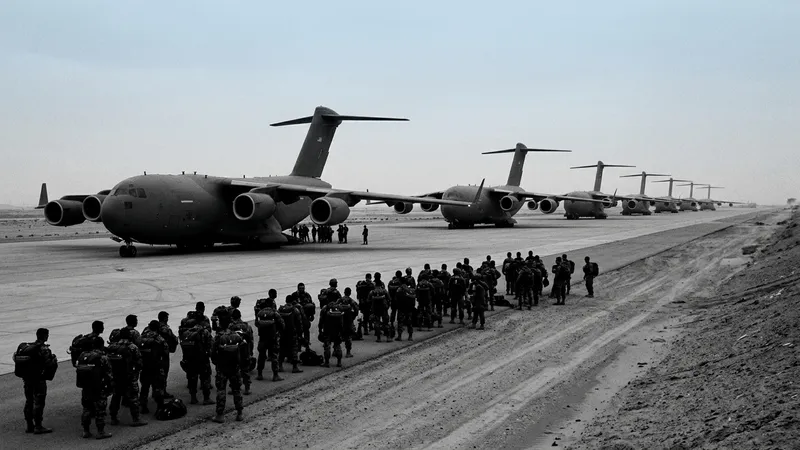
Washington appeared to be preparing a rapid military deployment to the Middle East as fighting intensified across multiple fronts, while Iran announced a fresh round of attacks targeting Israel and several US-linked sites in Gulf states.
Early Wednesday, Iran’s Revolutionary Guards said they launched a new wave of operations against Israel and against US bases in Kuwait , Jordan , and Bahrain .
Separately, Kuwait’s civil aviation authority said drones struck a fuel tank at Kuwait International Airport , triggering a fire.
Escalation Across the Region
In Lebanon , state media reported Israeli strikes killed at least six people in a town and a Palestinian refugee camp in the southern Sidon area, and three more people in another town.
The reports did not provide additional details on the locations beyond the Sidon area reference.
In the Israeli-occupied West Bank , Israeli soldiers were photographed inspecting remnants of an Iranian missile that landed in the village of Hares on Tuesday.
The image underscores how the conflict’s effects are being felt beyond Israel’s internationally recognized borders.
US Troop Movement Reports and Diplomatic Claims
Separately, the Wall Street Journal reported that the US appeared poised to send a combat team of up to 3,000 troops from the Army’s 82nd Airborne Division to the Middle East.
The unit is described as capable of deploying globally in under 24 hours, but the report did not specify a destination or mission parameters.
On the diplomatic track, Iran dismissed claims by US President Donald Trump that negotiations were underway around a “15-point framework” for peace.
An Iranian military spokesperson said Wednesday that Americans were “negotiating only with themselves,” while diplomats familiar with the talks believed the framework resembled a proposal advanced by Trump’s negotiating team during nuclear discussions in May 2025 .
Shipping Lane Update: Strait of Hormuz
Iran also said it would allow “non-hostile” vessels to transit the Strait of Hormuz safely.
The statement did not define what qualifies as “non-hostile,” leaving uncertainty for shipping operators and insurers assessing risk in one of the world’s most important energy corridors.
The developments come as markets and governments monitor the potential for disruptions to aviation, shipping, and energy flows.
While the source material does not quantify any supply impact, the combination of reported drone activity near a major airport and heightened military posturing adds operational risk for regional logistics.
Why This Matters Now
The immediate change is the reported widening of targets—spanning Israel , US bases in multiple countries, and infrastructure linked to civilian transport.
At the same time, the gap between public claims of a peace framework and Iran’s denial highlights how unclear the diplomatic channel remains.
Key unknowns include whether the reported US deployment proceeds, how Iran’s “non-hostile” shipping assurance will be applied in practice, and whether further strikes expand to additional critical infrastructure.
With information still emerging, the situation remains fluid.