

Ethiopia fighting displaces thousands in Amhara and Tigray
The UN said aid groups are preparing to expand support, but insecurity and road restrictions are disrupting deliveries in northern Ethiopia.
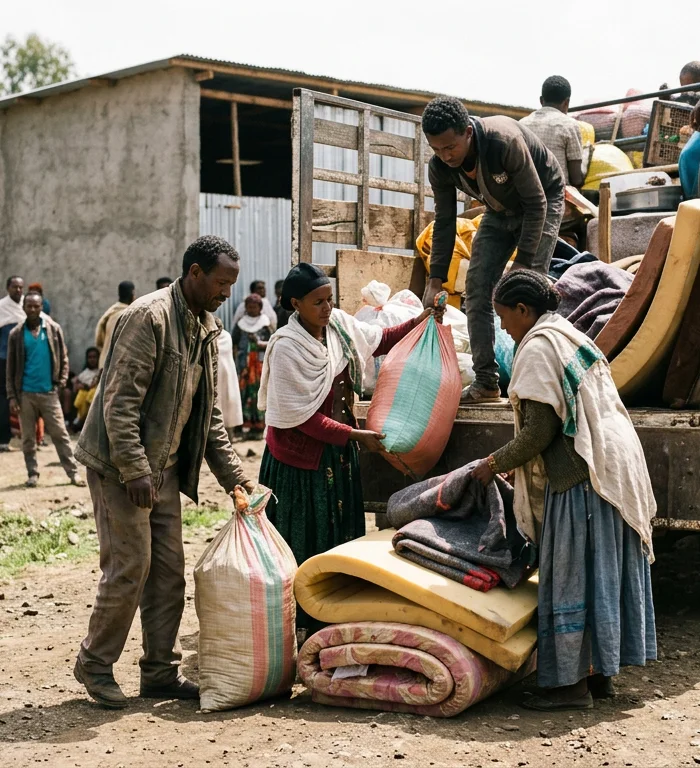
Renewed fighting in northern Ethiopia has displaced thousands in Amhara and Tigray as of Nov. 4, the United Nations said in an Addis Standard article distributed by AllAfrica.
The Nov. 4 article points to renewed pressure on fragile returns after Addis Standard reported in October 2025 that 12,155 displaced households, or 62,707 people, had gone back to six woredas, or districts, in Tigray. That earlier return movement was counted in tens of thousands, while the UN’s latest displacement update gave only a broad figure of thousands and no location-by-location breakdown.
The UN said displaced people are now in Debre Birhan in Amhara and Shire in northwestern Tigray. It did not say when the latest population movements began.
Families who had recently returned to Tahtay Adiyabo district in northwestern Tigray have left again because of renewed hostilities, the UN said. Humanitarian agencies are preparing to increase assistance, with priority for people it described as having the most urgent needs.
Aid delivery is being hampered by insecurity and restrictions on movement, according to the UN. In Amhara, insecurity is limiting travel on roads linking Gonder with Debark and Metema.
Debre Birhan was already hosting internally displaced people from West Shewa, East Wollega and West Wollega zones in Oromia. Those communities have faced long-running shortages of food, shelter and other basic assistance, according to the article.
The latest displacement follows fighting that began in late September in Tigray, Amhara and Afar, nearly four years after the November 2022 Pretoria Agreement ended the two-year war between federal forces and the Tigray People’s Liberation Front. The renewed violence has further disrupted recovery in areas affected by displacement, damaged infrastructure and limited access to services.
Source: news article, Addis Standard via AllAfrica, Nov. 4, 2026
More stories
- Monrovia mayor-designate seeks $14.5m city budget
- Iran's attacks hit 25 tankers near Strait of Hormuz
- Russia strikes Ukraine as Odesa faces electricity strain
- Bahrain reports two injuries after Iranian aerial attacks
- Baltic responders fight Sparta II fire after drone strike
- Estonia to close 5 Russia road crossings for six months
- Serbia, Georgia and Turkey face EU accession limits over alignment
- British Airways restores daily Dubai-Heathrow flights
- Philippine internet users 16 and older use AI at 94.4% rate
- Nelson Mandela Bay faces 70 Route 67 fixes
Latest news
- Nvidia board gets Trump input on Jensen Huang return as CEO
- Rwanda faces budget strain from 85% electricity access push
- ICE arrests at Seattle airport draw protests and scrutiny
- AI doubts leave Asian stocks facing a new investment test
- EU rejects COP31 deal as fossil fuel divisions block pact
- Deal Sheet: Fortis shutdown costs over 400 jobs
- Germany to pay about $11 a month into child pension accounts
- Laura Brand curbs prison messages after YouTube dispute