

Embodied Science Agent raises transmittance to 99.7%
The arXiv paper tests a self-driving laboratory design that links model reasoning with robot control across more than 200 million wastewater-treatment…
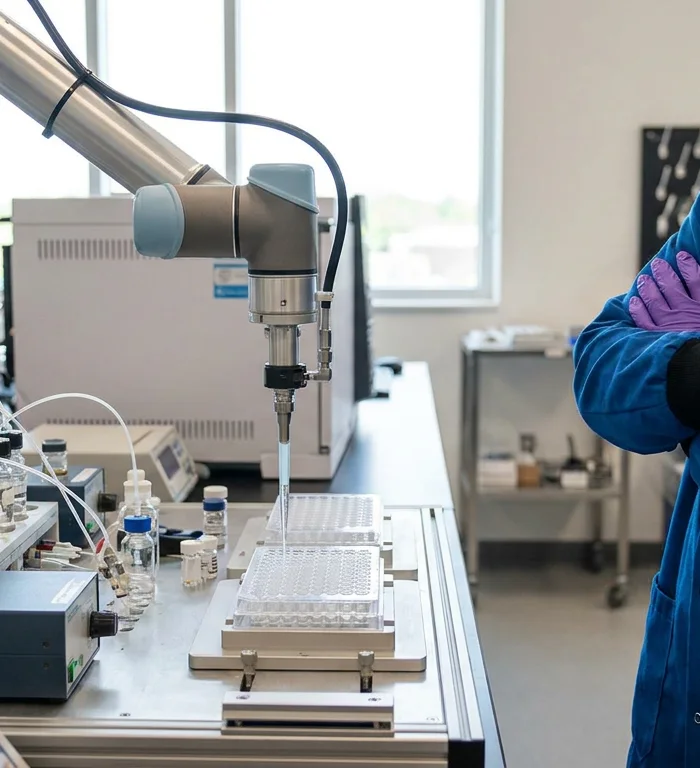
Yihang Che and five co-authors said their Embodied Science Agent raised solution transmittance from 82% to 99.7% over 15 wastewater-treatment rounds in an arXiv cs.AI preprint published Nov. 11.
That matters because ESA addresses laboratory hardware rather than software workflows; its 17.7-percentage-point transmittance gain, according to Atlas360 calculations, came while searching more than 200 million possible experimental conditions.
The authors said the final transmittance level corresponded to a 98.5% reduction in residual dye concentration, a measure tied to decolourisation in the wastewater-treatment experiment.
The paper targets self-driving laboratories, automated systems that choose and run experiments. The authors said in the arXiv abstract that existing designs face a “fundamental paradox” because “foundation model integration has increased linguistic sophistication while severing physical grounding.”
ESA combines three elements, according to the paper: a Digital Agent, an Embodied Agent and an Embodied Unified Interface. The Digital Agent uses memory-based reasoning and Bayesian optimisation, a statistical method for selecting promising experiments, while the Embodied Agent controls instruments through learned visuomotor policies, links between visual input and physical movement.
The scale of the search space is central to the claim. More than 200 million possible conditions is equivalent to more than 13 million possible settings for each of the 15 reported rounds, according to Atlas360 calculations, underscoring the challenge of choosing experiments without testing every option.
The limits are also clear from the arXiv record. The abstract reports validation in autonomous wastewater treatment, and the paper is listed as accepted by DAI 2026; it does not establish performance across other scientific domains in the abstract.
The authors said ESA’s learned visuomotor policies generalized across varying instrument placements during the wastewater-treatment validation.
Source: arXiv cs.AI preprint, Nov. 11, 2026
More stories
- Europe faces attribution gap after 16 cyber, physical incidents
- PIF backs Grand Theft Auto as Saudi players embrace game
- Signal limits screenshots to curb AI access to messages
- Cognition runs Devin Mac workspaces on EC2 in 6 AWS regions
- Salesforce engineers cut 600-failure triage to 90 minutes
- Türkiye Desk: GTA 6 puts console access and network demand in focus
- Anthropic IPO seeks $1.4 trillion fully diluted valuation
- UK agencies face 100-plus public-code security flaws
- White House quantum computing plan targets chips, talent
- Ariane 6 launch sends Amazon Leo broadband payload to LEO
Latest news
- Trump prepares tariffs on China and other major exporters
- New-car buyers pay record average $50,087 in October
- Banks face ECB reserve debate over liquidity and profits
- Investors see Anthropic debut gains fade below $83 a share
- Iraq orders federal control over Kurdish-area oilfields
- Germans oppose Ukraine aid as poll shows support slipping
- Kim Jong-un receives 10 envoys after constitutional shift
- Ukraine claims Libya strike sinks Russian naval corvette