White House quantum computing plan targets chips, talent
Trump signed quantum computing executive orders to accelerate development, strengthen supply chains, and transition federal systems to quantum security.
Jason Kwon ·
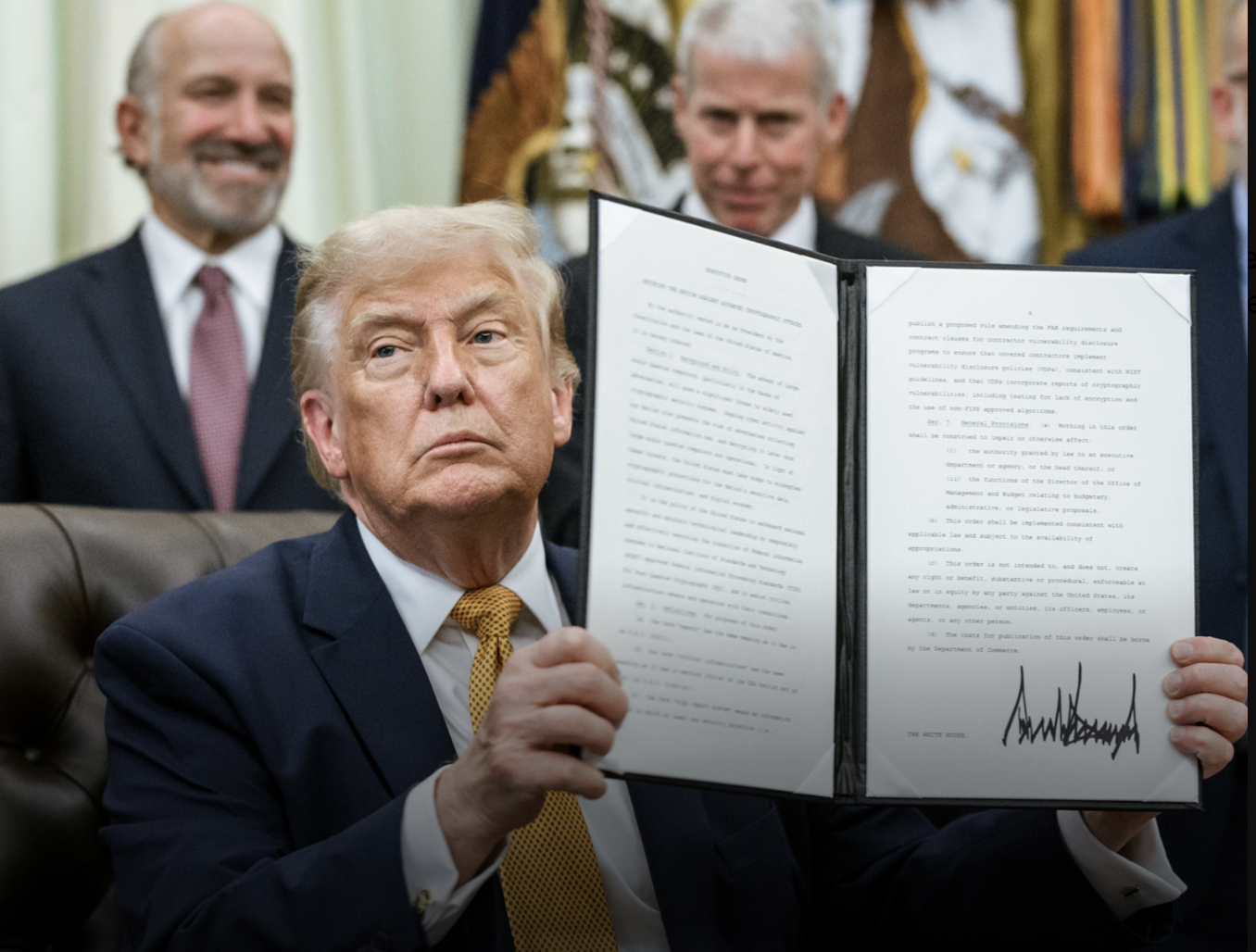
Trump signed quantum computing executive orders to speed development, bolster domestic supply chains, and move federal systems toward quantum cryptography within five years.
Two executive orders set development and security goals
President Donald Trump on Monday signed two executive orders that the White House said are meant to strengthen domestic quantum computing while preparing federal cybersecurity for a post-quantum era. The actions aim to both expand U.S. capability in advanced computing and reduce future risks to government communications.
Trump said the first order starts a nationwide effort to build a quantum computer designed for significant scientific calculations and to advance quantum-enabled sensors and networking technologies. He framed the goal as a five-year push to accelerate development and deployment.
The second order directs federal agencies to begin transitioning to “quantum cryptography,” according to Trump’s remarks at the signing. The stated purpose is to shift security practices to approaches designed to remain effective as quantum technology matures.
Trump was joined by major technology executives during the event, including the president of Google and IBM’s chief executive officer. He described the orders as an important move for U.S. competitiveness in a sector drawing rising investment and strategic attention.
White House outlines a 2028 timeline and supply-chain priorities
White House Office of Science and Technology Policy Director Michael Kratsios said the first order is titled “Ushering in the Next Frontier of Quantum Innovation.” Kratsios said it calls for the development of a quantum computer intended to be powerful enough for scientific research, and he pointed to 2028 as a target date.
Kratsios also said the order seeks to fortify the domestic ecosystem required to build quantum systems. That includes boosting U.S. production capacity for quantum infrastructure and materials viewed as essential to the technology’s progress.
Workforce measures are also central to the directive, Kratsios said. The order calls for expanding registered apprenticeships, establishing credentials, and creating new national quantum workforce development institutes, positioning talent development as a constraint on growth.
Although the administration did not provide a funding figure in the announcement, the policy framing links research capability, manufacturing readiness, and trained personnel as a single national effort. The approach mirrors how other frontier technologies have been advanced through coordinated federal procurement, standards-setting, and labor pipelines.
What quantum computing is, and why cryptography is a focus
Quantum computing is widely viewed as a next-generation approach that applies quantum physics to certain kinds of computation. The goal is to enable calculations that can be impractical for conventional machines, particularly in specialized scientific and engineering problems.
Traditional computers process information using binary “bits” that take values of 0 or 1. Quantum systems, by contrast, can use “superposition,” a property that allows quantum units to represent multiple states at the same time, which can change how some problems are computed.
Daniel Lidar, a University of Southern California engineering professor, has previously described the effect as a type of parallelism: a single quantum machine can effectively evaluate many possibilities at once for certain tasks. In practical terms, that potential is what has driven government and private-sector interest, even as the technology remains difficult to build and scale.
The administration’s emphasis on “quantum cryptography” reflects a growing policy concern: advanced quantum systems could eventually undermine widely used encryption methods that protect sensitive communications. By instructing agencies to transition, the order signals that federal networks are expected to begin adopting security approaches designed with future quantum capabilities in mind.
Next steps are likely to include implementation guidance to agencies, coordination on standards and procurement, and milestones tied to the 2028 development target. Progress will be measured by whether domestic manufacturing capacity and workforce programs keep pace with technical objectives, and by how quickly federal systems begin adopting quantum-resilient security methods.