

DSP matches reinforcement learning with 490 times less robot data
The arXiv preprint says supervised play reduced interaction needs in specific dexterous-manipulation tests, but the results are not peer reviewed.
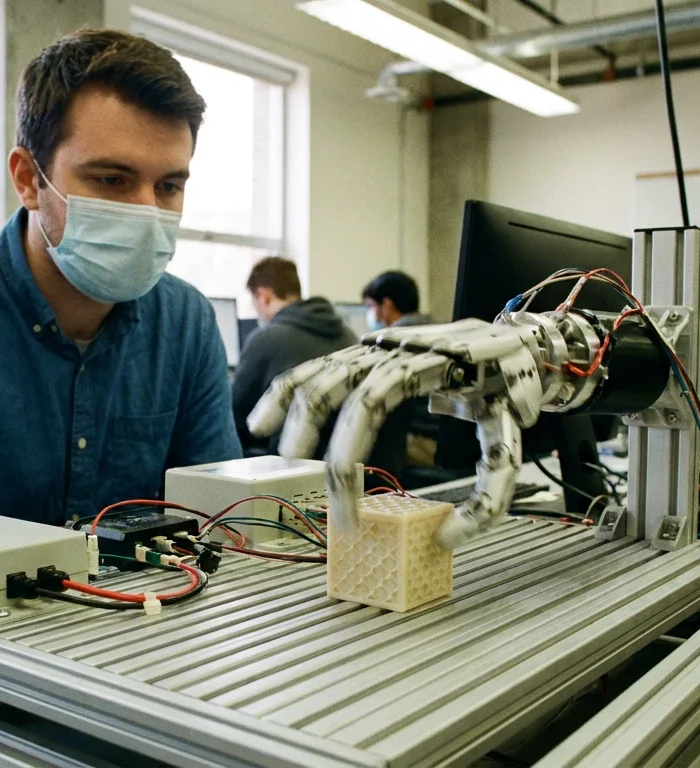
Researchers led by Botao He said in an arXiv preprint published Oct. 17 that their DSP robot-learning framework matched reinforcement learning with a reported 490-fold reduction in real-world interaction data.
In the Oct. 17 arXiv preprint, He and co-authors Yiming Dou, Yiannis Aloimonos, Jitendra Malik, Akash Sharma and Ruoshi Liu said DSP showed a 69.6% success-rate advantage over a hindsight behavior-cloning baseline. The comparison matters because robot manipulation methods often depend on large volumes of physical interaction data.
DSP, short for Dexterity from supervised play, starts with behavior cloning, a supervised-learning method in which software imitates observed actions. The robot studies “minutes of human play,” then uses the learned play policy to collect longer autonomous experience for a world model, a learned representation of how actions affect the environment.
At run time, the play policy proposes action sequences for model-predictive control, a planning method that evaluates short possible moves before acting. The authors said the same framework also uses self-play inside the world model to distill a faster closed-loop, goal-conditioned policy, meaning a policy that repeatedly adjusts actions toward a specified goal.
The authors said the results “demonstrate that supervised play can autonomously collect interaction data, guide model-based planning, and enable policy learning without any task-specific demonstrations or sim-to-real transfer.” The tests covered “underactuated pushing” and “any-to-any in-hand pose reorientation with a multifingered hand” in simulation and real-world experiments.
The finding remains limited by the source format.
The arXiv page lists version 1 as submitted on Oct. 15. It gives no dated next experiment, code-release deadline or peer-review milestone.
Source: arXiv preprint, arXiv cs.RO/cs.AI, Oct. 17.
More stories
- Europe faces attribution gap after 16 cyber, physical incidents
- PIF backs Grand Theft Auto as Saudi players embrace game
- Signal limits screenshots to curb AI access to messages
- Cognition runs Devin Mac workspaces on EC2 in 6 AWS regions
- Salesforce engineers cut 600-failure triage to 90 minutes
- Türkiye Desk: GTA 6 puts console access and network demand in focus
- The Week in Games: Selective capital meets harder scoreboards
- Bhaag Neha Bhaag draws 2,700 players in CJP protest game wave
- Government curbs on AI models add uncertainty for investors
- NASA taps Relativity Space to deliver Aeolus Mars mission
Latest news
- Trump prepares tariffs on China and other major exporters
- New-car buyers pay record average $50,087 in October
- Banks face ECB reserve debate over liquidity and profits
- Investors see Anthropic debut gains fade below $83 a share
- Iraq orders federal control over Kurdish-area oilfields
- Germans oppose Ukraine aid as poll shows support slipping
- Kim Jong-un receives 10 envoys after constitutional shift
- Ukraine claims Libya strike sinks Russian naval corvette