Drones shape NATO plan for Russian eastern-flank threat
NATO’s commander plans an Oct. 12 strategy rollout on defending the eastern flank as allies weigh drones, AI and US force commitments.
Lauren Collins ·
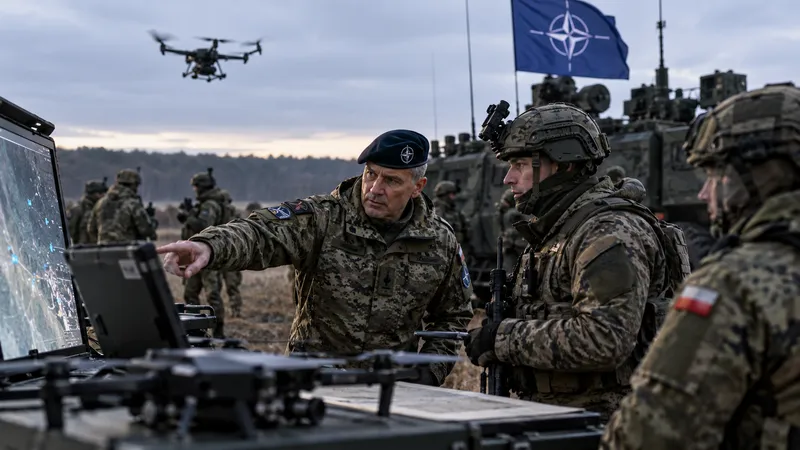
NATO’s top military commander will present a defense strategy on Oct. 12 to clarify how the alliance would answer an eastern-flank attack.
General Alexus Grynkewich, Supreme Allied Commander Europe, is expected to outline the document in Poland as relations between NATO and Russia remain under strain. Senior officials and diplomats familiar with the matter said the paper, called “Theory of Victory,” is intended to show how the alliance would handle a possible incursion into its territory.
Grynkewich sets Poland rollout
The officials and diplomats asked for anonymity to discuss private deliberations, and the central description of the document is based on those accounts. They said the effort is meant to give governments and the public a clearer view of the planning behind higher defense spending and eastern-flank readiness.
Colonel Martin O’Donnell, a spokesman for Grynkewich, declined to discuss the plan’s details and stressed that NATO’s posture is defensive. "The Supreme Allied Commander Europe’s theory of victory is simple: maintain NATO’s advantage." O’Donnell said the alliance needed to prepare conditions that would deter aggression and allow it to prevail if attacked. His framing places the document inside NATO’s long-standing claim that readiness is designed to prevent conflict, not initiate it.
Drones meet traditional firepower
The strategy is described as an effort to connect conventional military power with systems that have become more prominent since Russia’s full-scale invasion of Ukraine in 2022. Those include low-cost drones, minimally crewed systems and AI-enabled targeting, alongside land forces and other assets under NATO’s Eastern Flank Deterrence Initiative.
If NATO territory were attacked, the concept described by the officials would first seek to block the incursion. Once allied forces gained freedom of maneuver, the plan would aim at enemy command and control, with the stated goal of defeating Russian forces quickly and with overwhelming force.
The document also emphasizes avoiding involuntary provocations while confronting hybrid threats, a category that includes hostile actions below the threshold of open conflict. NATO Secretary General Mark Rutte recently said there were no indications that Russia was preparing a conventional attack on the alliance, while warning that Europe should be ready for prolonged hybrid pressure.
Spending choices divide allies
The planning comes as European allies have increased defense outlays and face harder choices over what those budgets should buy. The central trade-off is between traditional platforms such as tanks and newer technologies that have been tested at scale in Ukraine.
That debate also runs through the US role in Europe. This summer, Washington sent NATO allies a questionnaire on defense spending and support for President Trump’s policies as officials weighed planned reductions in US military assets assigned to Europe’s defense.
The same questionnaire asked whether allies could commit more forces to NATO for Grynkewich’s defense plans. That request puts the strategy in practical terms: an alliance doctrine only changes deterrence if governments provide units, systems and funding to carry it out.
Three paths for deterrence
If allies answer Grynkewich’s plan with additional forces and deployable technology, NATO’s eastern posture would depend less on emergency reinforcement after a crisis begins. The defense industry would likely see stronger demand for drone systems, counter-drone tools and AI-enabled targeting links that can work with conventional forces.
If Russia keeps pressure below the threshold of war, the plan’s hybrid-threat provisions would become the first test of allied coordination. The global macro effect would be less about battlefield movement than about persistent security costs for European governments, ports, energy networks and transport systems.
If US reductions move faster than European force commitments, NATO would face a gap between doctrine and available capacity. For the alliance, the open question is whether new technology can offset fewer traditional assets; for industry, the answer would shape whether procurement tilts toward cheaper scalable systems or heavier legacy platforms.