Colombia earthquake kills 111 as Cali buildings collapse
The Colombia earthquake killed at least 111 people and forced emergency funding as rescue crews searched collapsed buildings across the west.
Sofia Reyes ·
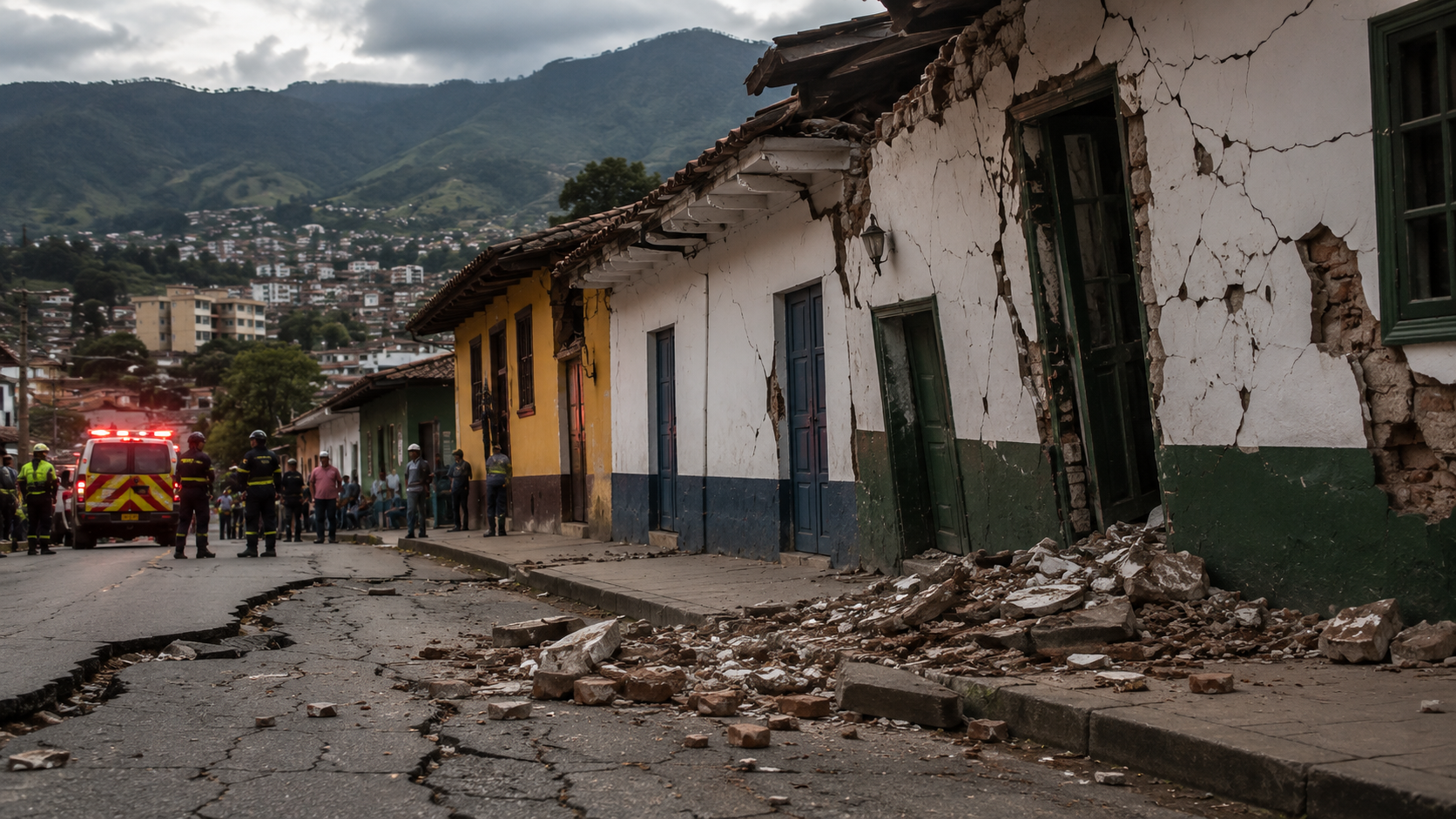
The Colombia earthquake killed at least 111 people and forced emergency funding as rescue crews searched collapsed buildings across the west.
The 7.4-magnitude quake struck on Monday, August 10, 2026, damaging about 1,600 buildings, according to President Abelardo de la Espriella. The epicenter was in San Jose del Palmar, a community of about 4,800 people in Choco about 250 miles, or 400 kilometers, west of Bogota, the U.S. Geological Survey said.
Rescuers comb Cali rubble
Search teams and residents worked through broken concrete in Cali, Colombia's third-largest city, after at least 61 buildings collapsed nationwide, according to the president. Volunteers formed lines to pass debris by hand as families waited near damaged structures.
Álvaro López, holding his dog near one search site, said, "Our building has basically been left in ruins, and the building next to ours? Completely collapsed." His account captured the immediate problem facing rescuers: people were still believed to be under debris while aftershocks complicated work around unstable buildings.
Emergency order unlocks funding
De la Espriella declared an emergency to speed public spending on rescue and recovery after the initial toll reached at least 111 dead and 87 injured. He said the government would stay with affected communities, adding, "We aren’t going to leave people alone. They are in our hearts and we are going to tend to people with our full determination."
National and local figures showed the damage spread well beyond Cali, with Pereira, Quibdo and Manizales also hit. Officials said the shaking was felt in neighboring Ecuador and Panama, extending the event's reach across borders even as confirmed casualties remained concentrated in western Colombia.
Authorities attributed at least 40 deaths to Risaralda, where Pereira is located, and 27 to Valle del Cauca, where Cali is located, including three children. They also reported nine deaths in Choco, two in Caldas and one in Antioquia, while the locations of 32 additional deaths were not immediately clear.
Choco access shapes the toll
Colombia's Geological Service described the quake as the strongest recorded in the country in the 21st century and said several aftershocks followed. The Pacific region near the epicenter sits on the Ring of Fire, the belt of seismic faults around the Pacific Ocean where many of the world's earthquakes occur.
Choco's geography may slow the full accounting of damage compared with urban centers such as Cali and Pereira. Much of the region is dense jungle and is reachable only by boat or plane, a constraint that can delay medical evacuations, engineering inspections and the delivery of heavy rescue equipment.
The damage also lands on one of Colombia's poorer regions, where weak infrastructure can turn an earthquake into a longer fiscal and humanitarian strain. If emergency funds reach isolated communities quickly, the immediate economic effect is likely to center on public spending, temporary shelter and repairs rather than a broader interruption to global activity.
Rebuilding hinges on collapsed blocks
If aftershocks remain limited and access routes hold, Colombia's recovery will depend on how quickly authorities can inspect the roughly 1,600 damaged buildings and clear unsafe blocks in Cali and other cities. That path would keep pressure on construction crews, hospitals and municipal budgets while limiting wider disruption to commerce.
If the toll rises in Choco or more structures are found unsafe, the emergency order could shift from short-term rescue toward a longer rebuilding program. That would increase demand for cement, steel, transport and temporary housing, while testing insurers, local governments and national disaster agencies.
Rescue teams' first task remains locating survivors and stabilizing damaged buildings before demolition or reconstruction begins. The main open questions are how many people remain trapped, whether aftershocks damage weakened structures, and how quickly authorities can reach communities beyond the main cities.