

Civil-society groups press Ramaphosa on AI costs in 60-person forum
The Johannesburg meeting challenged a Silicon Valley trip the authors said excluded labour, communities, artists and civil society.
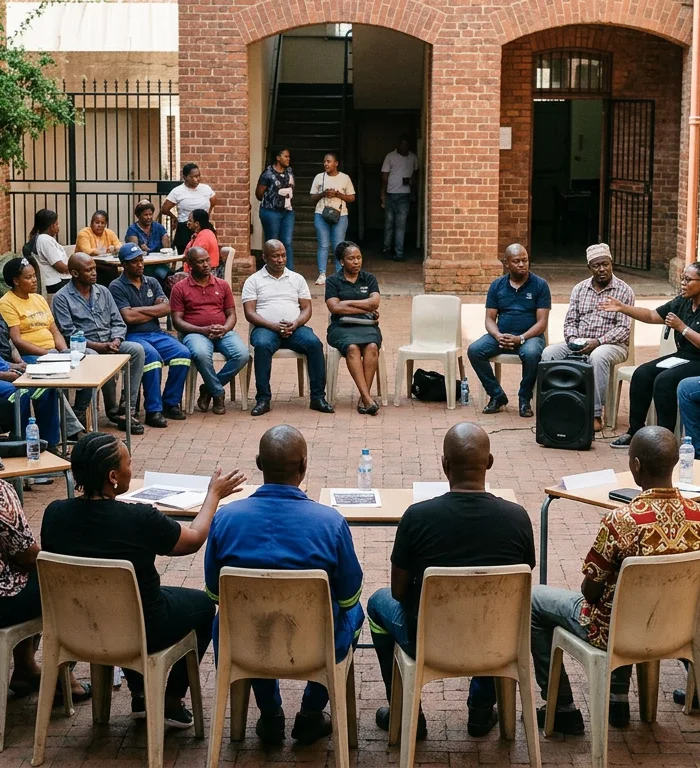
More than 60 labour, community and civil-society participants from over 35 organisations met at Johannesburg’s Constitution Hill on Nov. 16 and Nov. 17, Daily Maverick said in a Nov. 19 op-ed.
The dispute matters because President Cyril Ramaphosa was in Silicon Valley with some 300 South Africans while the country still lacks a national AI policy, according to the op-ed.
The authors said officials, business figures, technical specialists and students joined Ramaphosa’s delegation, but not the constituencies represented in Johannesburg. “Yet there was no space for labour, communities, artists or civil society to attend,” they wrote.
They described their meeting as an alternative AI Indaba at the Women’s Jail, a site within Constitution Hill. “We don’t even know how we were meant to respond, since the invite was never sent,” the authors wrote.
Participants included organised and casual workers, community organisations, think tanks, platform workers, data labellers, domestic workers, academics, lawyers, researchers and artists, according to the op-ed. The meeting examined artificial intelligence through its production chain, from raw materials and water use to workers and communities affected by the technology.
The authors said they had prepared questions for Ramaphosa to put to Big Tech and to answer domestically. Their concerns focused on natural-resource allocation, decent work, surveillance, land, water and electricity access in a country facing severe social and economic inequality.
The Silicon Valley programme promised to consider AI’s effect on the labour market and the future of work, the op-ed said. The authors’ criticism centred on who was absent from those discussions, rather than whether labour issues appeared on the agenda.
The policy backdrop remains unsettled. The op-ed said South Africa’s draft national AI policy was withdrawn in April after its references were found to include fictitious sources, and that a revised version is expected next year.
The letter also linked AI infrastructure to immediate resource pressures. On Nov. 16, Water and Sanitation Minister Pemmy Majodina announced precautionary Western Cape water-allocation cuts of 7% for homes and industry and 15% for irrigation, according to the op-ed.
In Cape Town, a protest against data centres took place at the CTICC, the venue for Africa Tech Festival 2026, the op-ed said. The authors also cited San José, California, where Mayor Matt Mahan is proposing a short pause on data-centre approvals while new development standards and community-benefit requirements are considered.
More stories
- Monrovia mayor-designate seeks $14.5m city budget
- Iran's attacks hit 25 tankers near Strait of Hormuz
- Russia strikes Ukraine as Odesa faces electricity strain
- Bahrain reports two injuries after Iranian aerial attacks
- Baltic responders fight Sparta II fire after drone strike
- Estonia to close 5 Russia road crossings for six months
- UN agencies seek aid for 30.3m facing DR Congo hunger
- Hungary seizes nearly $20m in Orban-era corruption probe
Latest news
- Rwanda faces budget strain from 85% electricity access push
- ICE arrests at Seattle airport draw protests and scrutiny
- AI doubts leave Asian stocks facing a new investment test
- EU rejects COP31 deal as fossil fuel divisions block pact
- Deal Sheet: Fortis shutdown costs over 400 jobs
- Germany to pay about $11 a month into child pension accounts
- Laura Brand curbs prison messages after YouTube dispute
- Nigeria's family-planning budget falls 97%