

New AI Framework Enables Autonomous Industrial Robot Programming
This new open-source AI framework lets autonomous agents program industrial robots in simulation, cutting deployment times and training needs.
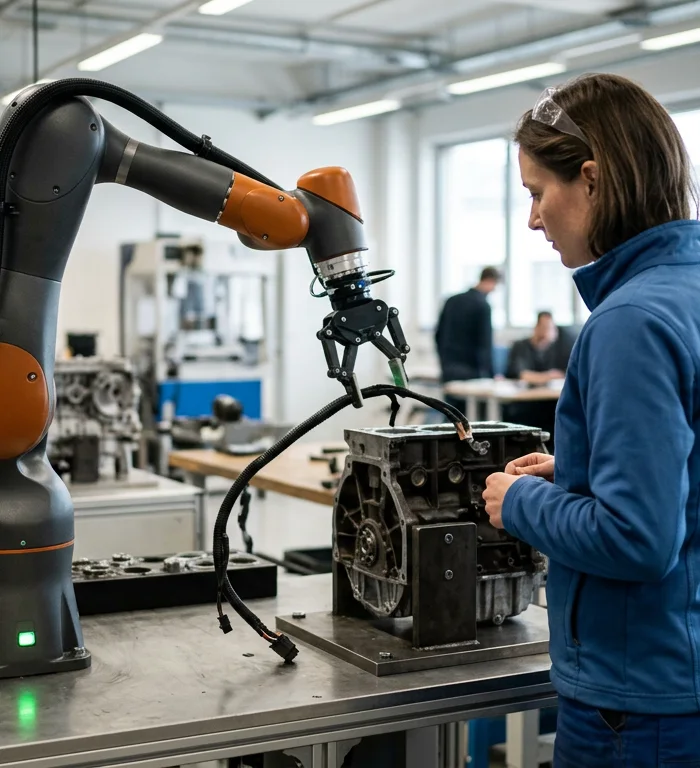
Researchers have introduced an open-source framework designed to automate the programming, simulation, and refinement of industrial robotic workcells. By utilizing agentic AI, this approach eliminates the traditional requirement for extensive training data and manual parameter tuning, which historically extended implementation timelines from weeks to months.
The system, developed through a collaboration between academic and industry partners, centers on a new interface called RoboSimStudio. This tool simplifies the complex parameter management of physics engines, allowing AI agents to iteratively test and optimize robot code within a simulated environment. By closing the loop between simulation and real-world feedback, the agents can autonomously generate functional programs for complex tasks such as cable routing, gear meshing, and tool manipulation.
To standardize performance evaluation, the researchers also released a new benchmark suite, the Variational Automation Benchmark for Agentic Robotics (VABAR). This suite provides standardized difficulty tiers and success metrics across various industrial manipulation tasks. By leveraging existing simulation platforms, the benchmark allows for large-scale, systematic testing of robotic policies under changing operational conditions.
This development represents a shift in industrial automation, moving away from hand-tuned behaviors toward modular, agent-driven workflows. For policymakers and industry stakeholders, this technology suggests a potential reduction in the capital and time expenditures currently associated with deploying industrial robots. The ability to generate and verify code in simulation before physical installation may significantly lower the barrier to entry for complex automation projects and improve the adaptability of robotic systems in dynamic manufacturing environments.
More stories
- Europe faces attribution gap after 16 cyber, physical incidents
- PIF backs Grand Theft Auto as Saudi players embrace game
- Signal limits screenshots to curb AI access to messages
- Cognition runs Devin Mac workspaces on EC2 in 6 AWS regions
- Salesforce engineers cut 600-failure triage to 90 minutes
- Türkiye Desk: GTA 6 puts console access and network demand in focus
- How Turkey's esports ecosystem works
- Xbox Game Pass guide: Ultimate costs 799 TL in Turkey
- Moscow Game Hub says two-thirds of its Tokyo Game Show titles are already localized for Japan
- Valve introduces pet chickens to Counter-Strike 2, testing a new retention model
Latest news
- Trump prepares tariffs on China and other major exporters
- New-car buyers pay record average $50,087 in October
- Banks face ECB reserve debate over liquidity and profits
- Investors see Anthropic debut gains fade below $83 a share
- Iraq orders federal control over Kurdish-area oilfields
- Germans oppose Ukraine aid as poll shows support slipping
- Kim Jong-un receives 10 envoys after constitutional shift
- Ukraine claims Libya strike sinks Russian naval corvette