

Cambodia’s $5.1 bn FDI inflow raises bar for Philippines
JC Punongbayan uses Cambodia’s airport, investment and budget systems to question whether Philippine policy is turning capital into local capability.
Cambodia’s economy is forecast to expand 3.5% in 2026, from an estimated 5.3% in 2025, World Bank data cited in a Rappler opinion column published Nov. 18 showed.
The comparison matters for the Philippines because columnist JC Punongbayan said Cambodia drew $5.1 billion of foreign direct investment in 2025, about a tenth of gross domestic product.
“Still, Cambodia is faring a bit better than us, and the data show that plainly,” Punongbayan said in the column, written after a return visit to Cambodia during the Philippines’ hosting of the Association of Southeast Asian Nations summit.
The International Monetary Fund expects Cambodia’s 2026 growth at 3% and average inflation at 5.6%, according to figures cited in the column. Punongbayan said expensive energy and weaker tourism are among the reasons for the slowdown.
The column set Cambodia’s economic strain against signs of infrastructure ambition. Techo International Airport in Phnom Penh opened in September 2025, and Punongbayan said the first phase cost $2.3 billion, with a Chinese state-owned company building the passenger terminal.
Punongbayan said questions remain over contract awards and the allocation of financial risks at Techo. Even so, he used the airport to contrast Cambodia’s main gateway with Manila’s Ninoy Aquino International Airport and to frame Cambodia as more prepared for regional-scale events.
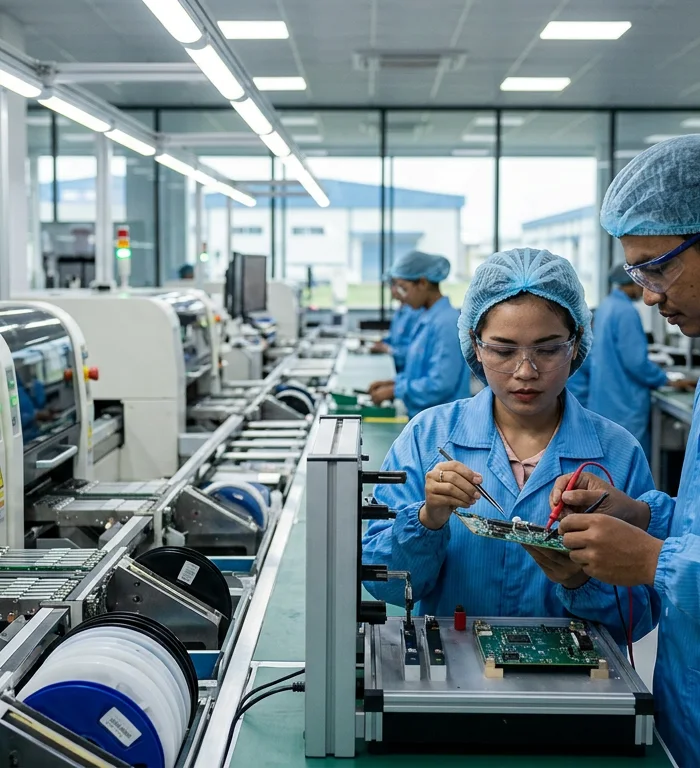
Foreign investment is moving beyond garments into electronics and renewable energy, Punongbayan said, while citing the IMF’s call for Cambodia to attract higher-quality investment and encourage more spending by domestic companies. His policy point was that investment inflows matter less if local suppliers and engineers do not move up the value chain.
That argument fed into his discussion of Pax Silica, a Philippine framework whose financial scale for New Clark City is not yet known in the column. Punongbayan said the framework is set to be formalized by December, after the ASEAN summit and a visit by U.S. President Donald Trump, and urged scrutiny of what Filipino engineers and companies would actually do under it.
The column also pointed to public financial management, the system for planning, spending and accounting for public money. Punongbayan cited Cambodia’s reform program since 2004 and compared it with the Philippines’ public financial management roadmap for 2024 to 2028.
The Cambodia comparison leaves Philippine policymakers with two linked tests: whether foreign investment produces local capability, and whether budget reforms can track projects from appraisal to delivery.
Source: opinion column, Rappler, Nov. 18, 2026
More stories
- Trump prepares tariffs on China and other major exporters
- Banks face ECB reserve debate over liquidity and profits
- Investors see Anthropic debut gains fade below $83 a share
- Iraq orders federal control over Kurdish-area oilfields
- Nvidia shares retreat as AI rally cools before PCE data
- Nvidia board gets Trump input on Jensen Huang return as CEO
- Nvidia investigation puts SEC focus on investor disclosures
- G7 economic optimism falls to 22% despite steady growth
- US challenges Airbus financing over $3.4bn EIB loan
- Deutsche Bank shares fall 6.4% after leaked-file reports