

Autonomous Robotic Construction Successfully Demonstrated in Orbital Environment
The first autonomous robotic assembly in space validates a new manufacturing paradigm, enabling the construction of massive orbital infrastructure.
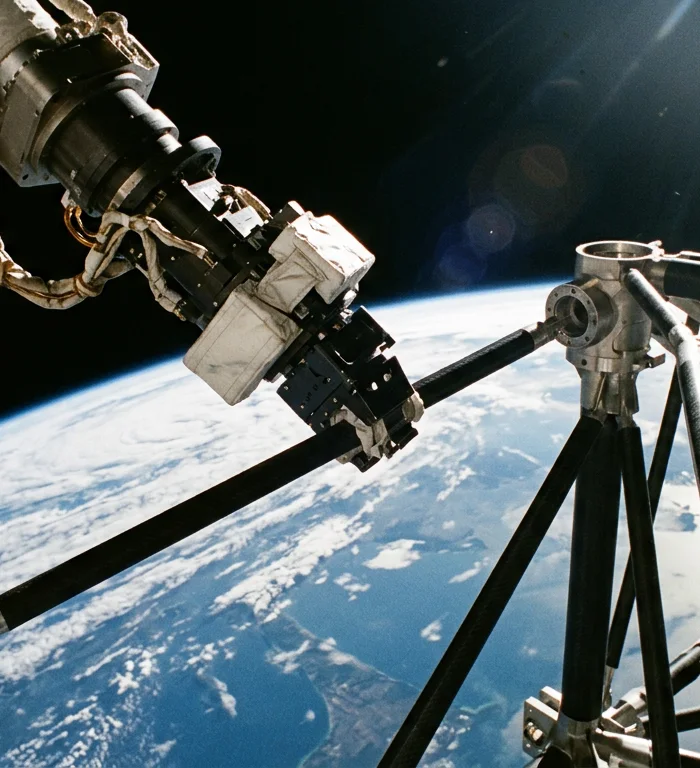
A robotic system has successfully completed the first autonomous assembly of a structural framework in orbit. Developed under the Novel Orbital and Moon Manufacturing, Materials, and Mass-efficient Design (NOM4D) program, the experiment validates the feasibility of building large-scale infrastructure directly in space without human intervention.
The system utilizes an automated arm to retrieve components from storage and assemble them into a truss structure. While the current mission faced technical and scheduling constraints that prevented the completion of the full 1.4-meter reflector antenna, the successful assembly of initial sections confirms the viability of the construction methodology. This capability represents a significant shift from traditional deployment methods, which rely on folding structures to fit within rocket fairings or manual assembly by astronauts.
This development addresses critical size constraints currently imposed by launch vehicle dimensions. By enabling the orbital assembly of large-scale components, this technology facilitates the future construction of massive telescopes, high-capacity communications antennas, and space-based solar power stations. The ability to manufacture or assemble structures in situ reduces the reliance on complex, high-risk deployment mechanisms and allows for the creation of frameworks that exceed the physical volume of existing launch platforms.
The project, funded by the Defense Advanced Research Projects Agency (DARPA), serves as a foundational step for future space-based manufacturing initiatives. Ongoing research aims to transition from assembling pre-manufactured parts to utilizing raw materials transported to orbit. This evolution is expected to support the development of kilometer-scale structures, fundamentally altering the logistics and design parameters for long-term space exploration and orbital infrastructure development.
More stories
- Europe faces attribution gap after 16 cyber, physical incidents
- PIF backs Grand Theft Auto as Saudi players embrace game
- Signal limits screenshots to curb AI access to messages
- Cognition runs Devin Mac workspaces on EC2 in 6 AWS regions
- Salesforce engineers cut 600-failure triage to 90 minutes
- Türkiye Desk: GTA 6 puts console access and network demand in focus
- Nvidia opens board inquiry into alleged foreign targeting
- Nvidia opens board inquiry into alleged foreign targeting
- Super-puff planets surprise scientists in TOI-791 system
- NASA Swift orbit boost aims to avert reentry this year
Latest news
- Trump prepares tariffs on China and other major exporters
- New-car buyers pay record average $50,087 in October
- Banks face ECB reserve debate over liquidity and profits
- Investors see Anthropic debut gains fade below $83 a share
- Iraq orders federal control over Kurdish-area oilfields
- Germans oppose Ukraine aid as poll shows support slipping
- Kim Jong-un receives 10 envoys after constitutional shift
- Ukraine claims Libya strike sinks Russian naval corvette