Australia-US defense ties deepen as Pacific focus grows
Australia and the US plan deeper defense cooperation as Canberra points to a growing American force posture and $580 million in Pacific funding.
Lauren Collins ·
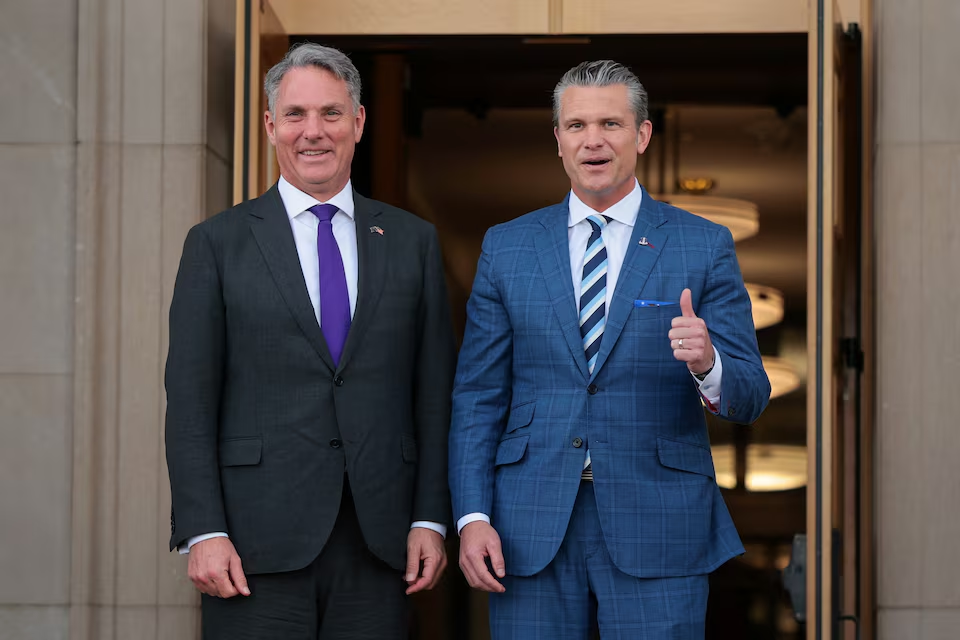
Australia-US defense ties will deepen under expanded force-posture plans, adding to a $580 million Pacific push aimed at regional deterrence.
Australian Defence Minister Richard Marles said after talks in Washington with US Defence Secretary Pete Hegseth that the American military presence in Australia is increasing across land, sea, air, cyber and space domains. He did not say whether the next phase would include a larger number of US troops stationed in Australia.
Marles points to force posture
The comments point to a broader military alignment between Canberra and Washington as both governments seek to strengthen deterrence in the Indo-Pacific. Marles said further details would be provided at the next meeting of Australian and US defense ministers later this year.
The US-Australia Force Posture Initiatives allow American forces to train in Australia, rotate aircraft through the country and store equipment there. The arrangements also support logistics for US vessels, giving Washington a larger operating base in the southern Pacific without requiring a permanent base structure to be announced in each case.
Marles framed the cooperation as part of Australia's national security interest, saying it was intended to support stability and peace in the Indo-Pacific. His remarks left open the central operational question: whether the next stage involves more personnel, more equipment, more frequent rotations or a combination of all three.
AUKUS adds submarine dimension
The defense relationship also sits inside AUKUS, the security pact among Australia, the US and Britain. Under that agreement, some US defense personnel are already working at HMAS Stirling on Australia's west coast, where four US-commanded Virginia-class submarines are due to be housed from 2027.
That timetable gives the naval base a larger role in allied submarine operations before Australia receives its own nuclear-powered submarines under the pact. For Australia, the arrangement is meant to build local skills and infrastructure; for the US, it offers additional reach into the Indian Ocean and western Pacific.
China has criticized AUKUS, calling the pact dangerous and warning that it could encourage a regional arms race. Beijing's position places the submarine plan inside a wider contest over military presence, political influence and infrastructure financing across the Pacific.
Hegseth said the two countries' defense strategies showed “strong alignment” and emphasized that allies should invest in their own sovereign security while contributing to collective defense. He said both sides shared a common view of a complex global threat picture and needed to ensure their capabilities were planned together and complementary.
Pacific summit sharpens timing
The Washington meeting took place as the Pacific Islands Forum moved into its final day in Palau. The regional summit has been marked by the absence of several leaders and by China's protest over the presence of Taiwan's foreign minister.
Australia and the US have announced a combined $580 million in funding for Pacific Island nations. The money comes as China continues to use grants, infrastructure projects and aid to deepen relationships in a region where small island states can shape access, basing, telecommunications and diplomatic recognition.
The immediate company-level impact is limited because no defense contractor or procurement award was named in the announcements. The wider defense sector, however, will watch whether expanded force posture translates into demand for base construction, sustainment, logistics, maintenance and maritime support services in Australia.
If the cooperation remains focused on rotations and logistics, the macro effect is likely to be gradual: more allied military activity, higher infrastructure spending and a stronger deterrence signal without a formal basing shift. Australia would gain deeper integration with US planning, while regional defense firms could see steady work tied to facilities and sustainment.
If the next ministerial meeting produces a larger troop presence or additional assets, the policy signal would be stronger and the diplomatic response from Beijing could become more direct. If the plans stay limited or are delayed, the practical effect would fall back on AUKUS milestones at HMAS Stirling and the $580 million Pacific funding package as the main near-term measures of allied follow-through.