

Humanoid Robotics Achieve 96% Efficiency in Automotive Production Proof-of-Concept
Humanoid robots achieved a 96% success rate in an automotive kitting trial, signaling advancements in VLA model integration and industrial safety protocols.
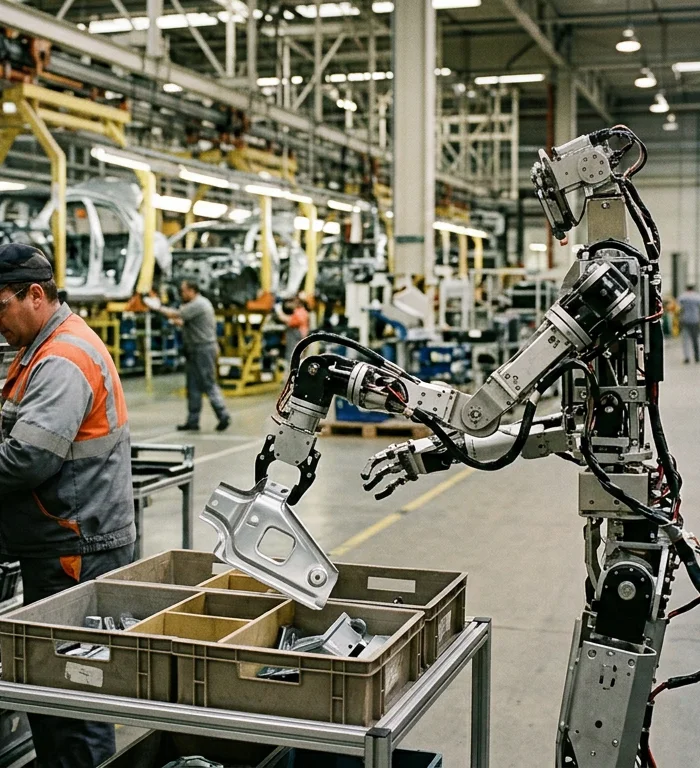
A recent proof-of-concept trial conducted at Mercedes-Benz production facilities in Hungary and Germany demonstrated a 96% success rate for humanoid robots performing automated parts sorting. The Apollo 2 humanoid units, integrated with the Gemini Robotics 2.5 vision-language-action (VLA) model, successfully executed kitting tasks by identifying and placing automotive brackets from bulk bins into specific sequencing containers. This deployment marks a transition from controlled laboratory environments to active industrial assembly lines.
The Gemini Robotics 2.5 model utilizes visual and language processing to manage complex physical movements, including dynamic balance and multi-step manipulation. Performance metrics indicate that the integration of this model allows for a 20% to 30% increase in task completion speed compared to previous benchmarks. Furthermore, the system demonstrated improved safety protocols, with a 33% increase in obstacle avoidance and a 43% improvement in navigation around human personnel.
To address security concerns regarding autonomous systems, the developers introduced the ASIMOV-Jailbreak benchmark. This tool evaluates the model's resistance to adversarial prompts that attempt to bypass safety constraints. The latest iteration, Gemini 4 Argon, reported a 99.5% jailbreak resistance rate, a significant improvement over the 82% baseline established by previous versions. This benchmark is now available as an open-source resource to facilitate standardized safety testing across the robotics industry.
Development cycles for these systems are being accelerated through simulation-based training. By utilizing digital twins generated from real-world camera data, developers can create thousands of training episodes to improve robot generalization. While the current results demonstrate high efficacy in kitting, the long-term scalability of this workflow across diverse manufacturing environments remains subject to further operational validation. The ability of these systems to maintain performance consistency outside of specialized, repetitive tasks will be a critical factor for future industrial adoption.
More stories
- Europe faces attribution gap after 16 cyber, physical incidents
- PIF backs Grand Theft Auto as Saudi players embrace game
- Signal limits screenshots to curb AI access to messages
- Cognition runs Devin Mac workspaces on EC2 in 6 AWS regions
- Salesforce engineers cut 600-failure triage to 90 minutes
- Türkiye Desk: GTA 6 puts console access and network demand in focus
- Anthropic IPO seeks $1.4 trillion fully diluted valuation
- UK agencies face 100-plus public-code security flaws
- OpenAI and Anthropic face AI spend slowdown to 1.5%
- Kalshi faces state gambling laws after two appeals losses
Latest news
- Trump prepares tariffs on China and other major exporters
- New-car buyers pay record average $50,087 in October
- Banks face ECB reserve debate over liquidity and profits
- Investors see Anthropic debut gains fade below $83 a share
- Iraq orders federal control over Kurdish-area oilfields
- Germans oppose Ukraine aid as poll shows support slipping
- Kim Jong-un receives 10 envoys after constitutional shift
- Ukraine claims Libya strike sinks Russian naval corvette