AI czar search now puts Jay Clayton on Trump’s shortlist
President Trump said Jay Clayton would be a strong AI czar candidate as he weighs a White House pick within three or four days.
Jason Kwon ·
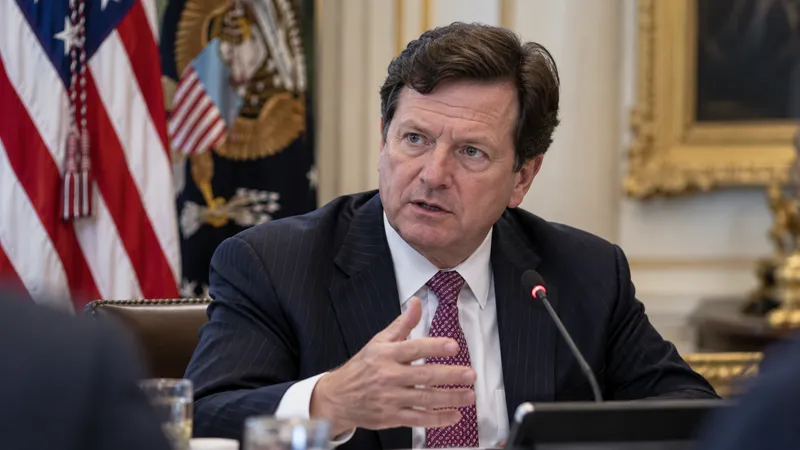
AI czar search narrowed Tuesday as President Trump said Jay Clayton was a candidate, with a choice possible within three or four days.
Clayton enters the AI list
Trump said he had "I have somebody in mind" when asked whom he wanted for the artificial intelligence post. When Clayton’s name was put to him, Trump called him "a good man" and said, "He's right here. That's a good idea."
Clayton is serving as director of national intelligence, a role that makes him the president’s principal intelligence adviser. The position sits above the 18-agency intelligence community, giving Clayton an institutional view of cyber risk, foreign competition and sensitive technology use.
AI Force remains undefined
The White House has not set out the precise duties of the AI czar role. Trump has previously said he wants to create an AI Force, described as a new government agency, but the structure, mandate and authority of that body have not been detailed.
The timing gives the personnel choice more weight than the title alone suggests. Trump said outside the White House that he wanted to name someone in the next three or four days, putting a near-term deadline on a job that could shape how federal agencies handle model safety, procurement and private-sector oversight.
Trump, House Speaker Mike Johnson and AI executives met Tuesday to discuss how to balance AI innovation and safety. The meeting also included discussion of encouraging companies to regulate themselves and each other, according to the account of the session.
Sacks leaves a policy gap
David Sacks, the venture capitalist and Silicon Valley figure who attended Tuesday’s meeting, previously held the AI czar role. He left the post in March after his special government employee status expired.
Sacks has continued to exert influence from an outside advisory role, according to the account. That arrangement left the White House with a less formal channel between the administration and technology executives at a time when calls for federal action on AI have intensified.
Clayton’s intelligence lens
During his July confirmation hearing, Clayton linked AI policy to both opportunity and security risk. He said Treasury Secretary Scott Bessent’s approach resonated with him because, for the intelligence community, "AI is not only an opportunity but a threat."
"When something's both an opportunity and a threat, you better get your arms around it," Clayton said at the hearing. That framing matters because an intelligence-led AI role would likely emphasize national security exposure alongside commercial development, rather than treating AI policy mainly as an industrial-growth file.
If Trump chooses Clayton, AI oversight would move closer to the intelligence apparatus. For the global economy, the mechanism would run through cross-border data flows, model controls and the way allied governments read US risk thresholds; for AI companies, it would put compliance and security claims under a sharper federal lens.
Three paths for Trump’s choice
If the White House names an AI czar with a defined mandate, companies would have a clearer federal counterpart for safety commitments and deployment rules. The industry effect would be uneven: larger developers can absorb reporting demands more easily than smaller labs, while global partners would watch whether US standards become a template.
If Trump instead creates the AI Force before defining the czar’s powers, agencies could spend the first phase sorting jurisdiction. That would slow near-term guidance for companies, but it could give the administration a vehicle for broader rules if Congress does not move first.
If the role remains informal, the current model of executive meetings and outside advice would continue. That path would preserve flexibility for the White House and AI executives, but it would leave the main uncertainty unresolved: who inside the federal government has authority to turn safety commitments into enforceable rules.