

AI Analysis Reveals Undiscovered Mathematical Theorems in Kurt Gödel’s Manuscripts
AI has decoded 1,009 pages of Kurt Gödel’s shorthand, revealing hundreds of previously unknown mathematical theorems and new logical frameworks.
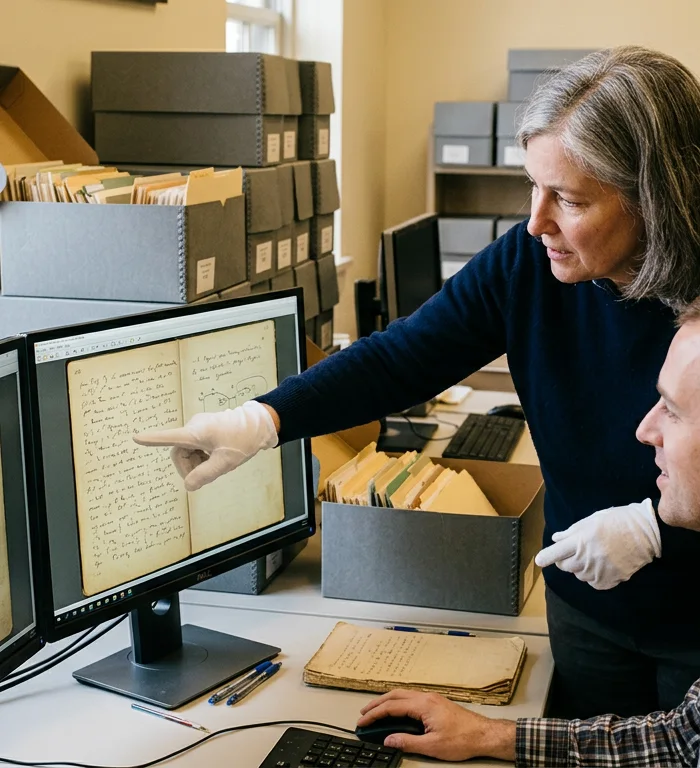
Artificial intelligence has successfully decoded and synthesized 1,009 pages of previously inaccessible mathematical manuscripts written by logician Kurt Gödel. The documents, composed in an obsolete German shorthand known as Gabelsberger, were analyzed using a large language model to identify hundreds of previously unknown theorems and logical frameworks.
Researchers indicate that the AI identified 14 distinct themes in logic that remain unexplored by the modern mathematical community. The analysis confirms that Gödel had anticipated several major mathematical developments that did not emerge until the 1970s and 1980s. Specifically, the model provided evidence that Gödel had nearly completed a proof regarding the independence of the axiom of choice decades before it was formally recognized by other mathematicians.
This project, supported by a grant of approximately $2.65 million from the European Research Council, demonstrates a significant shift in the methodology of historical scientific research. By processing the entirety of the manuscripts as a single dataset, the AI identified connections and logical structures that human researchers were unable to synthesize manually due to the volume and complexity of the shorthand text.
Kurt Gödel
The discovery suggests that a substantial body of foundational work in logic and computation remains hidden within archival materials. The ability to rapidly translate and interpret obsolete technical shorthand using AI models provides a new mechanism for institutionalizing and verifying historical scientific contributions that were previously considered lost or indecipherable.
Future efforts will focus on formalizing the 14 identified logical themes to determine their potential application in modern computational theory. The integration of AI into archival research is expected to accelerate the evaluation of unpublished works from 20th-century scientists, potentially altering the established timeline of mathematical and technological innovation.
More stories
- Europe faces attribution gap after 16 cyber, physical incidents
- PIF backs Grand Theft Auto as Saudi players embrace game
- Signal limits screenshots to curb AI access to messages
- Cognition runs Devin Mac workspaces on EC2 in 6 AWS regions
- Salesforce engineers cut 600-failure triage to 90 minutes
- Türkiye Desk: GTA 6 puts console access and network demand in focus
- Democrats push AI regulation as two state veterans arrive
- Japan & Asia: Zelda remake tops Japan boxed sales with 537,041
- Qudit instruction set projects 10-fold faster ion step
- Bandai Namco's Ace Combat 8 tops 1 million sales
Latest news
- Trump prepares tariffs on China and other major exporters
- New-car buyers pay record average $50,087 in October
- Banks face ECB reserve debate over liquidity and profits
- Investors see Anthropic debut gains fade below $83 a share
- Iraq orders federal control over Kurdish-area oilfields
- Germans oppose Ukraine aid as poll shows support slipping
- Kim Jong-un receives 10 envoys after constitutional shift
- Ukraine claims Libya strike sinks Russian naval corvette