

Qudit instruction set projects 10-fold faster ion step
The preprint shifts scaling focus from adding ions to using more internal states per ion, but its speedup remains model-based.
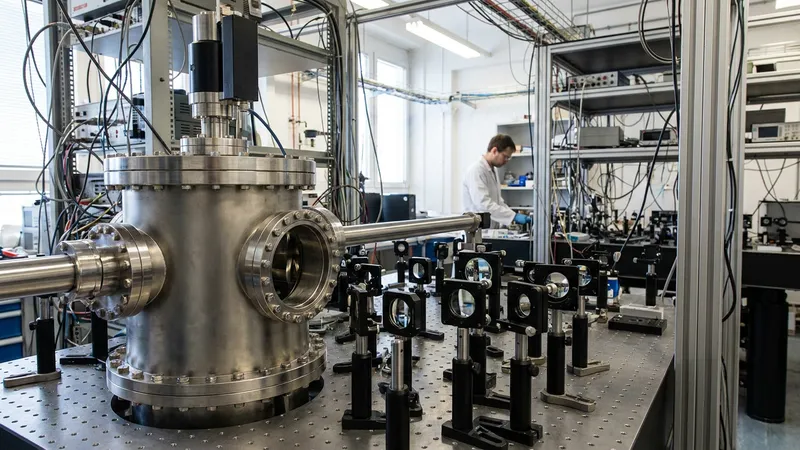
Masoud Hakimi Heris, Yuan Liu and Frank Mueller proposed a trapped-ion qudit-oscillator instruction set in an arXiv preprint submitted Oct. 9, projecting one Trotter step about 10 times faster under their model.
The 27-page arXiv preprint submitted Oct. 9 from Heris, Liu and Mueller matters because it targets a scaling bottleneck in trapped-ion quantum computing and reports about 1.1% average RMSE versus a published reference simulation.
The authors frame the approach as an alternative to expanding trapped-ion machines mainly by adding more ions. “Scaling trapped-ion processors by adding ions remains challenging,” they wrote in the abstract.
A qudit is a quantum information unit with more than two internal levels, unlike a qubit, which has two. The authors said their instruction set uses a general d-level internal register coupled to bosonic modes, the quantized oscillator modes used in the model.
The preprint said three families of native operations are enough for universal control of one qudit connected to several modes. Universal control means the operation set can, in principle, build any computation allowed by that model.
The authors said adding an entangling operation between ions extends that universality to a connected register of multiple qudits. That places the proposal in the hardware-architecture layer: it is about the operations exposed to software, not a new commercial processor.
The work also introduces HybridLane, an open-source framework that implements the architecture, according to the preprint. The authors said the design supports both phase-space and sideband instruction sets, two ways of controlling oscillator degrees of freedom in quantum hardware.
For a test case, the authors reproduced dissipative vibronic dynamics of a three-chromophore complex that had previously been simulated on a hybrid qubit-oscillator superconducting platform. A chromophore is a light-absorbing molecular unit; vibronic dynamics describe coupled electronic and vibrational behavior.
The reported advantage comes from mapping the electronic manifold into a single ion rather than using a one-qubit-per-state register. Under that mapping, the authors said electronic couplings become local transitions inside one ion, allowing the lab-frame Hamiltonian to compile directly into the instruction set architecture.
The speed result is a projection, not a reported hardware benchmark. The authors said the roughly 10-fold faster Trotter step uses a stated sequential timing model from a 40Ca+ qudit processor; a Trotter step is one incremental slice in a digital simulation of continuous dynamics.
The arXiv page lists the paper as 27 pages, with 10 figures and 10 tables. It classifies the work under Quantum Physics, Hardware Architecture and Emerging Technologies, and says the manuscript was submitted to ACM Transactions on Quantum Computing.
The paper is an arXiv preprint and is not yet peer reviewed. The source page lists an arXiv-issued DOI through DataCite as pending registration, and the posted version is arXiv:2610.13843v1.
Source: arXiv preprint, arXiv, Oct. 9, 2026
More stories
- SemiCat reaches 49.94% on TinyGSM in AI preprint
- Planet Zoo 2 hits No. 2 on Steam in Germany before launch
- DFDV grows SOL holdings 12% since August 12 through purchases
- Hood Warfare 2 rides $5 Steam launch into viral clips
- Bandai Namco's Ace Combat 8 tops 1 million sales
- Computational Breakthrough Enables Predictive Modeling of Quantum Material Behavior
- LLM agents can delete traces, risking regulatory compliance
- Trump and Xi AI safety talks risk accelerating military AI
Latest news
- India securitisation hits ₹1.47 trillion record in H1
- China sanctions two ministers over Taiwan ties
- Zelensky Says Russia Keeps Hitting Ukrainian Energy Sites
- Wells Fargo cuts Adobe to Underweight, target to $225
- DHT rises 4.3% after booking $509,100 spot rates
- ACSM sets 1-hour Oct. 14 webinar on health equity
- UAE's NCM issues 5.5-hour flood alert as hail hits
- Robert Pether returns after 5-year Iraq detention