

Room-Temperature Quantum Supersolid Breakthrough Enables New Computing Applications
Scientists have achieved a room-temperature supersolid state using light-matter particles, enabling advancements in optical computing and sensors.
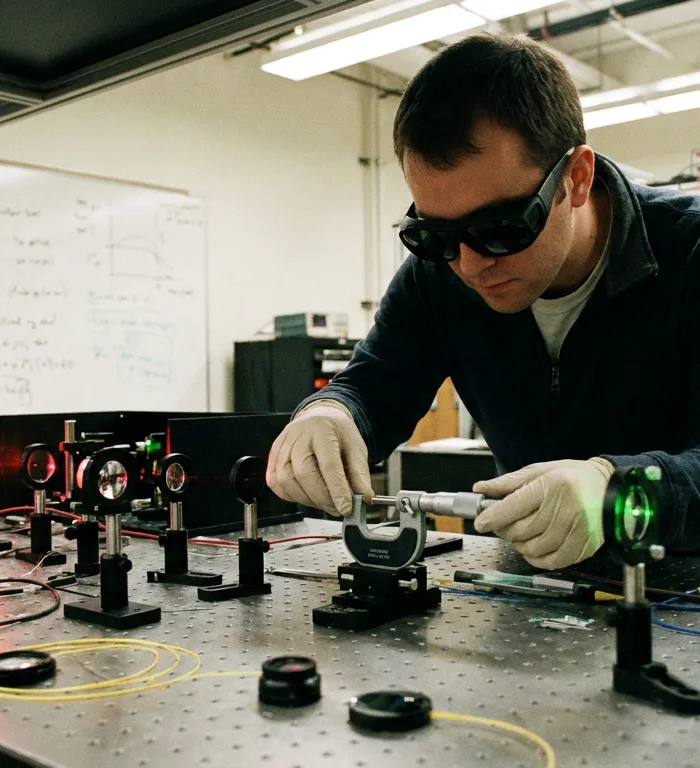
Researchers have successfully demonstrated a supersolid state of matter at room temperature, overcoming a significant technical barrier in quantum physics. By utilizing hybrid particles known as exciton-polaritons—which combine properties of light and matter—the team achieved a state that simultaneously exhibits the frictionless flow of a superfluid and the organized, periodic structure of a crystal.
Previous experimental observations of supersolidity required cooling atomic Bose-Einstein condensates to temperatures near absolute zero. This new method utilizes optical microcavities integrated with liquid crystals and organic semiconductors, allowing the phenomenon to occur at temperatures as high as 60°C (140°F). The removal of extreme cryogenic requirements significantly lowers the barrier for practical implementation of quantum-based technologies.
This development holds implications for the advancement of This development holds implications for the advancement of optical computing and high-precision sensing. Because the system operates under accessible thermal conditions, it provides a scalable framework for integrating quantum phenomena into existing hardware architectures. The ability to manipulate light-matter states at room temperature suggests a shift toward more viable, energy-efficient quantum information processing.
Institutional stakeholders should monitor this research for its potential to disrupt current optical communication and sensor manufacturing standards. While the particles involved have extremely short lifespans—measured in picoseconds—the successful observation of spontaneous density variations confirms the stability of the supersolid phase in non-cryogenic environments. Future efforts will likely focus on extending the duration of these states to facilitate complex computational tasks.
More stories
- Europe faces attribution gap after 16 cyber, physical incidents
- PIF backs Grand Theft Auto as Saudi players embrace game
- Signal limits screenshots to curb AI access to messages
- Cognition runs Devin Mac workspaces on EC2 in 6 AWS regions
- Salesforce engineers cut 600-failure triage to 90 minutes
- Türkiye Desk: GTA 6 puts console access and network demand in focus
- UK agencies face 100-plus public-code security flaws
- Nvidia opens board inquiry into alleged foreign targeting
- Apple foldable iPhone nears debut in Ternus product reset
- Saudi Humain IPO work signals PIF listing pipeline push
Latest news
- Trump prepares tariffs on China and other major exporters
- New-car buyers pay record average $50,087 in October
- Banks face ECB reserve debate over liquidity and profits
- Investors see Anthropic debut gains fade below $83 a share
- Iraq orders federal control over Kurdish-area oilfields
- Germans oppose Ukraine aid as poll shows support slipping
- Kim Jong-un receives 10 envoys after constitutional shift
- Ukraine claims Libya strike sinks Russian naval corvette