Washington’s Housing Slump Exposes Its Dependence on Federal Stability
DC housing market values are weakening as rents, home prices and construction starts fall amid federal workforce uncertainty in Washington.
Sophie McAlister ·
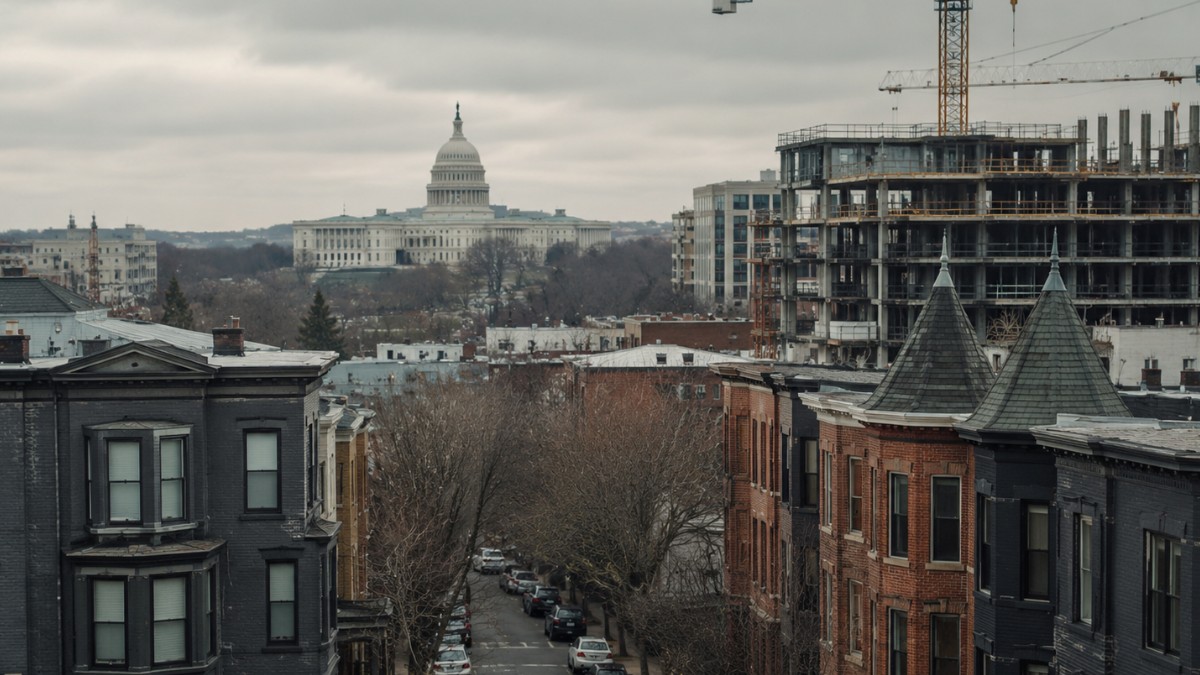
Washington, DC’s housing market is moving in the wrong direction while the broader mid-Atlantic holds steadier. Rents in the city are down 4.9% from a year earlier, compared with a national rental market that has been roughly unchanged. The median sale price per square foot has fallen 3.9%, and homes are taking longer to sell. Bright MLS’s 2026 forecast identifies the DMV as the only mid-Atlantic region expected to lose housing value this year.
Sixty-Eight Days on Market
Slower Sales Pace
The shift is showing up most clearly in the pace of sales. Homes in DC are now sitting on the market for 68 days, up from 57 days a year earlier. That 11-day increase matters because time on market is often where hesitation first becomes visible. Buyers are not disappearing, but they are moving more cautiously, and sellers are losing some of the pricing power they had during stronger years.
Federal Jobs Stop Anchoring Prices
Federal Workforce Uncertainty
The main pressure point is uncertainty around the federal workforce. For decades, DC real estate relied on a unusually dependable base of government employees, contractors, lawyers, lobbyists and policy professionals. That ecosystem helped support rents and home prices even when other markets weakened. The current data suggests that base is no longer providing the same floor under demand.
A Recovery Story Loses Momentum
DC has spent much of the past four years trying to rebuild a post-pandemic economic narrative. Office vacancies, hybrid work and slower downtown foot traffic already challenged the city’s tax base and commercial corridors. Housing had been one area where confidence could still hold if federal employment and household formation stayed stable. The latest numbers suggest that recovery remains tied to a federal economy that has not yet settled.
Construction Starts Hit 15-Year Low
Developer Pullback
The weakness is not limited to resale homes and rentals. Construction starts in DC fell to a 15-year low last year, according to the Washington DC Economic Partnership’s annual report. Groundbreakings across all property sectors dropped 27% from 2024. That decline points to a broader pullback by developers, who are less likely to begin new projects when financing is costly, demand is uncertain and future rents or sale prices look harder to defend.
DMV Stands Alone
The regional comparison makes DC’s position more striking. Bright MLS is not describing a broad mid-Atlantic housing retreat; it is singling out the DMV as the exception. That matters for investors, lenders and local officials because relative weakness can redirect capital to nearby markets with steadier population or job-growth expectations. If buyers can find better value or more confidence elsewhere in the region, DC’s recovery becomes harder to accelerate.
The Risk Is a Weaker Floor
Uncertain Future
The central risk is that housing softness feeds into a wider confidence problem. Lower rents can help affordability, but falling values, slower sales and fewer construction starts also mean weaker investment signals. The next test is whether federal workforce expectations stabilize enough to restore demand. Until then, DC’s housing market is carrying a message the city cannot ignore: the old price floor is no longer guaranteed.