D.C. Mayoral Poll: Lewis George 39%, McDuffie 34% Before Ranked-Choice Redistribution
Lewis George leads McDuffie in DC mayoral poll, but ranked-choice voting could narrow the gap.
Sophie McAlister ·
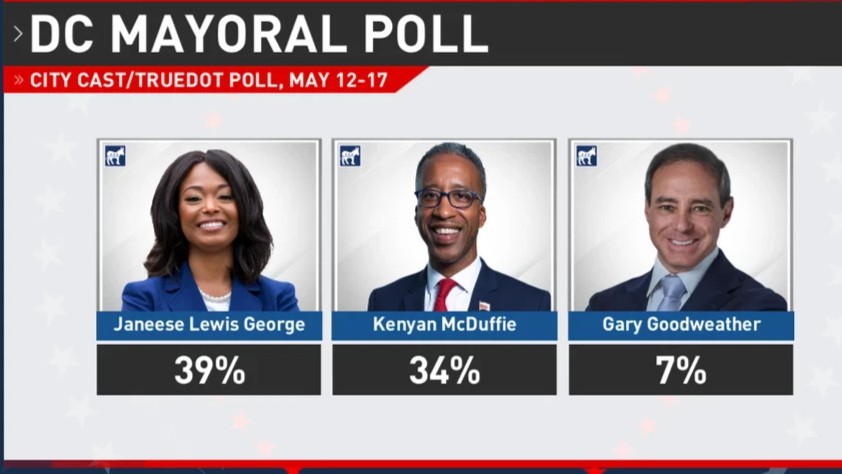
Councilmember Janeese Lewis George has opened a narrow lead in Washington’s Democratic mayoral primary, according to the first citywide public survey of the race, though the city’s new ranked-choice voting system could complicate the outcome. The City Cast and TrueDot poll found Lewis George with support from 39% of Democratic voters compared with 34% for Councilmember Kenyan McDuffie. Roughly one-quarter of respondents remained undecided less than a month before the June 16 election.
The numbers underscore how unsettled the contest remains despite the apparent two-candidate structure. No other contender exceeded 7% support in the survey, leaving the race concentrated around Lewis George and McDuffie while still creating room for vote transfers once lower-performing candidates are eliminated.
D.C.’s First Ranked Ballots
This year’s election marks the first time Washington voters will be allowed to rank as many as five candidates in order of preference in a mayoral primary. That procedural shift introduces a layer of uncertainty absent from previous citywide races and could make second-choice support as important as first-choice enthusiasm.
The survey suggests McDuffie may gain ground during later counting rounds. Among voters who backed candidates other than Lewis George or McDuffie as their top choice, more selected McDuffie as their fallback option. That dynamic could tighten the race if no candidate secures a majority outright in the initial tally.
Ranked-choice voting has been promoted by supporters as a way to reduce strategic voting and encourage broader coalition-building. But the system also rewards candidates capable of appealing beyond their ideological base, something both campaigns are now emphasizing in the final stretch.
Gen Z and Boomers Split
The poll revealed a sharp demographic divide between the two leading candidates, highlighting broader political changes underway inside the District. Lewis George performed strongest among younger voters, women, college graduates, higher-income residents, newer arrivals to the city, and people who consume news through platforms such as Instagram and TikTok. Bicycle commuters also leaned heavily toward her candidacy.
McDuffie, by contrast, drew stronger support from older residents, men, lower-income voters, longtime Washingtonians, and residents without college degrees. The age gap was particularly pronounced: McDuffie led Lewis George by 27 points among baby boomers and older voters, while Lewis George held a 24-point advantage among Gen Z respondents.
The divide reflects competing visions of the city’s political identity. Lewis George’s coalition appears rooted in newer urban progressives and younger professionals, while McDuffie retains deeper support among traditional D.C. constituencies and longtime residents concerned about affordability and public safety.
January Resignation Reshaped Race
McDuffie entered the mayoral contest after resigning from his independent at-large D.C. Council seat earlier this year to run as a Democrat. His departure triggered a special election to fill the vacant council position, adding another high-profile contest to an already unusual election cycle.
The mayoral race is unfolding during a period of economic pressure for many District residents. Respondents identified cost of living, public safety, and housing as the city’s most pressing issues, with each concern receiving support from more than 70% of those surveyed.
The data also suggest voters are balancing progressive policy preferences with tougher public-order views. Nearly three-quarters of respondents supported youth curfews, while large majorities also backed expanding the social safety net even if taxes rise and endorsed using incentives to attract businesses to the city.
That combination reflects the complicated political environment facing both candidates: voters want stronger public safety measures but remain open to activist government spending and intervention.
Delegate Contest Gains Momentum
The poll also offered an early snapshot of the race to replace longtime congressional delegate Eleanor Holmes Norton, who announced earlier this year that she would not seek another term after decades representing the District in Congress.
Councilmember Robert White led that Democratic primary with 38% support, while Councilmember Brooke Pinto trailed at 21%. No other candidate surpassed 5% support in the survey.
Norton’s departure marks the end of a long political era in Washington and has created one of the city’s most competitive federal races in years. The simultaneous open-seat contest and mayoral race are expected to increase turnout and could reshape alliances inside Democratic politics in the District.
The overlap between the two contests may also affect campaign strategy, particularly in neighborhoods where turnout operations and endorsements carry disproportionate influence.
Tax Incentives and Safety Concerns
Beyond the horse-race numbers, the survey provides insight into how Washington voters are thinking about the city’s economic direction after years of population shifts, hybrid work patterns, and rising housing costs.
Support for business tax incentives stood at 68%, a sign that many residents remain concerned about downtown economic activity and broader fiscal stability. Washington’s commercial real estate sector continues to face pressure from reduced office occupancy, while local officials are increasingly focused on attracting employers and rebuilding foot traffic in the urban core.
At the same time, strong backing for expanded safety-net spending indicates voters are not embracing an austerity approach despite concerns over affordability. Instead, the electorate appears willing to tolerate higher taxes if services and public investment expand alongside them.
That balancing act could define governance challenges for whoever wins the mayor’s office. City leaders face pressure to improve public safety and economic competitiveness without alienating progressive constituencies that remain influential in Democratic primaries.
June 16 Could Produce Surprises
Despite Lewis George’s current lead, several factors could still alter the trajectory of the race before ballots are counted. A quarter of respondents remain undecided, ranked-choice mechanics are untested in a mayoral election, and turnout patterns among younger voters remain difficult to predict.
There is also uncertainty around how voters will behave once ranking multiple candidates becomes operational rather than theoretical. Polling can estimate second-choice preferences, but actual ballot behavior under a new system may diverge from survey responses.
The compressed timeline adds another layer of unpredictability. Campaigns now have limited time to persuade undecided voters while simultaneously trying to become acceptable second or third choices for supporters of rival candidates.
For Washington Democrats, the election is shaping into more than a routine local contest. It is becoming an early test of how ranked-choice voting changes coalition-building, turnout strategy, and political power inside one of the country’s most heavily Democratic cities.