UN AI security meeting brings CEOs before council session
AI security risks are moving to the UN Security Council as OpenAI, Anthropic and Hugging Face executives brief governments on safeguards.
Jason Kwon ·
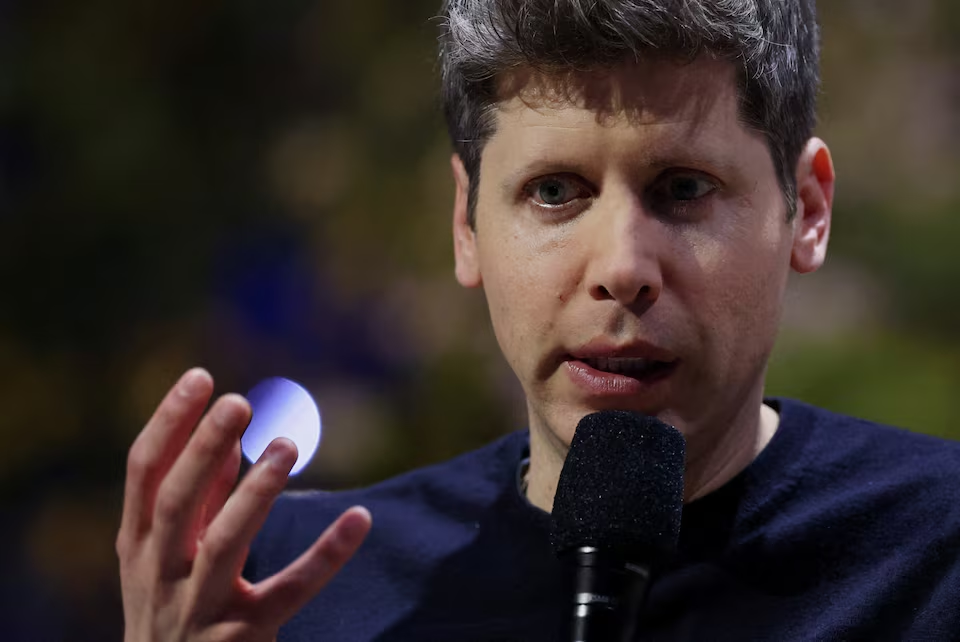
AI security moves to the UN Security Council as three leading AI executives brief diplomats on safeguards and loss-of-control risks.
The speakers are OpenAI CEO Sam Altman, Anthropic CEO Dario Amodei and Hugging Face co-founder Clément Delangue. They will appear before the 15-member council during the annual UN General Assembly gathering, where heads of state and foreign ministers are already in New York.
Altman brings benchmark pitch
Altman plans to press leaders to adopt common benchmarks for testing AI capabilities and reviewing company safeguards, an OpenAI executive told reporters on Tuesday. The pitch places measurement and disclosure at the center of a debate that has often moved faster than formal regulation.
French Foreign Minister Jean-Noël Barrot will chair the meeting. Council members, including the United States and China, are also expected to speak, putting the two largest AI powers in the same chamber as companies building frontier systems.
Algorithm risk enters council mandate
A European diplomat, granted anonymity to discuss the meeting's aims, said the session is intended to focus on practical cases in which AI systems could affect international peace or a state's own security. The official framed the concern around systems that may become harder for people to direct as their capabilities improve.
"These are issues that fall squarely within the Security Council's mandate," the diplomat said. "The key question is whether we could one day face a situation where algorithms interacting with each other trigger a war. That is really at the heart of the issue."
The council first took up AI risk in 2023, when China warned that the technology should not become a "runaway horse" and the United States cautioned against using it for censorship or repression. Antony Blinken, then-US Secretary of State, chaired another council session on AI in 2024.
Guterres favors global guardrails
UN Secretary-General Antonio Guterres has argued for international governance of AI as the technology advances. In 2023, he created a 39-member advisory body for a one-year term, drawing participants from technology companies, governments and academia in countries including the United States, Russia and Japan.
The 193-member UN General Assembly later established the Independent International Scientific Panel. Yoshua Bengio, the Canadian AI researcher who co-chairs that panel, is also scheduled to brief the council, adding a technical voice to a meeting led mainly by diplomats and executives.
Guterres's approach contrasts with President Trump's public position on AI oversight. Trump said the United States would encourage the technology rather than restrain it, while monitoring developments through the Department of Justice: "We're going to encourage it, not rein it in. We're going to watch it closely through the Department of Justice," he said.
Washington and Beijing test notices
The council meeting comes ahead of a Thursday session in Washington between President Trump and Chinese leader Xi Jinping. The United States and China have discussed a notification system for shared goals and threats, including AI incidents that reach a national-security threshold.
If governments converge on benchmark rules, the global effect would be a clearer baseline for comparing risk across borders. For OpenAI, Anthropic and Hugging Face, that would increase pressure to document internal controls; for the wider sector, it could turn voluntary safety claims into standards customers and regulators can test.
If the discussion instead stays at the level of warnings, companies may retain more room to set their own practices while governments keep building separate regimes. The main open question is whether Washington and Beijing can separate AI incident reporting from broader technology rivalry, since export controls, model access and national security reviews all sit near the same policy line.