AI chip design fund puts €40 million behind Europe teams
Dutch and German agencies are investing €40M in AI chip design, linking Europe’s semiconductor ambitions to ASML’s ecosystem and SPRIND’s research.
Jason Kwon ·
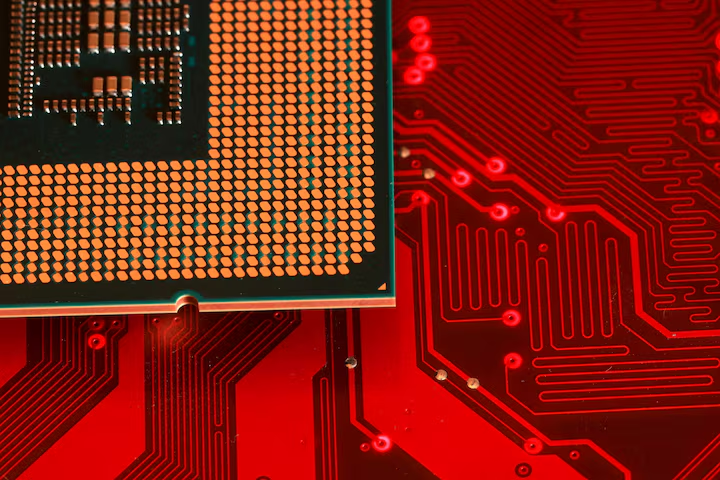
Dutch and German innovation agencies will put €40 million into AI chip design in a European push to rely less on US expertise.
Prime Minister Rob Jetten said Wednesday that the Netherlands’ National Agency for Disruptive Innovation, known as NADI, will work with Germany’s SPRIND on the chip program. The money will be committed over 20 months to small teams using artificial intelligence to speed the design of processors for training and running AI models.
€40 million over 20 months
The project gives NADI an early test after the Dutch government launched the agency this month with €500 million, equivalent to about $570 million. Jetten has backed NADI as one of the main projects from a competitiveness taskforce he created after taking office in February.
Jetten said cooperation across borders fits Europe’s need to compete at scale, arguing that the region “cannot afford to innovate country by country.” His framing puts the chip effort inside a wider European concern: critical technologies are advancing faster than national programs can easily match alone.
ASML ecosystem shapes the bet
NADI co-founder Jelle Prins said semiconductors were a natural starting point because the Netherlands has a chip equipment cluster around ASML (ASML.AS), while Germany brings research and manufacturing capacity. ASML is not described as a participant in the funding plan, but its surrounding ecosystem is part of the rationale Prins gave for choosing chips.
The agencies are targeting both training chips and inference chips, the processors used when AI models are run after they are built. Prins said NVIDIA chips are powerful but inefficient for inference, comparing that use case to “doing your shopping with a truck” rather than a grocery cart.
That distinction matters because inference demand rises as AI tools move from development into daily use. If smaller teams can design more efficient processors for that stage, the practical gain would come through lower computing waste and more specialized hardware rather than through a direct challenge to every part of the existing chip market.
DARPA model gets European versions
NADI was built as a Dutch counterpart to the US Defense Advanced Research Projects Agency, the government research body created in 1958 after the Soviet Union’s Sputnik launch. DARPA later played a role in technologies that contributed to the internet, stealth aircraft and GPS, according to the account provided with the Dutch program.
Europe has already created several similar institutions, though on separate national tracks. France established its defense innovation agency AID in 2018, Germany set up SPRIND in 2019, and Britain launched ARIA in 2023.
Jano Costard, SPRIND’s head of challenges, said the chip project aims for “several orders of magnitude acceleration” in a design process that currently takes years. That target is ambitious, but the disclosed plan remains limited to €40 million over 20 months, making execution by the selected teams the first test.
Three paths for chip autonomy
If the NADI-SPRIND effort cuts chip design times, the macro effect would be to give Europe more room in a supply chain where advanced AI hardware remains strategically sensitive. For ASML’s ecosystem, faster design work could deepen demand for nearby engineering talent and supplier expertise; for the sector, it could encourage more specialized AI processors.
If the teams produce only incremental gains, the program may still serve as a template for cross-border innovation funding rather than a technology break. That outcome would leave Europe’s broader reliance on US chip expertise mostly intact while giving NADI and SPRIND evidence on whether small-team models can handle semiconductor problems.
If the work stalls, the risk is that Europe adds another agency-backed initiative without narrowing the gap it has identified. The main open questions are which teams receive the funding, how performance will be measured after 20 months, and whether the resulting designs can move from research into manufacturing.