

Turkey Cabinet agenda puts Syria, Iran and SDF policy back on Washington’s desk
A Turkish Cabinet meeting at Beştepe is expected to examine counterterrorism policy and US-Iran contacts, giving Washington another test of how to balance…
Turkey Cabinet agenda puts Syria, Iran and SDF policy back on Washington’s desk
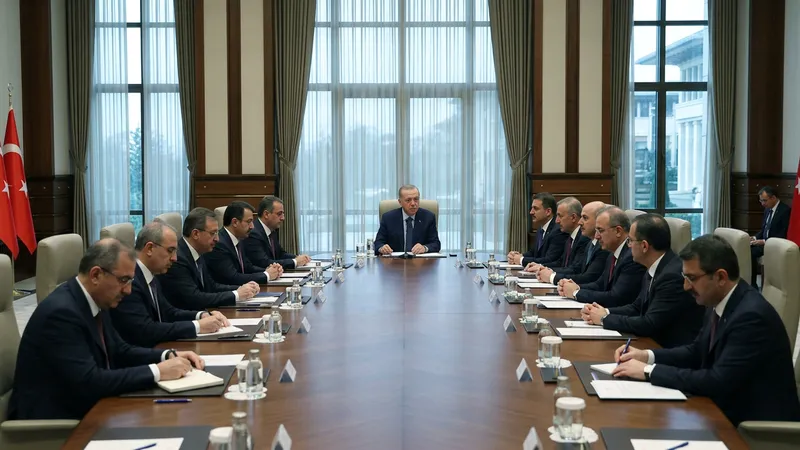
Turkey’s Cabinet is expected to meet at Beştepe on March 3 under President Recep Tayyip Erdoğan, with counterterrorism policy and US-Iran contacts on the agenda. For Washington, the meeting matters less as a Turkish domestic calendar item than as another signal that Ankara wants Syria, Kurdish forces and regional diplomacy handled as one security file.
Turkey Cabinet
The reported agenda includes developments around funds in liquidation, the government’s “terror-free Turkey” process, and contacts between the United States and Iran. The Syria question sits behind that language: Ankara views the PKK as a direct security threat and has long objected to Washington’s partnership with the Syrian Democratic Forces, whose Kurdish core includes the YPG.
The United States has kept a military presence in northeastern Syria to support operations against ISIS and to work with the SDF. Turkey, a NATO ally, argues that the YPG is inseparable from the PKK, which Washington also designates as a terrorist organization. That split has been one of the most durable irritants in the US-Turkey relationship across successive American administrations.
The State Department usually frames the relationship with Turkey through alliance management: NATO coordination, Black Sea security, sanctions policy, arms sales and regional diplomacy. The Pentagon’s Syria file is narrower but more operationally exposed. US commanders have to preserve the anti-ISIS mission while avoiding a clash with Turkish forces or Turkish-backed groups operating near SDF-held territory.
Congress adds another constraint. Lawmakers have periodically questioned the legal basis, duration and risk of US deployments in Syria and Iraq, especially as debates over war powers and authorizations for use of military force return to committee agendas. Any visible shift in Turkish policy can therefore land in Washington as a Syria policy question, a NATO management problem and a congressional oversight issue at the same time.
The Iran track gives the Cabinet agenda a second Washington hook. Turkey has often positioned itself as a regional channel capable of talking across lines that Washington cannot easily cross in public. If Ankara is discussing US-Iran contacts alongside counterterrorism, it suggests Turkish officials see their border security, Iraq-Syria posture and regional diplomacy as linked rather than separate portfolios.
That linkage creates a practical problem for the White House and the National Security Council. A concession that reassures Ankara on Syria could unsettle Kurdish-led forces that still work with US troops against ISIS remnants. A refusal to adjust the US posture could harden Turkish pressure for unilateral steps across the border.
The test is whether US officials publicly acknowledge higher-level consultations with Turkey on northern Syria stabilization, SDF positioning or counter-PKK deconfliction by May 30, 2025. The call is right if Washington confirms a negotiated shift in SDF positioning or deconfliction protocols with Turkish forces; it is wrong if the Pentagon announces an unconditional extension or expansion of US force deployments in SDF-controlled areas despite Turkish pressure.
More stories
- ESA Astronaut Completes Record-Breaking 237-Day International Space Station Mission
- Houthi strike kills 14 at Riyadh airport
- North Korea Fires Missiles Following Seoul Weapon Test
- Institutional Risks to International Criminal Court Operations Following US Sanctions
- NATO Concludes Innovation Continuum to Accelerate Defense Technology Integration
- UK Government to Mandate Stricter AI Safety and Infrastructure Oversight
- Reported Sudan Mine Strike Puts Egypt’s US Defense Ties Under Scrutiny
- Airstrike kills 72 at Sudan-Egypt border gold mine
- Galaxy Digital: $387.5M Bitget Hack Reveals Core Infrastructure Risk
- AI Biofoundry Designs and Runs Experiments, Raising Questions for Neuroscience
Latest news
- Computational Breakthrough Enables Predictive Modeling of Quantum Material Behavior
- Quantum Vacuum Engineering Increases Superconductor Critical Temperature
- ChangXin Memory Technologies Advances 4F Square DRAM Architecture
- Expansion of Enhanced Geothermal Energy Capacity and Market Scaling
- ASOS Data Breach Highlights Vulnerabilities in Third-Party SaaS Integration
- Emerging Cybersecurity Risks from AI Agent Manipulation
- Discovery of Persistent Pair Density Waves in Uranium Ditelluride
- Data Breach at iRhythm Impacts Over 360,000 Patients