

Reported Sudan Mine Strike Puts Egypt’s US Defense Ties Under Scrutiny
A Sudanese rights group said an Egyptian airstrike killed 72 people at a gold mine near the Egypt border, a claim that could complicate Washington’s security…
Reported Sudan Mine Strike Puts Egypt’s US Defense Ties Under Scrutiny
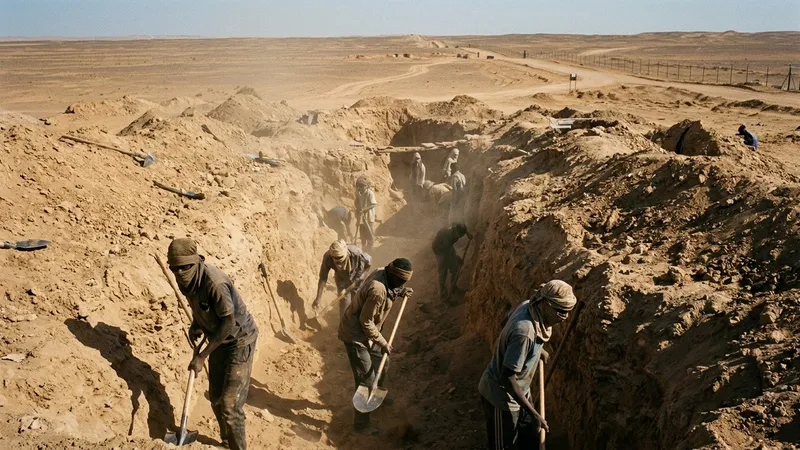
Washington faces a new test in Sudan after Emergency Lawyers, a Sudanese human rights group, said an Egyptian Air Force strike killed 72 people at a gold mine near the Sudan-Egypt border. The allegation, not independently confirmed by the US government, would mark a direct Egyptian military action inside Sudan if verified.
For the White House and State Department, the immediate question is whether to treat the reported strike as another episode in Sudan’s civil war or as a cross-border escalation by one of Washington’s closest Arab security partners. Egypt receives US defense support and maintains deep military channels with Washington, while Sudan’s war has already pulled in regional powers through arms flows, diplomacy and competing security interests.
Sudan has been at war since April 2023, when fighting broke out between the Sudanese Armed Forces, led by Gen. Abdel Fattah al-Burhan, and the Rapid Support Forces, a paramilitary force commanded by Mohamed Hamdan Dagalo. The conflict has fractured the state, displaced millions and turned border zones into military, smuggling and humanitarian pressure points.
Egypt has viewed the war through three linked concerns: its southern border, the security of the Nile basin and the survival of a Sudanese state actor it can work with. Cairo has been widely seen as closer to Burhan’s army than to the RSF, but a reported Egyptian strike inside Sudan would move the issue from political alignment to alleged direct military involvement.
Reported Sudan Mine Strike
The reported target matters because gold is not a side issue in Sudan’s war economy. Mines in northern and western Sudan have long fed informal trading networks, armed factions and cross-border smuggling routes. Control over gold sites can provide cash, patronage and access to foreign buyers, making them strategic assets rather than only civilian workplaces.
That is where the Washington angle sharpens. The State Department has pushed for cease-fire diplomacy and humanitarian access, while the Pentagon manages long-running defense relationships with regional militaries, including Egypt’s. The National Security Council would have to weigh those tracks together if evidence shows Cairo used air power across the border.
Congress is another pressure point. US lawmakers have repeatedly scrutinized security assistance to Egypt over human rights and regional conduct, even as administrations preserve cooperation on counterterrorism, Gaza, the Red Sea and military access. A confirmed Egyptian strike causing mass casualties in Sudan would give members of Congress a concrete incident to raise in aid reviews, hearings and private briefings.
The central evidentiary gap is still important. Emergency Lawyers attributed the deaths to the Egyptian Air Force, but the available material does not include a public US assessment, an Egyptian confirmation, a Sudanese military statement confirming Egyptian action, or independent forensic evidence from the strike site. That means Washington can ask questions without yet making a public finding.
Cairo would have strong reasons to avoid open-ended involvement in Sudan. A visible Egyptian air campaign could expose Egypt to retaliation, deepen the SAF-RSF proxy dynamic and complicate its effort to present itself as a stabilizing regional actor. It could also draw scrutiny at a time when the US depends on Egypt for coordination around Gaza, Suez Canal security and broader Arab diplomacy.
For Sudan’s army, outside air support, if present, could help defend northern supply routes and deny revenue to armed groups operating around gold areas. For the RSF and its allied networks, an Egyptian role would be useful politically: it would let them frame the war as foreign-backed and seek counter-support from other regional actors.
The mine location near the Egypt border makes the claim more sensitive than a strike deeper inside Sudan. Border zones are where military pursuit, smuggling interdiction and sovereignty violations can blur. Washington’s response will likely depend on whether US officials believe the alleged target was tied to armed financing networks, whether civilians were killed, and whether Egypt coordinated with Sudanese authorities.
The falsifiable marker is whether the State Department, Pentagon or Congress publicly addresses alleged Egyptian military action in Sudan by 2025-05-15. If Washington explicitly cautions Cairo against unilateral air operations or links future defense cooperation to restraint at the Sudan border, the episode will have moved into the US-Egypt security file; if US officials avoid naming Egypt and describe the deaths only as Sudanese border violence, the administration will be signaling that preserving defense coordination with Cairo still outweighs public confrontation over Sudan.
More stories
- ESA Astronaut Completes Record-Breaking 237-Day International Space Station Mission
- Houthi strike kills 14 at Riyadh airport
- North Korea Fires Missiles Following Seoul Weapon Test
- Institutional Risks to International Criminal Court Operations Following US Sanctions
- NATO Concludes Innovation Continuum to Accelerate Defense Technology Integration
- UK Government to Mandate Stricter AI Safety and Infrastructure Oversight
- Airstrike kills 72 at Sudan-Egypt border gold mine
- Riyadh airport attack kills one as Trump weighs response
- Houthis hit Riyadh airport after 12 killed
- Yemen Cabinet backs Houthi terrorist label after 12 deaths
Latest news
- Computational Breakthrough Enables Predictive Modeling of Quantum Material Behavior
- Quantum Vacuum Engineering Increases Superconductor Critical Temperature
- ChangXin Memory Technologies Advances 4F Square DRAM Architecture
- Expansion of Enhanced Geothermal Energy Capacity and Market Scaling
- ASOS Data Breach Highlights Vulnerabilities in Third-Party SaaS Integration
- Emerging Cybersecurity Risks from AI Agent Manipulation
- Discovery of Persistent Pair Density Waves in Uranium Ditelluride
- Data Breach at iRhythm Impacts Over 360,000 Patients