

Thailand cuts biofuel taxes for three months
The tax cuts are meant to lower pump prices while lifting demand for domestic ethanol and biodiesel feedstocks, the Bangkok Post reported.
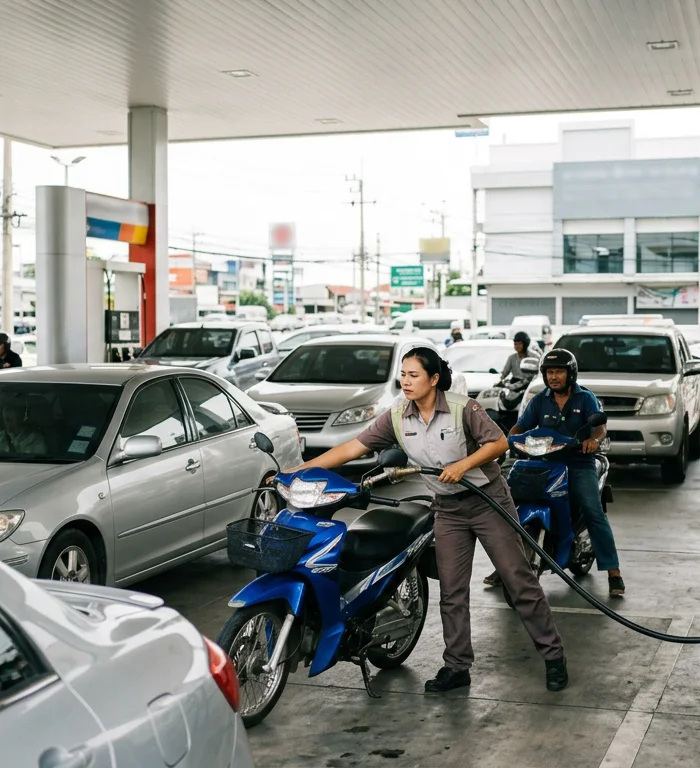
Thailand’s cabinet approved excise-tax cuts of 5.60 baht a litre for E20 gasohol and 5.50 baht for B20 biodiesel for three months, the Bangkok Post newspaper reported on Oct. 28.
The decision is intended to lower pump prices and widen E20 and B20’s advantage over conventional fuels by 5 baht to 6 baht a litre, linking consumer relief to demand for domestic farm feedstocks.
The Thai Ethanol Manufacturing Association welcomed the cabinet decision, saying the measure would ease living costs, support farmers and strengthen Thailand’s energy security.
E20 is petrol blended with 20% ethanol made from cassava and molasses. B20 is diesel containing 20% palm-oil methyl ester, tying the policy to domestic agricultural supply chains.
“The policy creates a strong incentive for consumers to switch to home-grown alternative fuels, reducing dependence on imported petroleum while providing direct benefits to Thai farmers,” Kittisak Wattanavekin, president of the association, said.
The government opted to absorb the loss of excise revenue rather than use the state Oil Fuel Fund, Thailand’s fuel-price support mechanism. The Bangkok Post did not publish an estimate of the fiscal cost.
The measure addresses underuse in Thailand’s ethanol industry. The country has 28 ethanol plants with combined capacity of about 7 million litres a day, compared with actual output of 3 million to 4 million litres a day, or about 43% to 57% of capacity, according to Atlas360 calculations.
The association said wider E20 adoption could increase domestic production and create stronger demand for cassava and molasses. It also said local producers were ready to raise output if consumption rises.
Vehicle compatibility remains a constraint. Kittisak said earlier efforts to promote E20 were slowed by public misconceptions, while the association said virtually all vehicles assembled in Thailand since 2008 can safely use the fuel.
Kittisak urged authorities to intensify public-awareness campaigns and add tools such as QR-code compatibility checks at petrol stations, so motorists can confirm whether their vehicles can use E20.
Thailand’s move comes as large Asian fuel markets recalibrate ethanol policy around food, farm and energy-security concerns. Atlas360 reported in October that Indian oil firms dropped sugar-based ethanol from an 11 billion-litre tender and lowered maize-based ethanol procurement to ₹68.86 a litre as India pursues 20% petrol blending.
Atlas360 also reported that India had curbed sugarcane ethanol for the Nov. 1 supply year after weak rains hurt output in the world’s second-largest sugar producer. Thailand’s policy, by contrast, seeks to draw more fuel demand toward cassava, molasses and palm-oil derivatives already produced domestically.
The Bangkok Post did not give a date for when pump prices would change. The approved tax reduction is set to run for three months.
Source: Newspaper article, Bangkok Post, Oct. 28, 2026; Atlas360 background, Oct. 17-18, 2026.
More stories
- Ruto seeks Russian investment in Kenya's $380m trade push
- Sudan teachers seek 20% budget share with 8m children outside school
- Spain rail network faces scrutiny after 64 killed near Toledo
- Spain reports at least 30 dead in high-speed train crash
- Villa Vie disembarks 203 passengers in Cambodia over fuel costs
- NEITI faces methane data questions over 18 incomplete records
- Deadlock hits Israel election as coalition math tightens
- Ethiopia church reports 60 deaths in two Oromiya attacks
- Syria's 20,000 Uyghurs face postwar suspicion, Feng says
- Dov Lior permits settlers to pick Palestinian olives