

Deadlock hits Israel election as coalition math tightens
Israel election exit polls showed no clear Knesset majority, leaving Netanyahu and Eisenkot facing coalition talks or another vote.
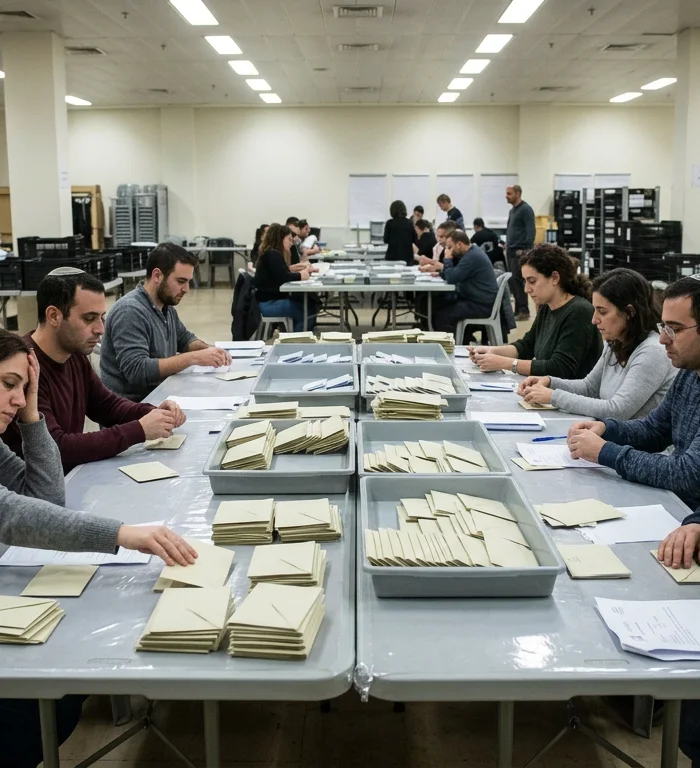
Israel election exit polls pointed to no 61-seat majority in the 120-seat Knesset, leaving coalition talks or a repeat vote as likely tests.
Exit polls from major television networks indicated that neither Netanyahu nor his main rival, Eisenkot, was on course to control a majority. Final results could take days, leaving the early picture provisional while vote counting continues.
The immediate issue is not which party came first, but whether any leader can assemble 61 seats in a parliament built around coalition bargaining. If neither Netanyahu nor Eisenkot can do so, Israel faces prolonged negotiations or another election.
Coalition arithmetic favors smaller parties
The 120-seat Knesset has never given a single party 61 seats outright, making coalition deals the normal route to government. In a close result, smaller parties can become kingmakers by deciding which bloc, if any, can cross the threshold.
That structure gives narrow factions leverage beyond their raw seat count. It also means exit polls can identify a deadlock before they can show the final shape of a governing majority.
The stalemate could work in Netanyahu's favor if it leaves him in office in a caretaker capacity while parties try to build a coalition. That would not resolve the election; it would extend the period in which the long-serving prime minister remains in power without a new majority confirmed.
Wartime vote tests Netanyahu
The election was the first since the Hamas-led attacks of October 7, 2023, and the wars that followed in Gaza, Lebanon and Iran. Voters were weighing leadership under wartime conditions as well as the usual distribution of seats among parties.
Turnout was described as a record, though the available figures did not provide a percentage or vote total. Without that number, the scale of participation cannot be compared precisely with earlier elections.
For Netanyahu, the count is a test of whether wartime incumbency can translate into a parliamentary route back to a full governing mandate. For Eisenkot, the same numbers determine whether opposition momentum is large enough to become a coalition rather than a protest vote.
Deadlock leaves three paths
If Netanyahu can gather enough partners to reach 61 seats, the exit-poll deadlock would become a negotiation over ministries, policy priorities and coalition discipline. The mechanism would be familiar: smaller parties exchange support for influence inside a government that depends on them for survival.
If Eisenkot can assemble a majority instead, the same arithmetic would produce a different governing bloc and shift the balance of power away from Netanyahu. The source material does not provide party-by-party seat estimates, so the likely partners and bargaining terms cannot be identified from the available information.
If neither leader reaches a majority, caretaker government and another election remain the two clearest outcomes. That scenario would preserve political uncertainty while Israel continues to manage the aftermath of the October 7 attacks and the wars in Gaza, Lebanon and Iran.
The international dimension comes from the timing rather than from any market or diplomatic reaction reported in the material. A delayed coalition would leave Israel's political mandate unsettled during a period defined by war, security decisions and pressure on state institutions.
The main open questions are the final seat distribution, the turnout figure, and which smaller parties are willing to join either bloc. Until those answers are known, the exit polls show a deadlock, not a government.
More stories
- Ruto seeks Russian investment in Kenya's $380m trade push
- Sudan teachers seek 20% budget share with 8m children outside school
- Spain rail network faces scrutiny after 64 killed near Toledo
- Spain reports at least 30 dead in high-speed train crash
- Villa Vie disembarks 203 passengers in Cambodia over fuel costs
- NEITI faces methane data questions over 18 incomplete records
- Ethiopia church reports 60 deaths in two Oromiya attacks
- UN inquiry finds Ukraine grid attacks amount to war crimes
- Iran execution adds missile-site case to Israel spy feud
- Greenland deal expands U.S. military role in Arctic pact