

Tata Motors buys 89.42% of Iveco in $4.32 bn deal
The purchase expands Tata Motors beyond India and joins businesses with about $24 billion in annual revenue across more than 130 countries.
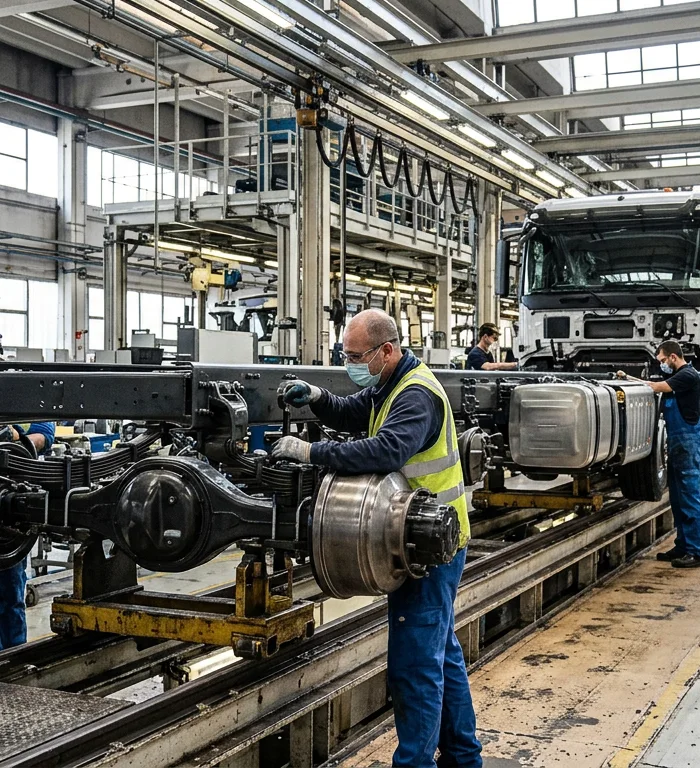
Tata Motors completed a $4.32 billion takeover of Iveco Group on Oct. 30, securing 89.42% of the Italian truck and bus maker, The Economic Times news report said Nov. 4.
The report said the deal is Tata Motors’ biggest overseas commercial-vehicle transaction and its largest automotive purchase since the group’s $2.3 billion Jaguar Land Rover acquisition in 2008.
Natarajan Chandrasekaran, chairman of Tata Sons, Tata Motors and Iveco Group, cast the transaction as a growth platform rather than a cost-led merger at a press conference in Turin, according to the report. “This should not be seen as a consolidation effort,” he said.
The acquisition, first announced July 30, 2025, settled on Oct. 30, 2026, making Iveco an indirect unit of Tata Motors. The report said steps to acquire the remaining Iveco shares and delist the company are under way, without giving a timetable.
The combined commercial-vehicle business will generate about $24 billion in annual revenue and sell nearly 600,000 vehicles, according to the report. It will operate in more than 130 countries, employ more than 73,000 people and have 9,300 sales and service locations.
Girish Wagh, managing director and chief executive of Tata Motors, said the two manufacturers have limited overlap across their main markets. Tata Motors is strong in India and has a growing position in Asia, the Middle East and Africa, while Iveco is established in Europe and Latin America, according to the report.
“The opportunity is not to make one organisation more like the other,” Wagh said. “It is to bring out the best in both.”
The deal gives Tata Motors a larger platform outside India as global truckmakers invest in cleaner powertrains, software and connected fleets. Commercial vehicles include trucks, vans and buses used by businesses and public operators, making the sector closely tied to freight demand, infrastructure spending and regulation.
Chandrasekaran said volumes, revenue and margins should improve over the next five years, but he did not provide targets, according to the report. He said the management teams would set out the business plan.
One early focus will be selling selected Iveco vehicles in India. Chandrasekaran said some models would first be introduced through semi-knocked-down manufacturing, where imported kits are assembled locally, before Tata Motors increases local sourcing.
The companies also plan to use Tata Motors platforms in overseas markets through Iveco, and to work together on components, batteries, electric and hydrogen technologies, connected vehicles, software-led platforms and decarbonisation, according to the report.
Chandrasekaran said Iveco’s FPT engine business could grow in industrial applications in India, Africa and Asia by using Tata Motors’ distribution network. Tata Motors will keep its more than three-decade-old Indian joint venture with Cummins for heavy commercial vehicle engines, the report said.
Iveco will keep its headquarters in Turin after the acquisition, Chandrasekaran said, according to the report. The immediate unfinished items are Tata Motors’ purchase of the balance stake and Iveco’s delisting process.
Source: news report, The Economic Times, Nov. 4, 2026
More stories
- Meta gains 2.15% despite weaker credit outlook
- Progressive posts 4% premium growth with AI shopping tests
- Gordon Brothers faces pressure over 12,000 Poundland jobs
- Fourthline and Veridas form 50-country identity group
- Fourthline and Veridas merge into 50-country digital ID provider
- Bioventus cuts 2026 revenue view to $590m-$595m
- Kinross Gold faces Q3 test after 2%-3% output cut
- Private equity firms face scrutiny over third of methadone clinics
Latest news
- Singapore to open 3 MRT stations for 25-minute trip savings
- De Wever offers resignation as Belgium budget talks stall
- Airlines face bomb threats as Europe orders plane checks
- Ukraine rescuers search shelter after 31 reported deaths
- Cash App and Block pursue banking shift as profit grows
- Apollo posts $53 billion inflows as accounting losses hit
- Trump says Israel aid ends this year, arms sales continue
- US job openings climb as layoffs hit a low last seen in 2025