

Airlines face bomb threats as Europe orders plane checks
Bomb threats disrupted flights involving four European airlines, prompting diversions, searches and fighter escorts, officials and carriers said.
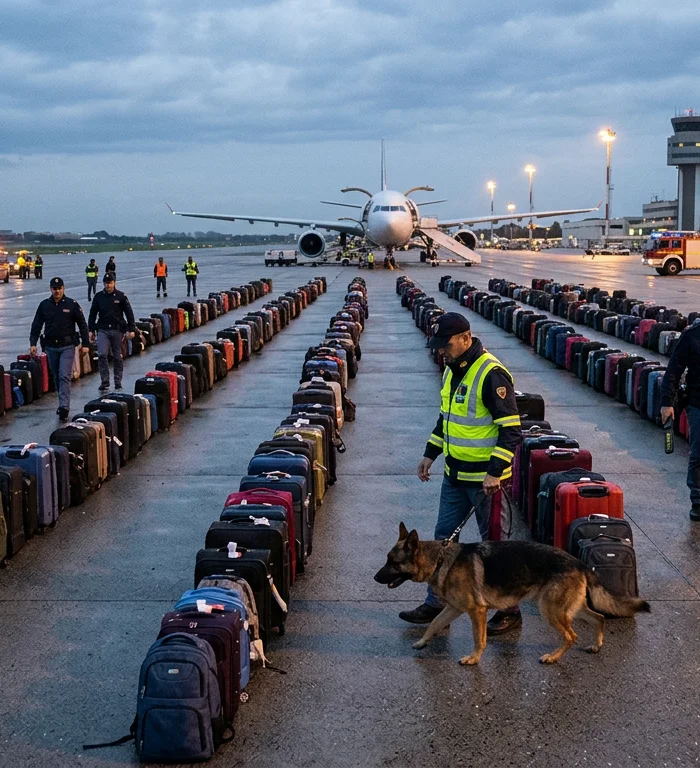
Bomb threats disrupted flights involving four European airlines, prompting diversions, searches and fighter escorts, officials and carriers said.
Authorities reported no explosives after checks on aircraft across Europe on Tuesday, following another threat on Monday. The affected carriers included Ryanair, LOT, Scandinavian Airlines and Wizz Air; no injuries were reported.
The responses extended beyond individual aircraft: Polish airports temporarily restricted operations, while Italy and Hungary deployed military jets. Investigators had not established an explanation connecting the incidents, and Bulgarian authorities said efforts to identify a threat sender continued.
Military escorts accompany civilian flights
Italy deployed two Eurofighters for a Dublin departure approaching Rome's Fiumicino airport, the Italian Air Force said. A Fiumicino official familiar with the response said checks on that Ryanair aircraft uncovered no explosives.
A separate Ryanair service arriving in Rome from Lisbon received a threat by email, the same official said. Specialists searched travelers, crew members and luggage without discovering explosives, according to the official, who requested anonymity because they lacked authorization to discuss the incidents publicly.
Hungary's response began Monday, when a Wizz Air aircraft traveling from Luton toward Bulgaria changed course for Budapest following a threat received during flight. Hungarian Defense Minister Romulusz Ruszin-Szendi said a Gripen accompanied the aircraft to Liszt Ferenc International Airport.
Wizz Air said inspections of the aircraft and those aboard identified no danger. On Tuesday, Bulgaria's acting Interior Ministry Secretary General Lyubomir Nikolov said investigators were still seeking the person who sent the threat.
Polish airports restrict operations during checks
In Poland, a LOT service departing London's Heathrow for Warsaw's Chopin Airport instead landed at Modlin following a bomb threat. LOT said the subsequent search uncovered nothing; airport officials said operations resumed after a temporary closure.
Chopin separately restricted use of one runway after receiving information about a possible dangerous object aboard a Scandinavian Airlines service arriving from Copenhagen, its communications office said. Airline spokesperson Alexandra Lindgren Kaoukji said the aircraft landed without an emergency, passengers left it, and Polish police received the case.
Other affected flights reached their intended destinations before inspections. In Spain, Francisco Lucas, the government's delegate for Murcia, said authorities checked a Ryanair aircraft arriving from Manchester and screened everyone aboard, ruling out explosives.
Lucas put the total aboard at 121, counting passengers and crew together. The incident required both an aircraft inspection and security screening, rather than a diversion to another airport.
Bulgarian Transportation Minister Georgi Peev said counterterrorism officers found no explosives on aircraft arriving in Sofia from Bergamo and Dublin on Tuesday. Both continued to Sofia despite threats received during their journeys.
Threat origins remain unresolved
Peev said information about one Sofia-bound flight came through its pilot, who had received the warning from the airline. Bulgarian controllers then applied the procedures for handling such threats.
Matthew Borie, co-founder and chief intelligence officer at aviation security adviser Osprey Flight Solutions, outlined several possible explanations: imitation following an initial threat, repeated messages from one person or group, or state-linked disruption. These were hypotheses, not findings establishing responsibility for the incidents.
Borie urged travelers not to panic, pointing to established coordination among national authorities. The reported responses differed by location and aircraft: some flights diverted, others landed normally, and military escorts accompanied selected services.
A Bulgaria landing following a threat against a Tel Aviv–Vienna service the previous month provided another recent example. Whether the latest incidents shared a sender or method remained unresolved, leaving identification of those responsible as a central investigative task.
More stories
- Singapore to open 3 MRT stations for 25-minute trip savings
- De Wever offers resignation as Belgium budget talks stall
- Ukraine rescuers search shelter after 31 reported deaths
- Trump says Israel aid ends this year, arms sales continue
- Retail investors face timing risk after OCBC's nearly 6% fall
- Planned North Africa hydrogen plants may draw 170 litres per kilogram
- Malaysia TVET entrants rise 30% in high-skills push
- Thai police arrest 39 in Cambodia-linked laundering probe