

Students turn Serbia election into Vučić’s biggest loss
Serbia election results put the Student List ahead with 52.7% as Aleksandar Vučić conceded defeat after two years of protests.
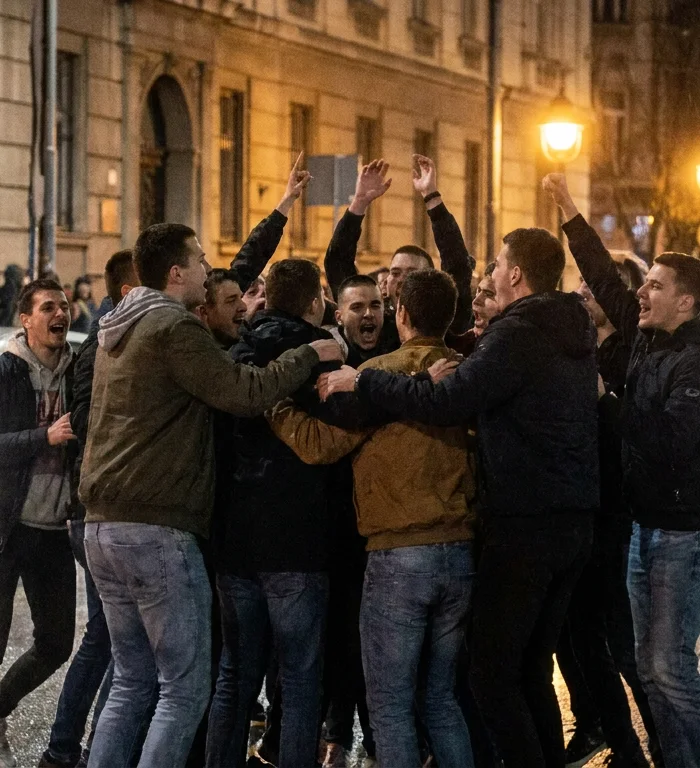
Serbia election results put the Student List on 52.7% with 97% of polling stations counted. Aleksandar Vučić conceded defeat.
The election commission’s preliminary count gave the student-led movement 2.25 million votes, compared with 1.67 million for Vučić’s Serbian Progressive Party, or SNS. The result ends the party’s hold on government power since 2012 if the final count and seat allocation confirm the preliminary outcome.
Student List passes 2 million
Vučić made the concession at SNS headquarters in Belgrade, saying, "It is clear we have lost these elections." He had called the snap parliamentary vote after two years of demonstrations that began in Novi Sad and spread into a national anti-corruption campaign.
The Student List’s lead candidate, Ilija Srdanović, said, "This will be a free state." Its campaign drew candidates from outside professional politics, including doctors, actors, academics and sports figures, for Serbia’s 250-member parliament.
Celebrations followed in Belgrade, Novi Sad and other cities, with crowds gathering in central squares, cars sounding horns and fireworks set off. Police had sealed streets around the Republic Electoral Commission in Belgrade, reflecting the tension that surrounded voting day.
Novi Sad disaster framed vote
The protest movement was formed after the collapse of a canopy at Novi Sad railway station killed 16 people. Demonstrators blamed corruption and negligence for the disaster, while Vučić and the SNS have repeatedly denied corruption.
The Student List campaigned on measures aimed at removing officials who broke rules during crackdowns on protesters, limiting party control over public enterprises and reducing political influence over the public broadcaster. Those pledges made the campaign a direct challenge to the governing system built under SNS rule.
Vučić had served two presidential terms and could not seek a third, so he led the SNS campaign with the stated aim of returning to the prime minister’s office, a post he left in 2017. His party offered higher pensions, higher public-sector salaries and more investment in state healthcare.
Belgrade celebrations expose mandate
The scale of the preliminary margin gives the Student List a strong claim to form the next government, though the supplied results do not include final seat distribution. Nebojša Vladisavljević, a political science professor at the University of Belgrade, said the Student List had "absolute legitimacy" to govern for the coming years.
Its first test is organizational rather than electoral. The movement has no obvious single leader, and its members will have to turn a protest coalition into a governing bloc with ministers, parliamentary discipline and a prime minister.
If the Student List can convert its vote share into a stable majority, Serbia’s public institutions and state-linked enterprises are likely to face pressure for personnel changes under its manifesto. If internal divisions slow that process, caretaker arrangements could extend uncertainty for public-sector pay, state companies and media governance.
EU and Russia respond
The result carries weight beyond Serbia because Vučić backed EU candidacy while refusing to impose sanctions on Russia over its full-scale invasion of Ukraine. Kremlin spokesperson Dmitry Peskov praised Vučić’s contribution to relations with Russia and said Moscow hoped "the new political force" would see cooperation with Russia as being in Serbia’s interests.
European Commissioner for Enlargement Marta Kos said "a new chapter can begin for Serbia" and that the door to the EU was open. Hungary’s prime minister, Péter Magyar, also welcomed the result, drawing a comparison with his party’s victory after 16 years of Viktor Orbán’s rule.
If the next government prioritizes EU alignment, the immediate effect would be political rather than macroeconomic: Brussels would have a clearer partner on accession issues, while Moscow would test whether existing ties remain intact. If Belgrade instead tries to preserve Vučić’s balancing act, Serbia’s foreign-policy direction could stay contested inside the new parliament.
December presidency shapes talks
Attention now turns to the choice of prime minister and to presidential elections due in December, with parliamentary speaker Ana Brnabić filling the presidency in a caretaker capacity. Long queues were reported at polling stations in Serbia and among Serbian communities abroad, including in Ljubljana, Munich, Paris, Los Angeles and Chicago.
The main open questions are the final certified result, the distribution of parliamentary seats and whether the Student List can impose discipline on a broad coalition. Until those are settled, Serbia has delivered a clear electoral break but not yet a settled governing order.
More stories
- Bolsonaro reaches Miami after defeat and fleeing Brasil
- South African parties split over Cape Town's 30,000-home annual gap
- Ruto seeks Russian investment in Kenya's $380m trade push
- Sudan teachers seek 20% budget share with 8m children outside school
- Spain rail network faces scrutiny after 64 killed near Toledo
- Spain reports at least 30 dead in high-speed train crash
- South Africa brings Coetzee into 1-1 Australia decider
- Southern Africa faces 2027 El Niño poverty squeeze, Sihlobo says
- Lovejoy links Bonetta to 700,000-person indenture system
- Six Black Sea ship attacks reach Romanian waters
Latest news
- Cyclone Arnab kills at least three on India's east coast
- EU rules bar Nord Stream return under 2027 gas phaseout
- Investors weigh OpenAI strengths against Anthropic growth
- Clariane posts 4.7% organic revenue growth
- GE Vernova lifts 2026 free-cash-flow outlook to $16bn-$17bn
- Kinross Gold faces Q3 test after 2%-3% output cut