

Spark-0 authors report 71.7% robot success
The arXiv preprint says touch supervision improved vision-only performance, but the benchmark results have not been peer reviewed or independently replicated.
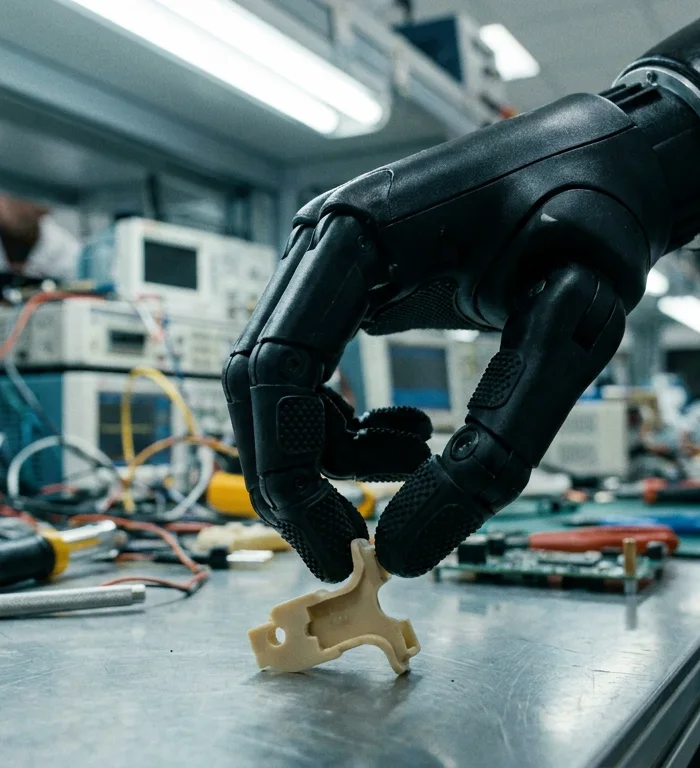
Spark-0, a robot-manipulation model, used a 1,000-hour HumanTouch dataset to improve dexterous-task results, according to an arXiv preprint submitted Oct. 15.
The Oct. 15 preprint by Tianxing Chen and 21 co-authors said Spark-0 reached 71.7% vision-only success on the Ego Humanoid Manipulation Benchmark, compared with 52.5% when touch data was discarded under matched training resources.
The work targets a persistent robotics problem: models trained mainly on images can miss contact cues such as force, compliance and early slipping. Those signals matter when a robot hand must grasp, adjust or manipulate objects through touch rather than sight alone.
The authors describe Spark-0 as a vision-tactile-language-action model, meaning it links camera input, touch signals, language instructions and robot actions in one policy. During pretraining, tactile-glove signals are converted into contact maps that supervise visual tokens, while a separate tactile pathway feeds force histories and 3D taxel states into the action system. A taxel is a tactile sensor element, analogous to a pixel for touch.
The paper said the model can be deployed in two modes: with vision alone or with tactile input. That design matters because robots may not always carry the same touch hardware used during training, while tactile sensors can still help shape visual representations before deployment.
The authors also introduced HumanTouch, described on the arXiv page as 1,000 hours of human manipulation with full-hand tactile data. That is equal to about 41.7 days of continuous recording, according to Atlas360 calculations. Spark-0 was pretrained using that dataset along with egocentric video, robot data and simulation, according to the preprint.
For evaluation, the authors released SparkArena, which combines vision-only simulated tasks with real-robot tasks that use tactile conditioning on one dexterous robot embodiment. They said Spark-0 achieved the highest mean success rate on both SparkArena tracks and ranked first on all eight aggregate metrics of the Ego Humanoid Manipulation Benchmark.
The largest reported gain came from retaining touch during pretraining even when the model later ran without tactile input. The preprint said success on SparkArena-Real, where touch was also used at deployment, increased to 52.0% from 44.0%.
The findings remain early. The paper is an arXiv preprint and has not been peer reviewed. The source material does not include independent replication, commercial deployment data, training cost, hardware cost or evidence that the same gains transfer to other robot hands.
The arXiv record lists the paper under Robotics and provides a project website at xsparkai.com/Spark-0.
Source: arXiv preprint, arXiv, Oct. 15, 2026
More stories
- Europe faces attribution gap after 16 cyber, physical incidents
- PIF backs Grand Theft Auto as Saudi players embrace game
- Signal limits screenshots to curb AI access to messages
- Cognition runs Devin Mac workspaces on EC2 in 6 AWS regions
- Salesforce engineers cut 600-failure triage to 90 minutes
- Türkiye Desk: GTA 6 puts console access and network demand in focus
- Japan & Asia: Switch 2 leads Famitsu chart with 22,420 units
- Kotukh maps quantum side-channel edge to AES-128 rank 2^58.6
Latest news
- Trump prepares tariffs on China and other major exporters
- New-car buyers pay record average $50,087 in October
- Banks face ECB reserve debate over liquidity and profits
- Investors see Anthropic debut gains fade below $83 a share
- Iraq orders federal control over Kurdish-area oilfields
- Germans oppose Ukraine aid as poll shows support slipping
- Kim Jong-un receives 10 envoys after constitutional shift
- Ukraine claims Libya strike sinks Russian naval corvette