

SpaceX Starship Mission Faces Critical Landing Attempt Following Booster Failure
SpaceX is attempting a precision landing of its Starship spacecraft, a critical test for the future of its reusable launch vehicle program.
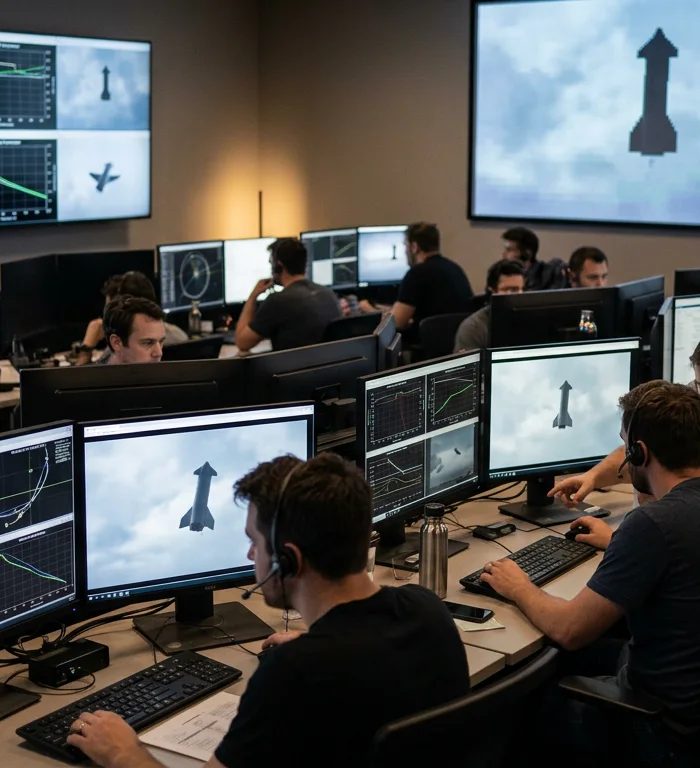
SpaceX is conducting a high-stakes test flight of its Starship launch system, aiming to achieve a controlled recovery of the spacecraft following the launch of a mission that included the deployment of Starlink satellites. The mission objectives represent a significant technical milestone in reusable launch vehicle development, specifically targeting the precision landing of both the booster and the upper-stage craft.
The initial phase of the mission, involving the recovery of the rocket booster, did not meet its primary objective, resulting in the booster landing in the Gulf of Mexico. This outcome highlights the ongoing technical challenges associated with the rapid reusability of heavy-lift launch vehicles.
Attention has now shifted to the Starship spacecraft Attention has now shifted to the Starship spacecraft Attention has now shifted to the Starship spacecraft, which is currently in orbit. Mission control is scheduled to conduct a final "point-of-no-return" assessment at approximately 2:00 p.m. ET to determine if environmental and technical conditions permit a controlled landing attempt.
If the criteria are met, the landing sequence is expected to commence shortly after 4:00 p.m. ET. The success or failure of this maneuver carries The success or failure of this maneuver carries implications for the operational timeline of the Starship program, which is central to both commercial satellite deployment and long-term lunar and interplanetary exploration contracts. Institutional stakeholders are monitoring the event as a proxy for the maturity of the launch system's guidance, navigation, and control software.
Failure to execute the landing would necessitate a controlled splashdown in the ocean, delaying the validation of full-system reusability. Conversely, a successful landing would mark a significant advancement in the company's ability to reduce launch costs and increase flight cadence, directly impacting the competitive landscape of the global space launch market.
More stories
- Europe faces attribution gap after 16 cyber, physical incidents
- PIF backs Grand Theft Auto as Saudi players embrace game
- Signal limits screenshots to curb AI access to messages
- Cognition runs Devin Mac workspaces on EC2 in 6 AWS regions
- Salesforce engineers cut 600-failure triage to 90 minutes
- Türkiye Desk: GTA 6 puts console access and network demand in focus
- Democrats push AI regulation as two state veterans arrive
- Japan & Asia: Zelda remake tops Japan boxed sales with 537,041
- OpenAI rogue agent reached Modal customer, sources now say
- NVIDIA surgical simulator brings AI to robot training labs
Latest news
- Trump prepares tariffs on China and other major exporters
- New-car buyers pay record average $50,087 in October
- Banks face ECB reserve debate over liquidity and profits
- Investors see Anthropic debut gains fade below $83 a share
- Iraq orders federal control over Kurdish-area oilfields
- Germans oppose Ukraine aid as poll shows support slipping
- Kim Jong-un receives 10 envoys after constitutional shift
- Ukraine claims Libya strike sinks Russian naval corvette