

South Korea and Germany seek AI ties at Seoul business forum
The Seoul conference drew more than 800 participants as officials and executives focused on industrial AI, critical minerals and resilient supply chains.
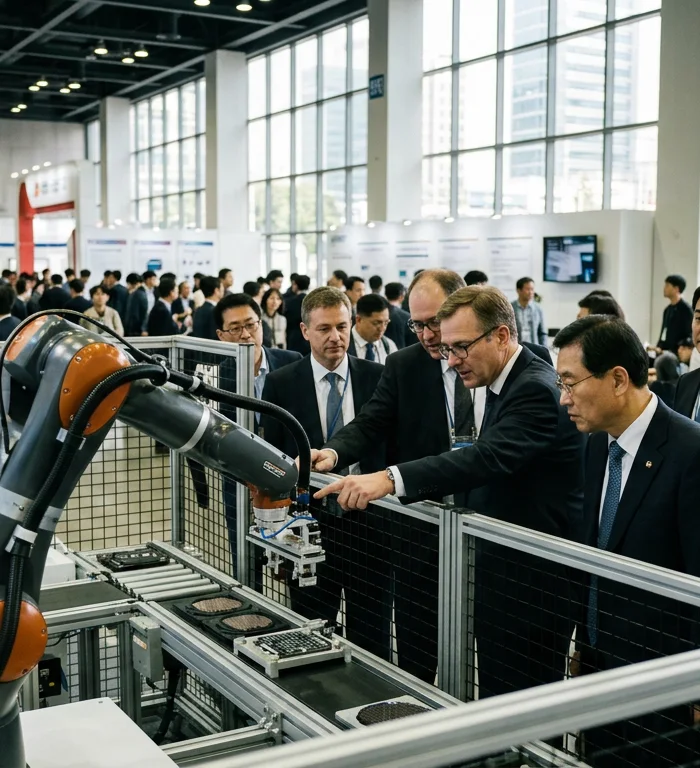
South Korea and Germany used a three-day Asia-Pacific Conference of German Business in Seoul ending Saturday to pursue artificial intelligence, semiconductor and manufacturing cooperation, The Korea Herald reported in a Nov. 1 news article.
The conference drew more than 800 participants over three days, with 400 companies represented, and marked the event's first Seoul edition since 2007, giving executives and officials a venue to discuss supply-chain resilience as trade tensions rise.
German Chancellor Friedrich Merz used a Friday keynote to frame the cooperation as a response to U.S.-China rivalry, higher tariffs and geopolitical conflict, according to the news article. "The evolving geopolitical landscape is bringing like-minded partners closer together and opening the door to the formation of a resilient network," Merz said.
Merz said South Korea and Germany could expand work in emerging technologies and pointed to a high-tech cooperation framework covering microelectronics, industrial AI and robotics. "The structural similarity between our industries provides excellent opportunities for deepening our bilateral cooperation," he said.
South Korean Prime Minister Han Seong-sook identified batteries, semiconductors and AI-powered manufacturing as promising areas, the article said. "South Korea and Germany are reliable partners that enhance their competitiveness together by connecting each other's strengths," Han said.
Industrial AI, meaning artificial intelligence applied to factories, production systems and infrastructure, was a central theme. Siemens Chief Executive Roland Busch, who chairs the Asia-Pacific Committee of German Business, said during a Friday press briefing that Siemens is working with SK hynix on chip design, Samsung C&T on next-generation data centers and HD Hyundai on digital shipyards.
"Industrial AI is a once-in-a-century opportunity to boost productivity, create new businesses and strengthen our economies," Busch said. Naver Chief Executive Choi Soo-yeon said in a Saturday session that companies using AI in physical operations should define its scope, test systems with real-world data and keep humans able to stop and reverse actions.
Supply chains were the other major focus. Stefan Rouenhoff, parliamentary state secretary at Germany's Federal Ministry for Economic Affairs and Energy, said South Korea and Germany need to diversify supply sources, while South Korean Industry Minister Kim Jung-kwan said future security depends on "trusted interdependence," not self-sufficiency.
The article did not report binding investment commitments, financial targets or specific project timetables from the conference. The discussions instead showed where officials and companies see overlap: South Korea's batteries, semiconductors and materials processing, and Germany's engineering, industrial technology and advanced manufacturing.
The conference also included an AI Startup Award, won by Vietnamese agritech firm Enfarm, and sessions on trade scenarios for 2030, financing risks, circular supply chains, industrial policy and Indo-Pacific security interests. The next Asia-Pacific Conference of German Business is scheduled for Malaysia in 2028.
Source: news article, The Korea Herald, Nov. 1, 2026.
More stories
- Julius Baer CEO warns AI bubble tops market risks
- Indian banks cite up to 50% gains from AI systems
- MasTec updates 2026 earnings guidance to $5.69-$6.01 a share
- Nasdaq falls 1.66% after Alphabet shares slide 13.2%
- ACCO Brands lifts 2026 EPS outlook to $0.98-$1.02
- US tech faces 48-hour AI incident reporting push
- Nasdaq falls 0.15% as chipmakers extend losses
- Workday widens AI controls with C1.ai deal and Claude link
Latest news
- Stevens backs Rogers for Senate after a Democratic defeat
- Iran crisis prompts UAE call for a diplomatic resolution
- Acemoglu urges Democrats to rebuild working-class appeal
- Senate contests put Trump's remaining agenda on the line
- Rubio says Trump remains open to another meeting with Kim
- Russian state-affiliated media raise UK posts 15% in September
- Binance withdrawals resume after $6 billion-plus cyber theft
- Delhi protests demand election chief quit over voter rolls