Trump Forms New Tech Council with Silicon Valley Leaders
President Trump has established a new advisory council focused on AI and advanced technologies, integrating prominent tech executives into policy discussions.
Cuneyd Erdogan ·
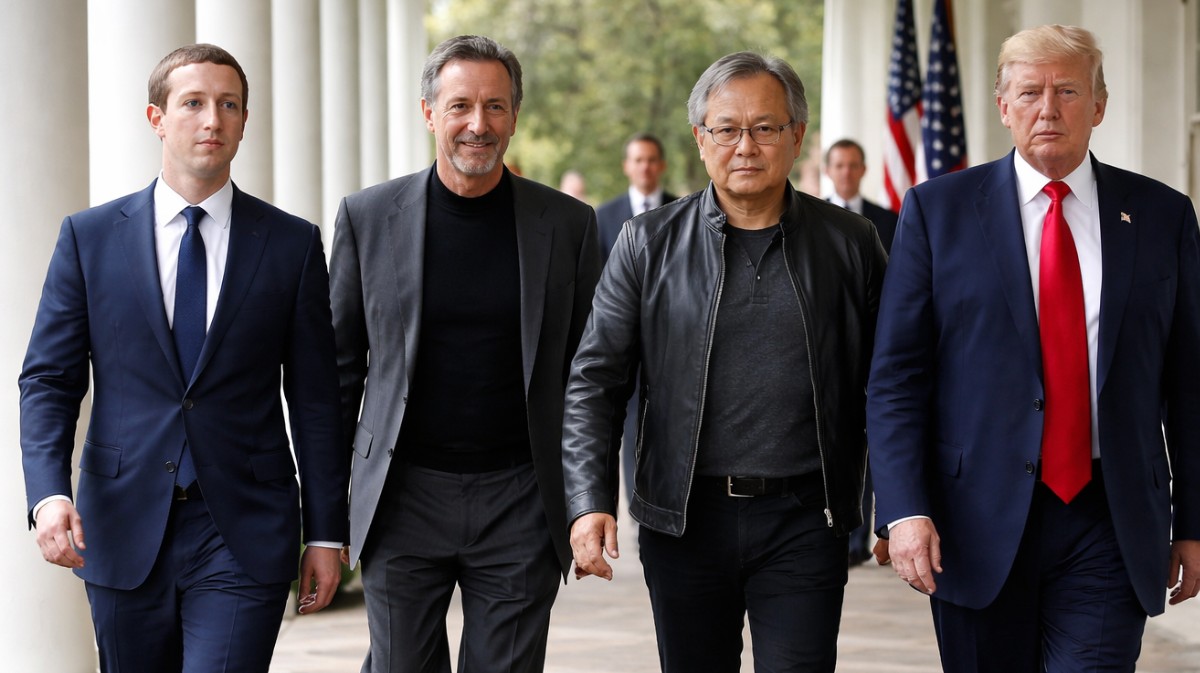
New Advisory Body for AI and Tech
President Donald Trump has initiated a new advisory council dedicated to artificial intelligence and advanced technologies. This move is seen not merely as an effort to infuse technical expertise into policy-making but also as a significant redefinition of the relationship between Washington and Silicon Valley's influential figures.
The inclusion of industry leaders such as Mark Zuckerberg from Meta, Larry Ellison of Oracle, and Jensen Huang from Nvidia within a White House-affiliated structure elevates the private sector's role in shaping U.S. technology strategy, making it more visible and institutionalized.
Council's Mandate and Strategic Importance
Officially known as the President’s Council of Advisors on Science and Technology (PCAST), the group will focus on enhancing America's scientific capabilities and analyzing AI's impact on the workforce. However, this body extends beyond a typical advisory mechanism, potentially serving as a strategic platform to define economic competition in the age of artificial intelligence.
A presidential order signed by Trump in January designated technological superiority as a "national security imperative." This underscores the council's design as not just an economic tool but also a geopolitical one.
Notable Absences and Past Dynamics
The council's composition, however, reveals some striking omissions. The absence of Elon Musk, CEO of Tesla and SpaceX, and Sam Altman, CEO of OpenAI, indicates that not all key players in the AI ecosystem are united under this new umbrella.
Musk's previous involvement in White House advisory boards during Trump's first term, followed by his resignation after the U.S. withdrew from the Paris Climate Agreement, highlights a historically intermittent relationship between the two parties. While this history suggests potential political or institutional reasons for current exclusions, no official explanation has been provided.
Nvidia's Critical Role in AI Infrastructure
A particularly noteworthy aspect of the council is the inclusion of Nvidia, a company that under Jensen Huang's leadership represents the foundational layer of AI infrastructure. Nvidia produces essential chips for large language models and data centers, effectively acting as a "bottleneck provider" in the global AI race.
This inclusion signals that U.S. technology policy considers not only software and platform companies but also the hardware supply chain as a strategic element. Nvidia's role in this process also highlights the profound dependence of Washington on the private sector to advance its AI capabilities.
Public Scrutiny and Future Implications
The announcement of the council has sparked broader discussions and criticism. Some commentators suggest that the support from powerful Silicon Valley billionaires for the Trump administration is now formally integrated into policy-making through an institutional mechanism.
Concerns have been raised that the increasing influence of these tech leaders on public policy could introduce new risks concerning regulatory independence and public interest. These criticisms point to an era where the boundaries between government and the private sector are becoming increasingly permeable, though these views are subject to ongoing debate and lack official confirmation.
This development coincides with an acceleration of technological competition, particularly with rival economies like China. Washington's approach demonstrates a preference for closer collaboration with the private sector to accelerate innovation. However, the long-term balance this model will achieve remains uncertain. A critical question for the coming period is how the line between policy formulation and commercial interests will be maintained, especially in a high-impact field like artificial intelligence.
Ultimately, Trump's technology council can be interpreted as an attempt to reshape the architecture of U.S. power in the digital age, extending beyond a mere advisory body. Yet, it remains unclear whether this new structure can establish a sustainable balance between public authority and private sector influence.