Scientists trace Lanmaoa asiatica effects unlike psilocybin
Lanmaoa asiatica has drawn attention after a Mycologia study detailed reports of vivid “tiny people” hallucinations unlike typical psilocybin effects.
Ayla Demirhan ·
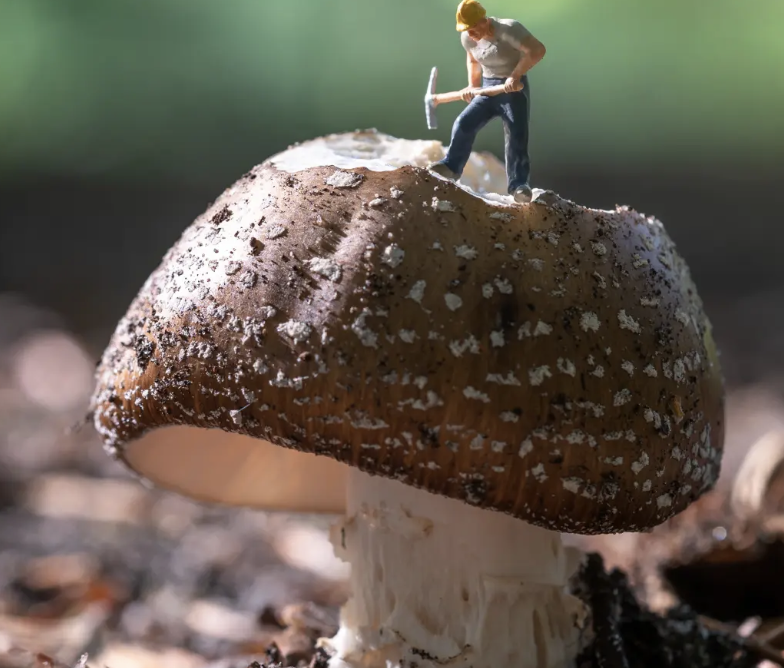
Lanmaoa asiatica is drawing scientific scrutiny after a recent Mycologia paper documented reports of vivid “tiny people” hallucinations linked to the mushroom.
The phenomenon appears distinct from the better-known psychedelic profile of psilocybin mushrooms, and researchers say the biological mechanism remains unresolved.
A mushroom tied to an unusual, delayed hallucination
According to University of Utah researcher Colin Domnauer, people who ingest L. asiatica can appear largely unimpaired at first, with little change in their surroundings.
What sets the reports apart is a specific visual experience: highly detailed, three-dimensional figures described as miniature people occupying the external environment.
Domnauer told LiveScience that these figures are often described as interacting with real-world objects—such as moving across chairs, tables, or through doorways—rather than appearing as abstract distortions.
The onset is also atypical. Domnauer said the miniature-figure hallucinations are reported to emerge about 12 to 24 hours after ingestion and can persist for multiple days.
Researchers emphasized that, so far, L. asiatica is the only known fungus—and the only known food source—reliably associated with this narrow class of hallucination.
How it differs from “magic mushrooms”
Classic “magic mushrooms” typically contain psilocybin or psilocin, compounds associated with changes in perception that can include intensified colors, shifting surfaces, and geometric patterns.
Those substances often begin producing noticeable effects roughly 30 minutes after ingestion, and they are frequently accompanied by physical symptoms such as dilated pupils, nausea, higher heart rate, and impaired coordination.
In contrast, accounts connected to L. asiatica frequently lack the expected early psychedelic markers. Domnauer said many individuals report feeling functionally sober even as the unusual visual episode later develops.
That split—limited immediate impairment combined with a delayed, highly specific hallucination—has helped push the mushroom into a separate category of concern for mycologists and toxicology researchers.
Where it grows, how it’s used, and what science doesn’t know
L. asiatica is a bolete mushroom native to pine forests of southwestern China and the northern Philippines, and it is reportedly collected from the wild and sold in local markets.
It has been used as a routine culinary ingredient, but anecdotal accounts have linked hallucinations to preparation issues, particularly when the mushroom is undercooked.
Despite longer-standing local reports, Domnauer noted that the species entered the scientific literature relatively recently, becoming known to science around a decade ago.
The Mycologia study adds weight to the pattern by consolidating observations and sharpening the question that remains unanswered: what compound, or combination of compounds, drives these miniature-figure visions.
Domnauer said neuroscience still lacks a clear explanation for the brain processes that generate this type of detailed, externally projected hallucination, as well as a standardized approach to treatment.
For now, the research community’s next steps are likely to focus on chemical profiling of L. asiatica and comparisons with other boletes and known psychoactive fungi, alongside careful documentation of onset timing and symptom duration.
Public health implications may also follow, particularly in regions where the mushroom is traded for food, because the reported delay in symptoms could complicate efforts to connect an episode to a specific meal.