

Rowmax-H15 cuts Nvidia B200 attention latency 26%
The approximation method reduces hardware power consumption by 8.4% on Blackwell chips while limiting language model perplexity degradation to under 0.
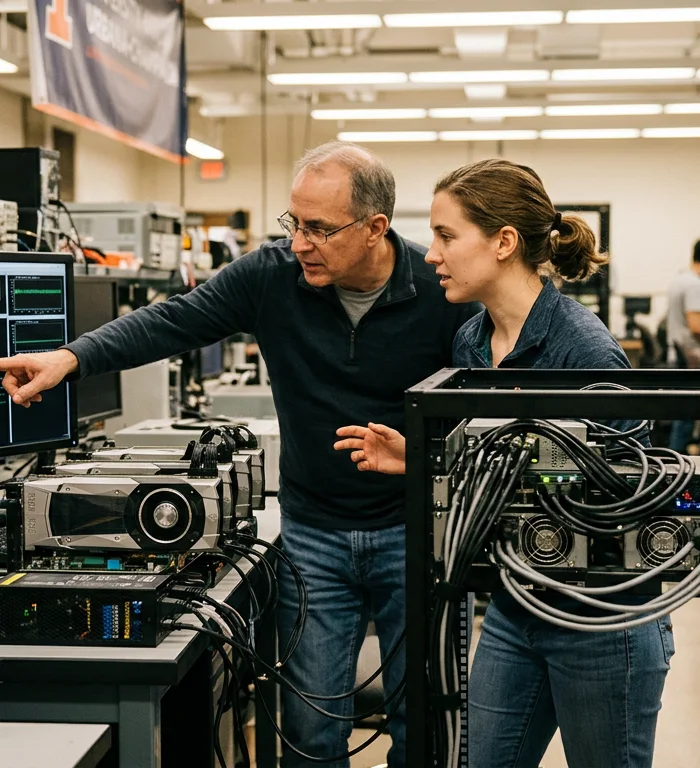
Researchers at the University of Illinois Urbana-Champaign released a kernel optimization called Rowmax-H15 on Nov. 23, cutting non-causal attention forward latency on Nvidia B200 GPUs by 25.8% at 8,192 tokens.
The preprint shows that replacing exact exponential evaluations inside FlashAttention-4 also reduces board power consumption by 8.4% at 16,384 tokens, addressing a hardware bottleneck where Blackwell tensor cores outpace special-function units by over 100 times.
For causal sequences of 8,192 tokens, the modified FP8 attention forward pass accelerated execution times by 12.4% on B200 systems. The method relies on Rowmax-PoT, an integer base-two logarithmic scheme anchored directly to the running maximum value of each attention row.
Evaluated in BF16 at 2,048 tokens across five model architectures, the kernel increased next-token perplexity by 0.091% to 0.492% on WikiText-103. Tests on frozen models indicated that while support size can shrink, assigning uniform weights to remaining positions sharply increases cross-entropy loss.
Blackwell streaming multiprocessors process 8,192 matrix operations each cycle but only 16 special-function exponentials. That imbalance leaves fused attention kernels throttled by transcendental math rather than raw tensor compute.
The investigation covered ten frozen language models spanning 500 million to 72 billion parameters, including Qwen2.5, Llama-3, Gemma-2, and Mistral-7B variants. The researchers published code publicly on GitHub, though production-scale validation across diverse serving frameworks remains uncompleted.
Source: Academic preprint, arXiv, Nov. 23, 2026.
More stories
- Europe faces attribution gap after 16 cyber, physical incidents
- PIF backs Grand Theft Auto as Saudi players embrace game
- Signal limits screenshots to curb AI access to messages
- Cognition runs Devin Mac workspaces on EC2 in 6 AWS regions
- Salesforce engineers cut 600-failure triage to 90 minutes
- Türkiye Desk: GTA 6 puts console access and network demand in focus
- Gemini flags 69% of held-out thermal-video falls
- Anthropic reports $80.7 billion loss ahead of planned IPO
Latest news
- Trump prepares tariffs on China and other major exporters
- New-car buyers pay record average $50,087 in October
- Banks face ECB reserve debate over liquidity and profits
- Investors see Anthropic debut gains fade below $83 a share
- Iraq orders federal control over Kurdish-area oilfields
- Germans oppose Ukraine aid as poll shows support slipping
- Kim Jong-un receives 10 envoys after constitutional shift
- Ukraine claims Libya strike sinks Russian naval corvette