Quantum Computing Quietly Joins the AI Infrastructure Stack
Microsoft, IBM, & NVIDIA integrate quantum processors into data centers as co-processors, ending quantum's isolation from conventional tech.
Jason Kwon ·
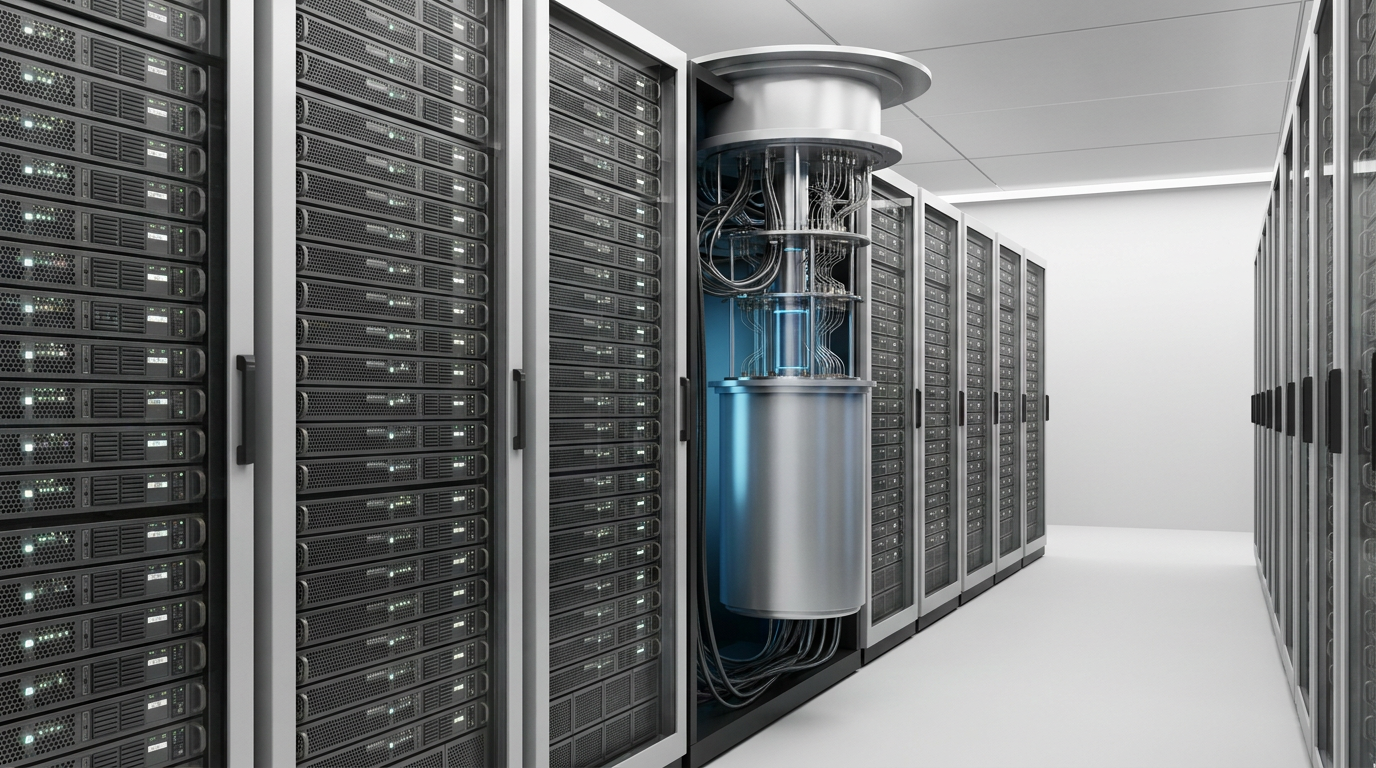
Quantum hardware is being slotted into the same buildings that house AI training clusters, ending a long stretch in which the two technologies were discussed in entirely separate conversations. Microsoft has engineered a quantum processor that fits a standard server rack. IBM is operating quantum machines beside classical supercomputers at major research sites. NVIDIA this month released Ising, an open-source family of AI models built to correct the errors that have held qubit hardware back.
A decade of lab framing ends The change reflects engineering progress more than marketing. Quantum has been covered for years as either a future cybersecurity hazard or an academic experiment perpetually ten years away from utility. The hardware is now compact enough, cool enough, and reliable enough to live inside commercial infrastructure rather than dedicated physics labs. That is what has shifted the conversation from theory to procurement.
Where the cold actually sits Microsoft's current quantum design draws roughly 30 kilowatts, most of it consumed by refrigeration that holds qubits at a fraction of a degree above absolute zero. The chilled core itself is described as roughly the size of a soda can, with the rest of the system running at ambient temperature. "A quantum machine is very much part of the ecosystem. It sits right next to a hyperscaler," said Zulfi Alam, corporate vice president of quantum at Microsoft. The hybrid model is already running at Japan's RIKEN institute, where an IBM quantum machine works alongside the Fugaku supercomputer on molecular simulations that hand workloads between the two.
Pickup trucks, not engines Enterprises hoping quantum will reduce AI's electricity bill are looking at the wrong machine. A single rack of NVIDIA's mainstream AI chips pulls 120 to 140 kilowatts, with next-generation systems projected above 200, while hyperscale AI campuses run tens of thousands of such racks and can approach a gigawatt of total demand. Quantum systems cannot absorb that workload because they are bad at the matrix math GPUs handle. "You might have a pickup truck and a small two-place sports car in your garage," said Marc Lijour, an IEEE member who teaches at International Business University. "One is not lowering the costs of the other."
Drug discovery, batteries, derivatives The applications driving real demand are narrow but commercially serious. Quantum machines are well suited to designing battery chemistries, modeling molecular interactions for pharmaceutical research, improving photovoltaic conversion efficiency, and pricing complex financial derivatives in ways classical systems cannot match. Scientific computing and financial services are currently the two sectors generating genuine enterprise interest, according to Rodrigo Madanes, EY's global next frontier technology and AI leader. Most other industries are watching from the sidelines.
The 2030s redesign IBM is positioning the shift as a redesign of the supercomputer itself. "We're moving into a data center model where we're actively looking at co-located CPU and GPUs with quantum processors," said Jerry Chow, CTO of quantum-centric supercomputing at IBM, who expects fully integrated CPU-GPU-QPU systems to become the industry baseline by the 2030s. That timeline matters globally because the same hardware capable of running drug-discovery simulations is also capable of breaking the encryption protecting most internet traffic. Governments and large enterprises have already begun migrating to post-quantum cryptography on a schedule dictated by the hardware rather than by their own readiness.
Encryption is the deadline For most chief information officers, the immediate question is not whether to buy quantum compute but when someone else's machine will be powerful enough to read their data. "I don't think we're at the year of at-scale quantum data center scale-up," Madanes said, noting that the encryption migration is already on the clock. Whether the optimistic 2030s integration timeline holds depends on error-correction techniques that remain unproven at scale, and on energy and cooling demands that will grow as qubit counts rise. The infrastructure question is no longer whether quantum belongs in the data center — it is how quickly the rest of the stack will be ready for it