OpenAI misses sales targets as competition from Anthropic and Google intensifies globally
Jason Kwon ·
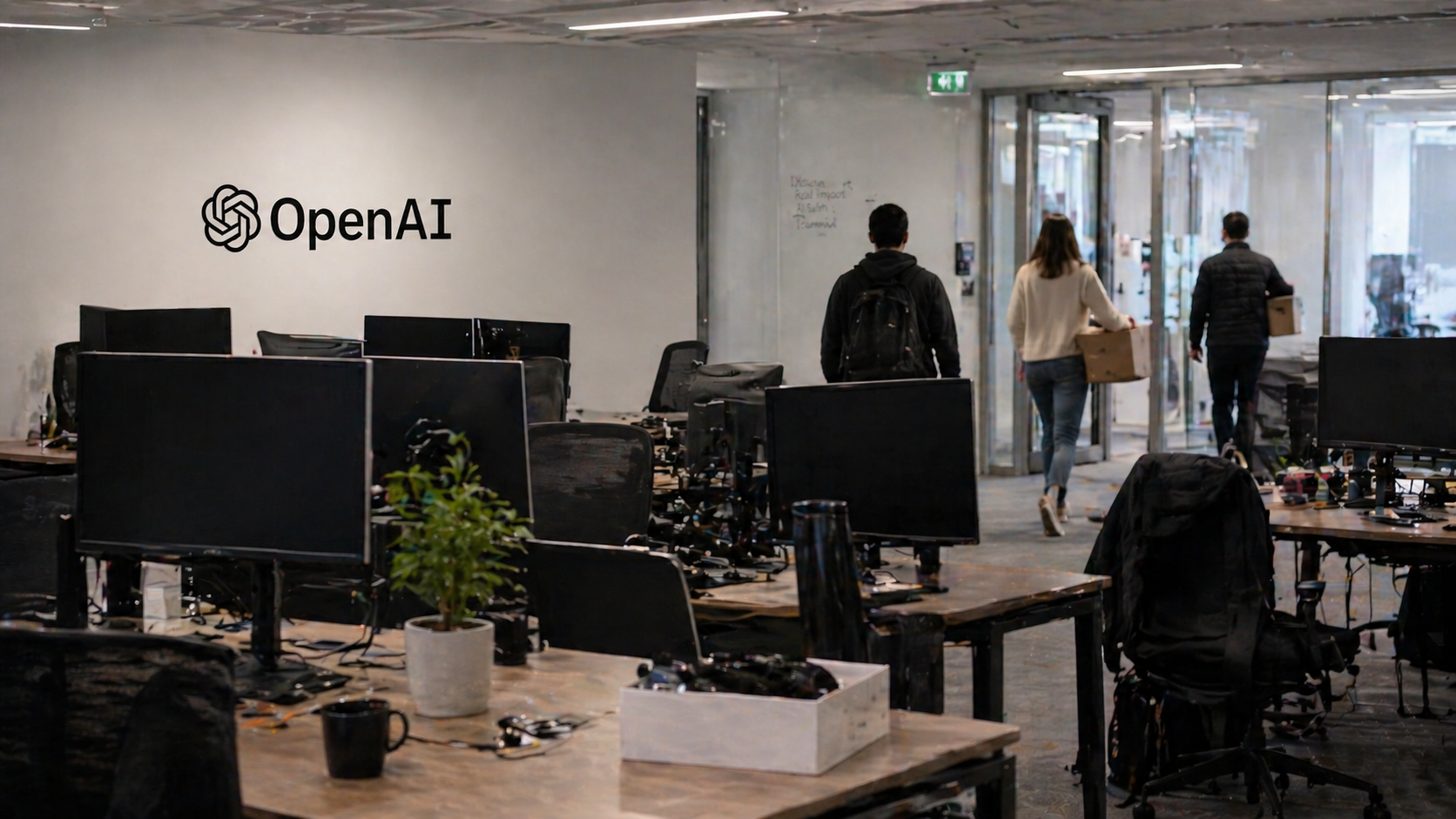
OpenAI's recent miss on monthly sales and new-user targets has knocked down the public companies most exposed to its growth, reviving doubts about the AI capex cycle just before tech earnings. SoftBank fell as much as 11% in Tokyo on the news, while CoreWeave, Oracle, and Advanced Micro Devices each dropped roughly 3% in U.S. premarket trading. The selloff hit the small group of names — Nvidia, Microsoft, and the others above — that markets treat as listed stand-ins for the privately held ChatGPT maker. The Wall Street Journal first reported the shortfall, citing unidentified people.
Anthropic and Google Compete for Customers
The miss isn't happening in a vacuum. OpenAI fell short of several monthly sales targets in 2026 as Anthropic gained share in coding and enterprise deals, and perceptions of OpenAI's lead began shifting last fall after strong reviews of Alphabet's Gemini and Anthropic's Claude. A basket of OpenAI-linked stocks has risen about 75% since the end of 2024, while a comparable group of Alphabet-tied names is up more than 300% over the same window. That gap is now the cleanest market expression of where investors think momentum has moved.
OpenAI's Internal Financial Concerns
Behind the public numbers, Chief Financial Officer Sarah Friar has told colleagues she is concerned the company may struggle to fund future computing contracts if revenue growth doesn't accelerate, people familiar with the matter said. Directors have started looking more carefully at the company's data-center commitments and have questioned CEO Sam Altman's push to lock in additional compute despite the slowdown. The scrutiny is reshaping internal priorities ahead of a possible IPO by year-end. Altman and Friar said in a joint statement that they are "totally aligned on buying as much compute as we can," and called any suggestion of division "ridiculous."
Impact on OpenAI's Partners
OpenAI is private, so the market expresses its view through the listed firms tied to its build-out: chipmakers, cloud providers, financiers, and infrastructure operators. SoftBank's exposure is the most direct, which is why the Tokyo move was the largest. Oracle and CoreWeave have signed major compute supply deals; AMD sells the silicon. When OpenAI's revenue trajectory wobbles, every contracted dollar of future capex on those partners' books gets repriced for risk.
AI Capex Cycle Under Scrutiny
Investors are watching this earnings season for proof that the hyperscaler and AI infrastructure cohort will hold to previously announced spending plans. "That's what the market needs to see to keep the AI narrative intact," said Amanda Lyons, head of research at Energy Group Capital, adding that the path is narrow: a slowdown reads as ecosystem weakness, while a sharp acceleration raises questions about returns. The OpenAI miss tightens that path because it directly tests whether end demand can absorb the supply being built.
Competitive Realignment in the AI Market
"OpenAI's growth has been phenomenal since the release of ChatGPT but competitors are stealing a march from both sides," said Anna Macdonald, investment strategy director at Hargreaves Lansdown. Anthropic is winning enterprise and developer mindshare; Google is winning on consumer and model benchmarks. That two-front pressure changes the strategic calculation for every partner that built its AI thesis around OpenAI being the default winner, and it raises the cost of OpenAI defending its position with more compute rather than better products.
IPO Window and Compute Gap Considerations
The questions worth tracking: whether the revenue trajectory recovers fast enough to support the contracts already signed, whether the board imposes harder spending limits before any IPO filing, and whether Altman and Friar's stated alignment holds once specific data-center commitments come up for approval. If OpenAI misses again next quarter, the proxy trade gets repriced more violently — and any IPO would arrive into a much harder market than the one Altman planned for.