

Routine Battery Diagnostics Identified as Source of Global Power Grid Oscillations
A global, decade-long power grid oscillation has been traced to synchronized battery diagnostic cycles in uninterruptible power supplies, highlighting risks…
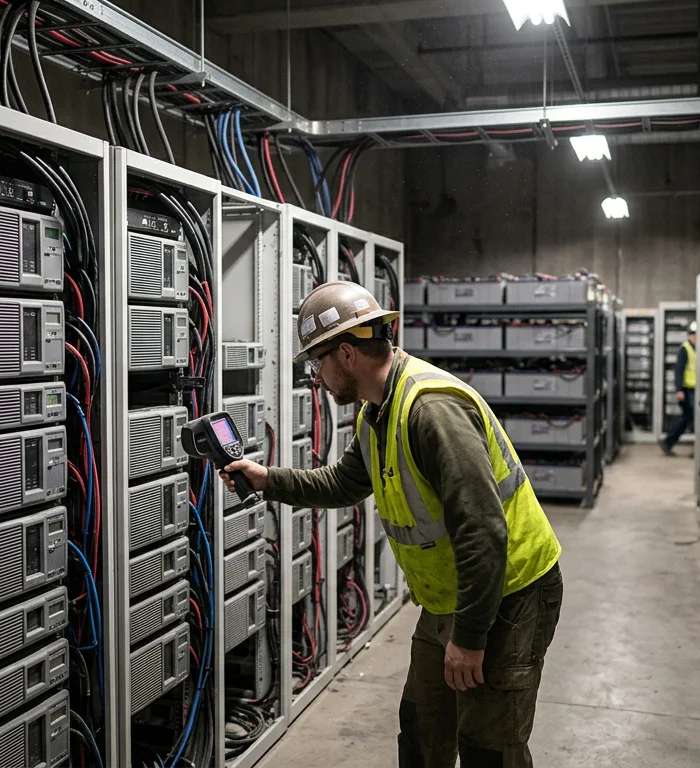
Researchers have identified the cause of a persistent, minute-long frequency oscillation affecting electrical grids across five continents. The phenomenon, which has been observed for over a decade, manifests as a recurring, high-precision pulse in grid frequency. Analysis confirms that these fluctuations are not the result of systemic failure or external interference, but rather the cumulative effect of routine diagnostic cycles performed by uninterruptible power supply (UPS) systems.
These backup power units, commonly deployed in hospitals, data centers, and research facilities, are programmed to conduct automated battery self-tests at 60-second intervals. While individual diagnostic events generate negligible electrical demand, the synchronization of these devices—facilitated by digital clocks that align with external time signals—results in a collective surge that is measurable at the grid level. The resulting oscillations typically measure only a few millihertz in amplitude, posing no immediate threat to current grid stability.
This discovery highlights an emerging risk factor for
This discovery highlights an emerging risk factor for This discovery highlights an emerging risk factor for critical infrastructure: the unintended synchronization of distributed, digitally controlled equipment. As power grids become increasingly reliant on automated, internet-connected hardware, the potential for small-scale control routines to aggregate into systemically relevant disturbances grows. While the current pulses are benign, the findings suggest that grid operators must account for the collective behavior of decentralized devices when modeling future grid resilience and stability.
Engineers are now tasked with evaluating whether these synchronized diagnostic patterns could be mitigated through software updates or staggered scheduling. The research underscores the necessity of monitoring the cumulative impact of automated cyber-physical systems on large-scale energy networks. Future grid management strategies will likely require stricter oversight of the control routines embedded within third-party hardware to prevent similar, potentially more disruptive, synchronization events.
More stories
- Europe faces attribution gap after 16 cyber, physical incidents
- PIF backs Grand Theft Auto as Saudi players embrace game
- Signal limits screenshots to curb AI access to messages
- Cognition runs Devin Mac workspaces on EC2 in 6 AWS regions
- Salesforce engineers cut 600-failure triage to 90 minutes
- Türkiye Desk: GTA 6 puts console access and network demand in focus
- Anthropic IPO seeks $1.4 trillion fully diluted valuation
- UK agencies face 100-plus public-code security flaws
- Palantir stock rally hands shorts $3 billion paper loss
- Video reveals robotic hand design for faster object grips
Latest news
- Highly diversified investors report 91% confidence in retirement
- Russian military faces 1,087 recorded suicides in Ukraine war
- US faces China, Russia in Africa minerals contest
- Russian war deaths top 460,000, Guardian says
- Nvidia board gets Trump input on Jensen Huang return as CEO
- Rwanda faces budget strain from 85% electricity access push
- ICE arrests at Seattle airport draw protests and scrutiny
- AI doubts leave Asian stocks facing a new investment test