People Are Apparently Applauding “The Odyssey” — at Normal Movie Screenings
The rare response may be the clearest evidence yet that Nolan’s three-hour epic has crossed from blockbuster to cultural event.
Mei Lin ·
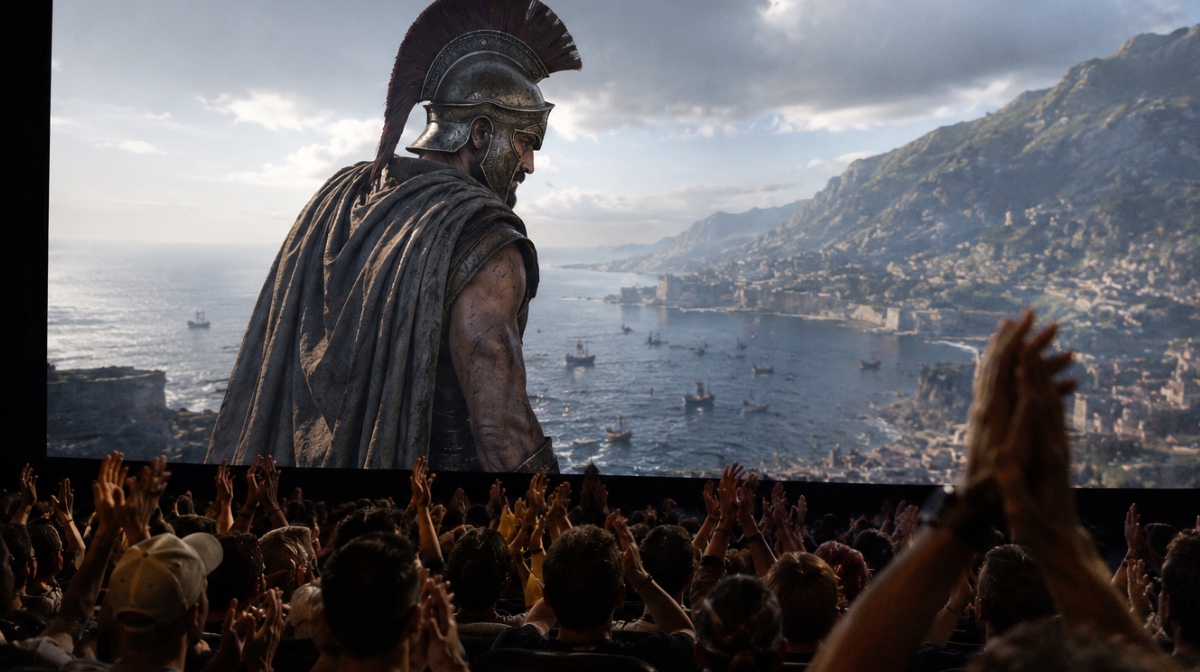
Audiences at ordinary showings of Christopher Nolan’s “The Odyssey” are reportedly applauding as the film ends, an unusual reaction that has given Hollywood a striking new measure of the movie’s momentum. A circulating social-media post said its author had received numerous accounts from viewers who encountered clapping at commercial screenings rather than premieres, where such responses are more common. The reports remain anecdotal, but they have landed after a formidable opening weekend: the R-rated epic earned $264.1 million worldwide, including $124.5 million in North America, while receiving an A CinemaScore. The combination of ticket sales and spontaneous audience reaction suggests the film is operating on two levels at once — as a commercial release and as a public occasion.
One Post Breaks Through
The post resonated because applause is not built into the modern multiplex experience. At a festival or gala, viewers may be responding to actors, directors and craftspeople seated inside the auditorium; at a neighborhood theater, the people responsible for the movie are usually hundreds or thousands of miles away. Clapping in that setting serves no practical purpose, which is precisely why it carries weight: strangers have independently decided that watching the credits arrive in silence would feel inadequate. The reaction also gives “The Odyssey” something that online ratings and box-office charts cannot fully capture — evidence, however informal, that viewers are experiencing the ending as a communal release rather than immediately reaching for their phones and the exit.
Nolan Built a Pilgrimage
That response did not appear from nowhere. Nolan and Universal spent years positioning “The Odyssey” as a film that should be encountered in a theater, shooting the production entirely with IMAX film cameras and promoting the scarcity of its highest-quality presentations. The movie follows Matt Damon’s Odysseus on the journey home from the Trojan War, with a cast that includes Tom Holland, Anne Hathaway, Robert Pattinson, Lupita Nyong’o, Zendaya and Charlize Theron; its 172-minute running time asks viewers to surrender nearly three hours to the experience. Some theaters scheduled sold-out midnight and 3 a.m. IMAX 70mm performances, turning a screening into the cinematic equivalent of a concert date or championship game.
For cinema operators, the applause carries a commercial message. Streaming trained viewers to expect convenience, control and an instant escape from any story that loses their attention; a theater cannot compete on those terms because it requires travel, fixed schedules, higher prices and the presence of other people. It can compete by making those apparent disadvantages feel valuable — the giant screen, the uninterrupted concentration and the emotional charge produced when hundreds of viewers react together. Reports of clapping tell exhibitors that “The Odyssey” is giving customers something difficult to reproduce at home, while full auditoriums provide theaters with badly needed revenue from premium tickets, concessions and repeat visits.
IMAX Sells the Difference
The film’s performance also strengthens the business case for premium formats. IMAX screenings generated $81.4 million globally during the opening weekend, according to figures reported by the Associated Press, giving the company its largest weekend on record and accounting for nearly one-third of the movie’s worldwide debut. Premium formats reportedly represented more than half of North American revenue, showing that audiences were not merely buying access to the story; many were paying extra for scale, projection quality and sound. That distinction is crucial for an industry that has struggled to persuade customers that every studio release deserves a trip outside the home. “The Odyssey” is succeeding because the format is part of the product rather than an upgrade offered after the purchasing decision.
Hollywood usually defines a phenomenon through numbers: presales, opening weekends, audience scores and the rate at which revenue declines after Friday night. “The Odyssey” already has those indicators, including a 95% critics’ score and a 97% verified-audience rating reported during its first week, but applause introduces a less measurable form of value. It turns spectators into participants and gives later customers a story to join: this is the film people travel for, schedule at strange hours and discuss before leaving the auditorium. The effect can support longer theatrical legs because social proof is moving through workplaces, group chats and families in a form more persuasive than a conventional advertisement — not simply that the movie is good, but that seeing it with a crowd changes the experience.
Applause alone does not guarantee that “The Odyssey” will sustain its opening pace, and social-media reports can magnify enthusiastic pockets of viewers until they appear universal. The film carried a reported production cost of about $250 million before a substantial marketing campaign, meaning a spectacular first weekend is the start of the financial calculation rather than its conclusion; its lengthy running time also limits the number of daily showings available to theaters. Competition, word of mouth beyond Nolan’s core audience and the second-weekend decline will offer firmer evidence of its durability. Yet the clapping already tells Hollywood something worth hearing: when a movie is designed, marketed and presented as an event, audiences may still respond not as isolated consumers but as a room full of people who briefly remember they are watching together.