Non-citizen voter registrations show US state system gaps
State license errors may have added more than 30,000 non-citizen voter registrations since 2000, intensifying a proof-of-citizenship fight before midterms.
Atlas Newsdesk ·
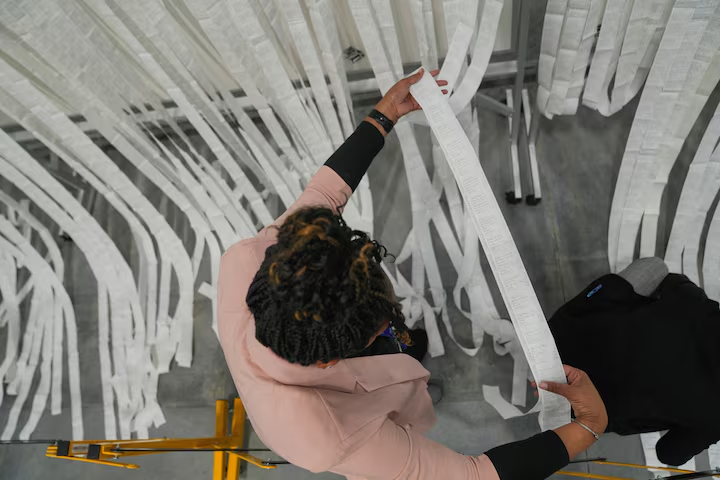
State license errors may have added more than 30,000 non-citizen voter registrations since 2000, against more than 170 million registered voters.
Official records and state disclosures point to software glitches and clerical mistakes in driver’s license and state ID systems across a dozen states led by both parties. The available records do not show how many of those people, if any, cast ballots.
New Jersey’s 6,600 registrations
New Jersey disclosed the most recent large error this summer, saying a technology failure added about 6,600 self-declared non-citizens to voter lists between June 2023 and June 2024. State officials said the applicants had answered “no” when asked whether they were citizens during license and ID applications.
Similar errors have been reported in California, Illinois, Iowa, Nevada, Ohio, Oregon, Pennsylvania, South Dakota, Texas, Utah and Virginia. The figures remain tentative in several states because voter-list reviews are revised as officials verify citizenship, removals and later naturalizations.
Motor-voter systems meet ID agencies
The mistakes trace back to motor-voter systems created under the National Voter Registration Act, the 1993 law that linked registration to license offices and other public agencies. Voter registration rose to more than 86% in 2024 from 62% in 1990, according to Census data and the US Election Assistance Commission.
The same system now intersects with broader license access for immigrants. All 50 states allow legal immigrants to obtain driver’s licenses, while 19 states and the District of Columbia also issue licenses to undocumented immigrants.
Don Palmer, a senior legal fellow at the Heritage Foundation and a former Trump-appointed chair of the US Election Assistance Commission, said license agencies appear to be a primary source of the problem. He said states should strengthen eligibility checks before erroneous registrations reach election rolls.
SAVE America Act’s process test
The White House is pressing Congress to pass the SAVE America Act, which would require proof of US citizenship to register and photo identification to vote. President Trump and allies have argued that non-citizen voting is broader than official cases show, while opponents say the proposal could burden eligible voters who lack ready access to passports or birth certificates.
David Becker, executive director of the Center for Election Innovation & Research, said proof-of-citizenship rules may not prevent errors that start inside agency workflows. In the New Jersey example, applicants identified themselves as non-citizens, but the system still placed them on voter rolls.
The Justice Department says false citizenship declarations sometimes occur. Federal prosecutions under the “voting by aliens” statute created in 1996 totaled 129 in a data review published earlier this year, and none of those cases alleged a coordinated effort to change an election result.
Iowa’s count falls to 277
Iowa shows how initial tallies can change after review. Before the 2024 election, officials said more than 2,000 people had registered or voted after reporting themselves as non-citizens to the Iowa Department of Transportation; six months later, the figure fell to 277.
Iowa officials said 35 non-citizens cast ballots that were counted in the 2024 general election, compared with more than 1.6 million total voters statewide. Virginia reported more than 4,500 foreign-national matches on its rolls in 2025, but state officials said the number included people later naturalized and others removed from registration lists.
If states fix the data-transfer failures, the direct effect would fall on election offices and motor-vehicle agencies through cleaner screening and fewer post-election disputes. If Congress instead imposes new proof rules before November 3, the burden would shift toward voters, state administrators and election-technology vendors asked to verify documents under tighter deadlines.
The global macro effect is likely indirect unless election disputes alter market expectations for fiscal policy or US political stability. The main open question is whether state agencies can separate clerical errors from unlawful voting quickly enough for lawmakers to legislate without creating new bottlenecks in registration systems.