

Multimodal AI model flags benign breast tumors with 0.72 AUC
An arXiv preprint tested 1,632 patients, but the in-house dataset and lack of peer review limit immediate clinical conclusions.
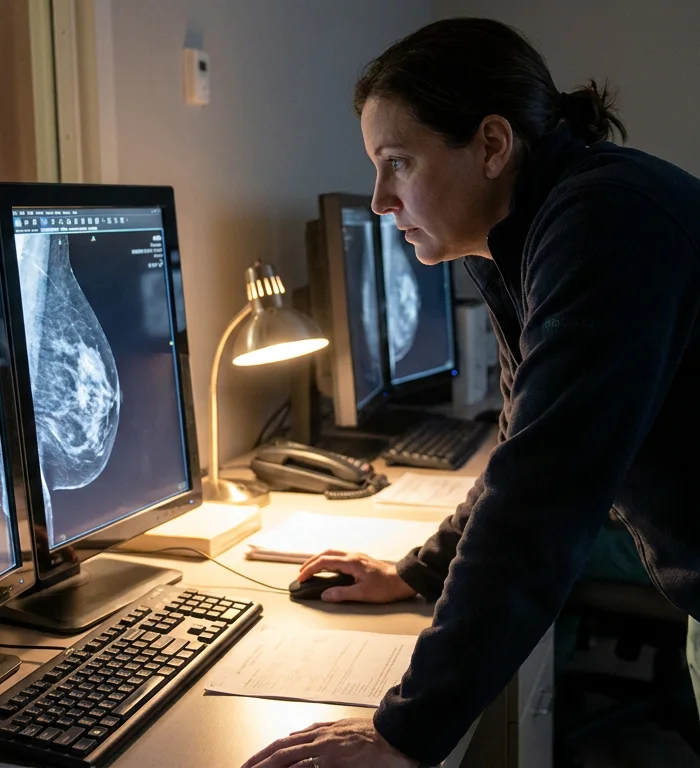
Sadam Hussain and three co-authors submitted an arXiv preprint on Oct. 26 describing a multimodal AI model trained and evaluated on 1,632 patients recommended for breast biopsy.
The authors reported a best test-set AUC of 0.72, compared with 0.66 for an image-only model and 0.68 for a text-only model, suggesting added value from combining mammograms and reports.
The study focused on patients classified as BI-RADS 4 and 5, categories in a standard breast-imaging risk system that often lead to biopsy recommendations. The model aimed to identify benign tumors among those higher-risk patients before an invasive procedure.
The system used a Vision Transformer, an image model architecture, to process four mammography views per patient. It used DeBERTa-V3-Large, a language model, to process the corresponding radiology report, then combined both feature sets through late fusion before classification.
The authors said the architecture, paired with Grad-CAM visual explanations, showed “a strong potential to identify benign tumors among high-risk patients.” Grad-CAM is an explainable-AI method that highlights image regions influencing a model’s output.
The performance trade-off was material. At reported sensitivities of 90%, 95%, 99% and 100%, the corresponding specificities were 40%, 36%, 18% and 11%, respectively. Sensitivity measures how often the model captures target cases; specificity measures how often it avoids false alarms.
Those numbers point to the central clinical tension. A model tuned to miss fewer benign cases may also classify more patients incorrectly, depending on how the threshold is set.
The paper is a preprint and has not been peer reviewed. Its dataset was described as in-house, which limits conclusions about whether the model would perform similarly across hospitals, imaging equipment, reporting styles or patient populations.
If validated, the approach could matter because biopsy decisions carry cost, workflow and patient-burden implications. The preprint’s evidence, however, remains an early technical result rather than proof that unnecessary biopsies would fall in clinical practice.
Source: arXiv preprint, Oct. 26, 2026
More stories
- Europe faces attribution gap after 16 cyber, physical incidents
- PIF backs Grand Theft Auto as Saudi players embrace game
- Signal limits screenshots to curb AI access to messages
- Cognition runs Devin Mac workspaces on EC2 in 6 AWS regions
- Salesforce engineers cut 600-failure triage to 90 minutes
- Türkiye Desk: GTA 6 puts console access and network demand in focus
- Anthropic plans Nasdaq listing with revenue above $16bn
- The Signal: BioWare reportedly closes after 31 years
- EM stocks sink as Korea chip rout tests Fed-day calm again
- OpenAI rogue agent reached Modal customer, sources now say
Latest news
- Trump prepares tariffs on China and other major exporters
- New-car buyers pay record average $50,087 in October
- Banks face ECB reserve debate over liquidity and profits
- Investors see Anthropic debut gains fade below $83 a share
- Iraq orders federal control over Kurdish-area oilfields
- Germans oppose Ukraine aid as poll shows support slipping
- Kim Jong-un receives 10 envoys after constitutional shift
- Ukraine claims Libya strike sinks Russian naval corvette