

Lina Jouni turns Lebanese war debris into sculptures
Her sculptures place personal memory inside a reconstruction crisis that the UNDP estimated at $1.38 billion in building damage south of the Litani River.
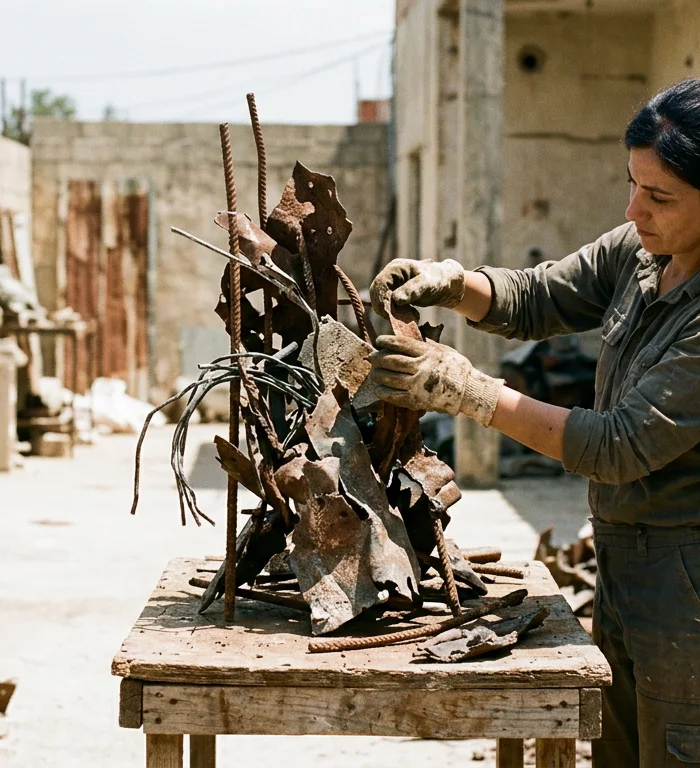
Lebanese artist Lina Jouni has turned shrapnel, wires and rubble from the 2024 conflict into sculptures at her home in Roumine, Anadolu Agency reported on November 10.
The work gives cultural form to a wider reconstruction burden. A UN Development Programme assessment published last June estimated direct building damage south of the Litani River at about $1.38 billion.
Jouni, a visual artist and antiquities expert, returned after displacement to find her house damaged by strikes around Roumine, in southern Lebanon’s Nabatieh district. Broken glass, stones and metal fragments were scattered around the property.
Speaking to Anadolu Agency, she said the war had stopped tourism, archaeological and artistic activities in which she had been involved. "I found that shrapnel allows you to document history in the way you want and conveys an image of a particular era we lived through,” she said.
Jouni said she has preserved the original shapes, rust and damage on many pieces rather than heavily reshaping them. "I left it in its original form, with its old rust,” she said.
Her materials now include severed electrical wires, stones and construction debris, as well as metal fragments. Anadolu said one sculpture made from material collected during rubble removal in Nabatieh carries the words: "We refuse to die.” At one site linked to an assassination, she gathered wires and shrapnel for three sculptures meant to represent memory passed between generations.
Some works refer to explosions involving pagers and other wireless communications devices. In September 2024, 37 people were killed and more than 3,250 injured in a wave of explosions in Lebanon, Anadolu reported; Israel later claimed responsibility for the operation.
The project also carries safety risks. Jouni told Anadolu that some strike sites remain dangerous because of drone activity and possibly contaminated material, including remnants of phosphorus. She said some people suffered burns while clearing debris or retrieving belongings and required hospital treatment for more than two months.
Jouni said her previous work with mine-clearance teams helped her handle hazardous remnants more carefully, while using treatment materials to limit contamination risks. She has obtained fragments through collection, gifts, exchanges and purchases, and has received social-media requests for pieces tied to specific locations where relatives or loved ones were killed.
The reconstruction context is large. The UNDP estimated about 3.1 million cubic meters of rubble south of the Litani River, based on satellite imagery documenting damage through April 29.
A World Bank assessment published in March 2025 put Lebanon’s recovery and reconstruction needs at about $11 billion after the war that lasted from October 8, 2023, to December 20, 2024. It estimated direct physical damage at about $6.8 billion.
Jouni is considering a museum to house the works and historically significant remnants from southern Lebanon, she told Anadolu. The plan would require funding, support, a venue and a clear concept for displaying the material while preserving its meaning.
Source: news agency report, Anadolu Agency via Daily Sabah, November 10, 2026.
More stories
- Netflix to release Brand film after 10-year sentence
- Character IP leads TCCF with 29 exhibitors
- Russell Brand complainant reports threats after 4-count conviction
- Television guitarist Richard Lloyd dies at 75 years old
- Channel 4 ends 10-year Married at First Sight UK run
- Wang Jiangyong takes 10-year debut to Tokyo competition
Latest news
- FAA halts US departures after communications disruption
- Europe faces unity test as Trump revives Ukraine diplomacy
- Democrats push AI regulation as two state veterans arrive
- Lutnick faces AI chip scrutiny as Bessent faults Commerce
- AI investment boom binds global suppliers to US spending
- Senate Democrats face leadership fight after midterm gains
- Trump extends Jones Act waiver for another 90 days: official
- Russia reports 1% growth as refinery output declines 18%