

Lagarde brings ECB succession forward with Feb. 7 exit
Antonio Costa said the replacement process will start without delay, with Klaas Knot and Pablo Hernandez de Cos identified as leading contenders.
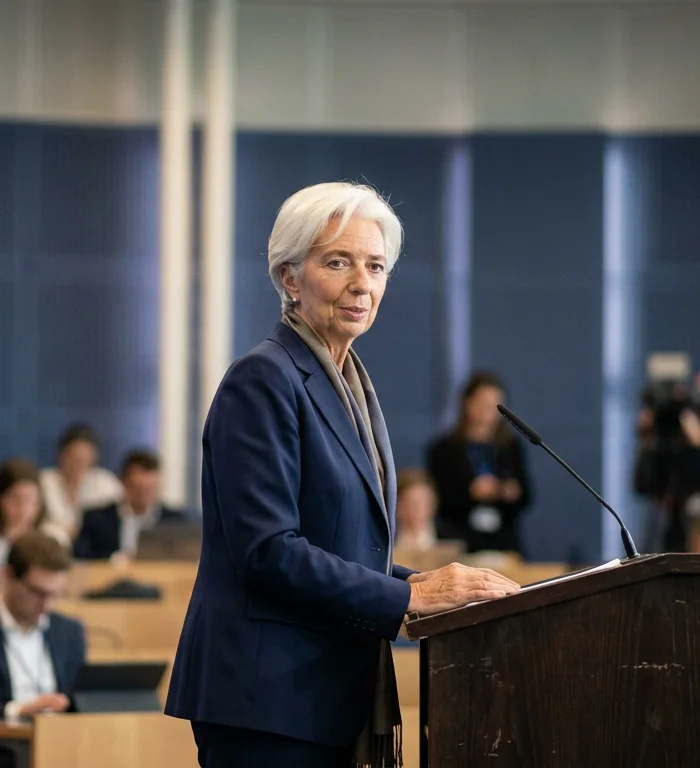
European Central Bank President Christine Lagarde told European Council President Antonio Costa she intends to leave on Feb. 7, 2027, Costa said in an Oct. 29 social-media post.
The planned exit would end Lagarde's ECB presidency about eight months before its October 2027 expiry, accelerating succession as the deposit rate stands at 2.5%, Atlas360 reported on Oct. 29.
Costa said the procedure to appoint Lagarde's successor would begin on Oct. 29 and be handled without delay. He said the process would follow the relevant article of the Treaty on the Functioning of the European Union.
Costa said he respected Lagarde's decision and thanked her for her work since she took office in November 2019. He said her leadership during the pandemic, war in Europe, energy crises and inflation shocks helped preserve euro-area stability and resilience.
BirGün, citing AA, reported that speculation about an early exit had circulated before Costa's announcement. It also reported that Lagarde had been discussed as a possible future figure at the World Economic Forum, without giving confirmation of such a move.
The report identified Klaas Knot of the Netherlands and Pablo Hernandez de Cos of Spain as the strongest names for the post. Knot was described as the more hawkish option, a term used for policymakers more inclined toward tighter monetary policy to contain inflation.
Berenberg Chief Economist Holger Schmieding, cited by Gazete Oksijen in the BirGün report, said the ECB should consider who would be best suited to handle possible financial turbulence. He said Knot's former role as chair of the G20 Financial Stability Board could give him an advantage.
Schmieding also linked the succession to French political risk, saying the European Union was trying to protect itself at least partly against the possibility that Marine Le Pen wins France's presidential election. He said the ECB had neither the mandate nor the desire to finance what he called France's fiscal excesses, while adding that in Berenberg's view the central bank would support France if it returned to more sustainable policies.
Pierre Roke, global capital markets specialist at Validus Risk Management, said in the report that a Knot appointment would probably be read as a hawkish message and could support the euro, but might increase pressure on French and peripheral bond spreads. He said a De Cos appointment would suggest greater policy continuity and a stronger focus on financial stability.
ING Global Head of Macro Carsten Brzeski said candidates' national backing would matter. He said Knot could draw more support from northern European governments, while De Cos's prospects would depend partly on whether Spain's current government supports him.
No official shortlist was reported. Costa said the aim was for euro-area leaders in the European Council to reach a timely decision on the next ECB president.
The next procedural marker is Oct. 29, 2026, when Costa said the formal appointment process for the next ECB president would start and proceed without delay under the EU treaty procedure.
Lagarde told Costa she intends to leave the ECB presidency on Feb. 7, 2027, about eight months before the end of her term.
Source: social-media post reported by BirGün Gazetesi/AA, Oct. 29, 2026
More stories
- EU rules bar Nord Stream return under 2027 gas phaseout
- Investors weigh OpenAI strengths against Anthropic growth
- Anthropic faces $265.6bn purchase commitments in IPO push
- Anthropic faces $800bn compute burden before Nasdaq IPO
- Anthropic seeks IPO after $16.3bn revenue, $9bn AI spend
- Brent crude falls more than 6% as Trump weighs Iran deal
- Nvidia forecast lifts shares as AI revenue outlook rises
- Anthropic TAM pitch tops $30 trillion in IPO growth case
Latest news
- EU faces AI gaps with 90% rare-earth reliance on China
- Japan & Asia: Switch 2 leads Famitsu as Korea fines stores
- Eric Nshimiye faces 10-year maximum after US conviction
- Boakai seeks Liberia mining investment with $30m survey
- South Africa health department faces call on boys' HPV shots after 3.6M girls vaccinated
- Singapore tribunal backs dismissal over secret workplace recording
- One Planet Partners makes Yulu first investment in $93m round
- Malaysia faces calls to tighten haze rules for 1.8 million workers