

Nvidia forecast lifts shares as AI revenue outlook rises
Nvidia shares rose after the company projected 70% fiscal 2028 revenue growth, topping the 45% estimate in FactSet analyst polling.
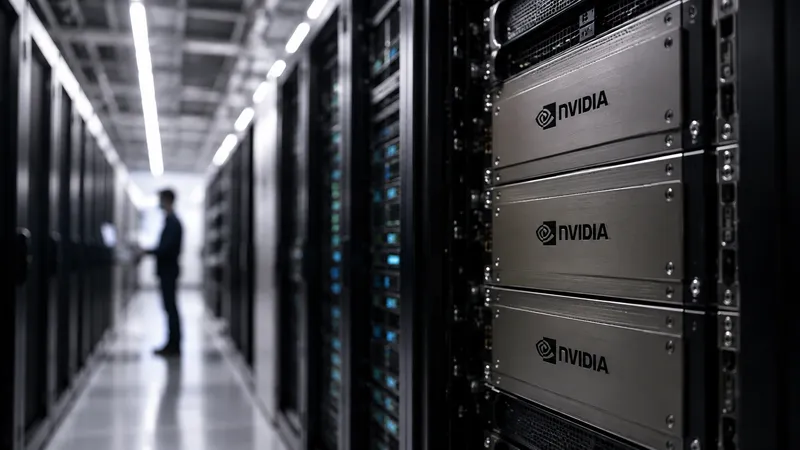
Nvidia shares rose 4% Wednesday after the company projected 70% fiscal 2028 revenue growth, above analysts’ 45% estimate.
Fiscal 2028 resets the bar
Colette Kress, Nvidia’s chief financial officer, gave the fiscal 2028 outlook on the company’s second-quarter earnings call. FactSet analyst polling had pointed to 45% growth for that year, making the company’s guide 25 percentage points above that consensus mark.
The stock rose 4% Wednesday in FactSet data that included after-hours trading as of 5:11 p.m. ET. The move followed a seven-session slide that ended Tuesday, giving investors a fresh benchmark for the AI spending debate.
Nvidia’s fiscal 2026 ended Jan. 25, so the 2028 target sits beyond the latest completed fiscal year in the chart provided by the company. The forecast arrived as investors were testing whether demand for advanced chips can keep pace with the data-center building financed around them.
Customer financing draws scrutiny
The concern is no longer only chip demand. Nvidia earlier this month announced a partnership with leading investment firms to provide partial guarantees for up to $500 billion of data-center financing, a structure intended to help customers buy its processors.
Soon after, Nvidia agreed to backstop an Ohio data-center project tied to OpenAI, exposing the company to potential multi-billion-dollar costs if leasing plans do not materialize. Those arrangements have put Nvidia’s balance sheet closer to customer expansion plans than in earlier phases of the AI cycle.
Kress defended the approach on the call, saying frontier AI labs such as OpenAI may become among the largest technology companies. She said some critics would call the strategy “circular financing” but added, “The equity returns on our invested capital will be excellent.”
Jensen Huang, Nvidia’s chief executive, framed the spending as part of a computing transition affecting the broader industry. “The big picture is that we’re going through this platform shift and it affects every computer company,” Huang said.
AI profit gap tests demand
The valuation backdrop makes small shifts in expectations matter. Nvidia is about a $5 trillion company, a scale that leaves its share price tied to assumptions about advanced processors used in AI training and inference.
Investors have also had to weigh reported server price increases linked to a memory-chip capacity crunch. Separate product investments aimed at competing with China in AI models have added another channel of spending beyond selling chips and systems.
Naveen Chhabra, principal market analyst at Forrester, said a gap persists between the pace of infrastructure spending and the slower profit generation from AI products. That gap matters for Nvidia because its customers’ cash flows affect their capacity to keep ordering chips, leasing data centers and financing new builds.
Three paths for AI spending
If Kress’s 70% fiscal 2028 growth view holds, the macro effect would run through capital spending on chips, power and data-center construction. Nvidia would have a stronger case for using its balance sheet to support customers, while the semiconductor supply chain would face pressure to expand memory, packaging and server capacity.
If leasing demand weakens or financing guarantees are called, the mechanism reverses. Credit risk would move from customers toward Nvidia, the company’s margins and cash deployment would draw closer scrutiny, and the wider AI infrastructure sector would face tighter funding terms.
If memory supply improves and server price increases moderate, AI builders could add capacity with less pressure on budgets. That path would support global technology investment, reduce friction for Nvidia’s customers and give rival chip, cloud and equipment suppliers more room to compete on availability rather than financing.
More stories
- IRGC says tanker explodes near Hormuz mine route
- Take-Two faces $30 million GTA 6 leak threat
- TG Therapeutics leads Valneva on 12 of 14 measures
- Pune police detain 92 over election-roll protest
- Tesla takes 90% of output from Arizona solar project
- New Horizon posts $4.1 million Q1 loss as R&D rises
- National Bank Exceeds Quarterly Financial Forecasts
- Gold Prices Decline as PCE Data Fuels Fed Rate Hike Concerns
- High Financing Costs Pressure Turkish Manufacturers
- India's Economic Growth Challenges Job Creation
Latest news
- US disables cargo ship in Iran blockade breach
- Ronaldo Ranks Third in Football's 1,000-Game Club
- Republicans Prepare Bill to Curb Trump Russia Deal
- Nollywood Star Urges Investment in Ghanaian Actor LilWin
- Marvels' Box Office Flop Still Pivotal for MCU's Future
- Hefner's Ex-Wife Defends Legacy Amid Film Controversy
- Fatal shooting incident reported in Istanbul's Bagcilar district
- Chelsea's Chavarria Impresses in 5-1 Bournemouth Victory