

New Horizon posts $4.1 million Q1 loss as R&D rises
The aircraft developer says more than $70 million of liquidity gives it at least 24 months to advance its hybrid-electric Cavorite X7 program.
New Horizon Aircraft said on its Oct. 9 earnings call that its fiscal first-quarter 2027 net loss narrowed to $4.1 million, or $0.06 a share.
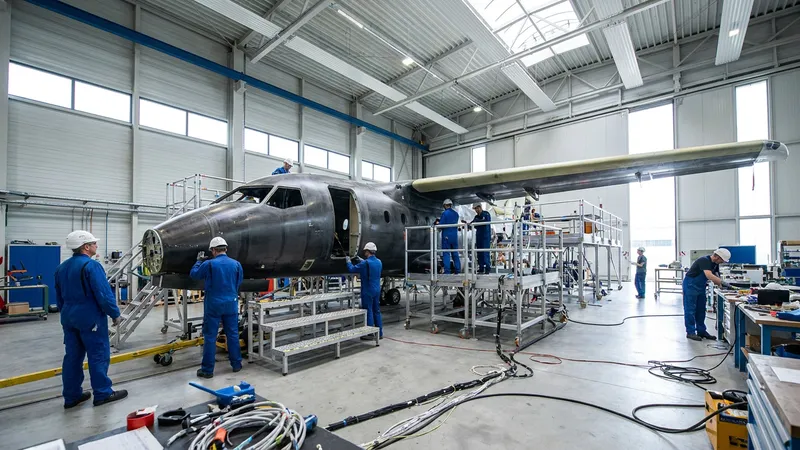
New Horizon said on the same call that R&D costs rose to $7.4 million in the quarter from $2.7 million a year earlier as work increased on its full-scale Cavorite X7 demonstrator.
The company reported a smaller loss than the $10.9 million, or $0.29 a share, posted in the prior-year period. General and administrative expenses fell to $1.7 million from $3.2 million, primarily because of lower stock-based compensation, management said.
Chief Executive Officer Brandon Robinson said the company is shifting from design validation to production of a full-scale aircraft. “Our current target is to complete the demonstrator around the end of the first calendar quarter of 2027 and begin testing shortly thereafter,” Robinson said.
New Horizon said it held more than $70 million in cash and liquidity as of Aug. 31, 2026. Management said that amount should fund at least 24 months of operations, while net operating cash usage rose to $7.2 million in the quarter from $2.4 million a year earlier.
Development spending rises
The Cavorite X7 is a seven-passenger hybrid-electric vertical takeoff and landing aircraft, meaning it is designed to lift off vertically and also fly on wings. New Horizon said the hybrid design avoids reliance on ground-charging infrastructure and is intended for regional transport, emergency response, cargo and military missions.
Engineering costs within R&D increased to $5.3 million from $0.3 million in the year-earlier period, the company said. Management linked the increase to fuselage and flight-control development for the demonstrator, including electrical systems, avionics, landing gear and primary and secondary structures.
New Horizon said it selected BETA Technologies to provide flight-control computers and customized fly-by-wire software, an electronic system that processes pilot commands. Robinson said BETA’s platform has flown more than 200,000 miles, and he framed outside partnerships as a way to avoid building every major system internally.
The company also said headcount reached 65 employees and more than 85 full-time equivalents including contractors, compared with 30 employees a year earlier. New Horizon said capital expenditures were $0.7 million in the quarter, focused on equipment and tooling for aircraft production.
Orders remain preliminary
New Horizon said it has signed letters of intent for as many as 200 aircraft purchases and five leases, representing more than $1 billion in potential sales value. Letters of intent are not firm orders, and the company did not provide binding purchase terms or conversion rates on the call.
The company said one letter of intent with V-Star Powered Lift Aviation covers up to 100 aircraft, with a potential value of about $600 million, for emergency-services use in Australia. It also said it signed a letter of intent with Great Lakes Helicopter to support future X7 maintenance, repair and overhaul services and pilot training.
Financing remains central because advanced aircraft development is capital intensive. New Horizon said it raised $0.6 million through an at-the-market stock program during the quarter at an average price of $2.81 per share, or $2.04 in U.S. dollars; an at-the-market program lets a company sell shares into the market over time.
New Horizon said it received $0.5 million of reimbursed costs through the INSAT project and expects more than $1 million by the end of the fiscal year. The company said it has access to a $350 million INSAT project bucket for nondilutive sustainable-aviation funding.
Certification risk
Management said it is targeting aircraft certification in early 2030, with work involving Certification Center Canada and Transport Canada. Certification is a central hurdle for new aircraft designs because regulators must approve safety, controls, testing and operating standards before commercial use.
Robinson also identified a risk outside New Horizon’s control: failures elsewhere in the advanced-aircraft sector. “If something happens during testing with one of those major OEMs, that's something that we can't control,” he said.
The company said the flight-test sequence is expected to begin with conventional takeoff and landing before progressing to vertical operations. Management also said it expects research and development spending to remain elevated as design and testing work advances.
What to watch
End of the first calendar quarter of 2027: New Horizon’s target for completing the full-scale Cavorite X7 demonstrator, followed by ground runs, taxi testing and flight testing.
End of fiscal 2027: New Horizon said it expects more than $1 million in reimbursed costs through the INSAT project by the end of the fiscal year.
Early 2030: New Horizon’s target for aircraft certification, with work involving Certification Center Canada and Transport Canada.
Source: earnings-call transcript, The Motley Fool, Oct. 10, 2026
More stories
- Tesla takes 90% of output from Arizona solar project
- French Borrowing Costs Hit 5% as Debt Crisis Deepens
- Grabar probes shareholder claims at four Nasdaq companies
- Byrna revenue drops 46% as sales reset deepens
- PepsiCo cuts 2026 EPS outlook to 2.5%-3.5% growth
- Mortgage rates squeeze US consumers as sentiment weakens
- Turkey Hits 127 GW Capacity as Renewables Rise
- Trump and Xi Sign $30B Tariff Deal
Latest news
- Red Cross says Gaza hostage access involved Haniyeh talks
- Trump urges Zelensky replacement over refinery strikes
- Saudi Arabia suspends Riyadh airport operations after attack
- Kyiv playground blast puts Ukraine air-defense stocks back on Washington’s agenda
- Rubio’s Athens speech hardens Washington’s public line on Iran
- Saudi airport hit in new Houthi attack, officials say
- Houthis claim Riyadh airport strike as injuries reported
- Germany Reaffirms Russia Sanctions Amid Potential US Policy Shift