

Kyiv playground blast puts Ukraine air-defense stocks back on Washington’s agenda
A video from the Kyiv region showing a man narrowly escaping an apparent drone strike near a kindergarten adds pressure to Washington’s debate over how…
Kyiv playground blast puts Ukraine air-defense stocks back on Washington’s agenda
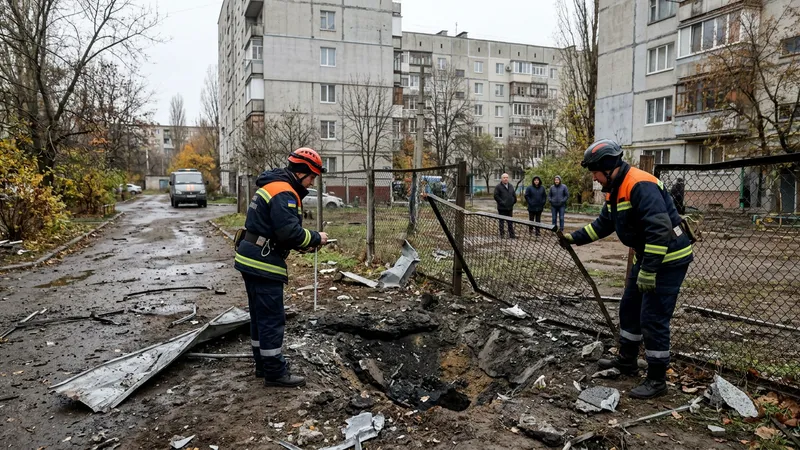
A video published on October 10, 2026, showed a man walking near a kindergarten in Sviatopetrivske, a village in the Kyiv region, moments before an apparent drone struck nearby and sent debris and smoke into the air. In Washington, the footage gives new force to a familiar policy problem: how fast the United States can help Ukraine defend its cities without drawing too deeply from US military inventories.
But its location near civilian infrastructure outside Kyiv
The clip does not by itself establish who launched the drone, what munition was used, or whether the kindergarten was the intended target. But its location near civilian infrastructure outside Kyiv places it inside the operational question now facing the White House, Pentagon and Congress: whether Ukraine’s air-defense umbrella can be sustained through another winter if attacks keep reaching the capital’s perimeter.
Ukraine’s air-defense network depends on a layered mix of Western-supplied systems, Soviet-era equipment, mobile gun teams and electronic warfare. The most politically sensitive layer for Washington is the supply of interceptors, especially for systems such as Patriot and NASAMS, because those munitions are expensive, slow to produce and also needed for US and allied contingency plans.
The Pentagon has two main channels for arming Ukraine. One draws directly from existing US stocks under presidential authority, which can move faster but affects American inventories. The other funds new production or purchases for Ukraine, which protects US stockpiles but often takes longer to deliver battlefield effects.
That distinction matters when the target is a That distinction matters when the target is a drone approaching a city rather than a tank on a front line. Urban air defense is a math problem as much as a technology problem: defenders need enough sensors, launchers and ammunition to cover likely approach routes, while attackers can send cheaper drones to force costly intercept decisions.
For the Biden and Trump administrations alike, air defense became one of the least negotiable parts of US support for Kyiv because it links battlefield policy to visible civilian risk. A strike near a playground or kindergarten carries a different political charge in Washington than an artillery exchange along the front, even when both are part of the same war.
The Kyiv region also matters strategically. Russia has repeatedly used drones and missiles to pressure Ukrainian cities, energy infrastructure and air-defense crews, seeking to stretch protection across too many targets at once. If attacks intensify around the capital’s suburbs, Ukrainian commanders may have to choose between guarding government and military sites, power assets, and residential areas.
Congress is the second constraint. Lawmakers supportive of Ukraine have pressed for faster transfers and larger replenishment orders, while skeptics have asked how each drawdown affects US readiness, especially in the Indo-Pacific and Middle East. That debate tends to sharpen when the requested items are not rifles or trucks, but interceptors that take time and specialized production lines to replace.
The White House’s role is to decide whether the strategic cost of sending more air-defense munitions now is lower than the cost of letting Ukraine absorb more strikes. The Pentagon’s role is narrower but decisive: it must certify what can leave US stocks, what must stay for US forces, and what industry can replace on a usable timeline.
Sviatopetrivske turns that bureaucratic question into a concrete image. The man in the video survived by seconds; the policy issue is whether Ukraine’s cities are relying too heavily on that kind of luck when drones penetrate close to civilian spaces.
The falsifiable test is whether the Pentagon
announces, by November 20, 2026, an emergency package that explicitly prioritizes short-range counter-drone munitions and air-defense interceptor refills for transfer through European Command. If that happens, it would suggest Washington has judged the near-term risk to Ukrainian cities and winter infrastructure to outweigh the inventory strain on US forces; Ukraine’s main company-level and municipal defenders would gain more depth, while the US defense sector would face added pressure to expand interceptor and counter-drone production.
If the administration instead defers those transfers and cites baseline stockpile thresholds, the macro effect would be a more cautious US posture on military depletion, the immediate burden on Ukraine would shift toward rationing interceptors and dispersing defenses, and the wider air-defense industry would receive demand signals without the same urgent delivery clock.
More stories
- Red Cross says Gaza hostage access involved Haniyeh talks
- Trump urges Zelensky replacement over refinery strikes
- Saudi Arabia suspends Riyadh airport operations after attack
- Rubio’s Athens speech hardens Washington’s public line on Iran
- Saudi airport hit in new Houthi attack, officials say
- Houthis claim Riyadh airport strike as injuries reported
- Solstice Swaps $15B Deal for $500M Buyback After 11% Revenue Pop
- Report Touts 32% CAGR for Quantum in Healthcare, Names Tech Giants