Report Touts 32% CAGR for Quantum in Healthcare, Names Tech Giants
A new market report projects 32.4% annual growth for quantum computing in healthcare through 2030, putting a spotlight on the long-term R&D of IBM, Google…
Jurgen Goldmeier ·
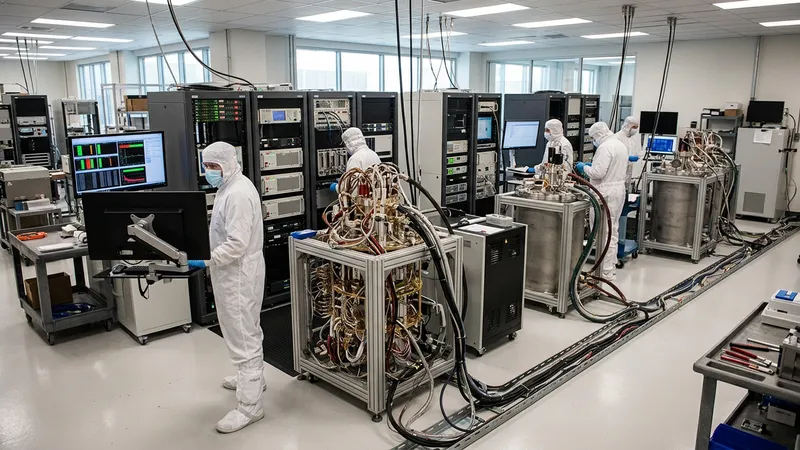
Report Touts 32% CAGR for Quantum in Healthcare, Names Tech Giants A market research report projects 32.4% compound annual growth through 2030 for the quantum computing in healthcare sector, citing drug discovery as a primary driver. The forecast identifies tech incumbents IBM, Google, Microsoft, and Intel alongside pure-play quantum firms IonQ and Quantinuum as central to this potential expansion. ## Background The projection comes from a report titled "Quantum Computing in Healthcare Global Market Report 2026." Such long-range forecasts are common but require scrutiny, particularly for technologies still in early development. A compound annual growth rate (CAGR) measures the mean annual growth of a market over a specified period longer than one year; in this case, it suggests a market doubling in size roughly every 2.5 years. The tape, however, shows that quantum computing remains a pre-commercial, high-spend research area for most companies involved. Investors have historically treated these divisions as long-dated call options on future disruption rather than near-term revenue contributors. The field is populated by two distinct types of players. Tech giants like Google, Microsoft, and IBM are leveraging immense balance sheets to fund in-house quantum hardware and software development as part of broader R&D portfolios. For them, quantum is one of many strategic bets. In contrast, specialized firms like IonQ, which is publicly listed, and the privately-held Quantinuum are total-commitment quantum plays. Their valuations are almost entirely dependent on the technology achieving commercial viability. The report groups these disparate business models together as drivers of a single market vertical. ## Why it matters The 32.4% growth figure, while speculative, provides a tangible number for a market that has been largely conceptual. For investors in Alphabet (Google's parent), Microsoft, and IBM, it forces a question: what portion of their long-term growth models accounts for these deep-tech initiatives? While core businesses like cloud computing and advertising drive current earnings per share (EPS)—the portion of a company's profit allocated to each outstanding share of common stock—this report frames quantum as a potential future pillar. Ascribing a specific growth rate to a segment like quantum healthcare gives analysts a new variable to plug into valuation models. The report's narrative puts investors who have dismissed quantum as a perpetual science project on the defensive. It suggests a specific, high-value application—drug discovery—is on a discernible path to acceleration. If the report's timeline proves even directionally correct, portfolios underweighting companies with credible quantum programs could miss a significant technological shift. The market has been rewarding tangible AI profits; this forecast pressures firms to articulate a similarly clear path from quantum research to revenue, moving beyond theoretical qubit counts to commercial applications. ## What to watch The immediate test of this thesis will be the next round of quarterly earnings calls. Look for any change in language from the management teams at IBM, Alphabet, Microsoft, and IonQ regarding their quantum divisions. Specifically, watch for any new commentary on R&D spending, strategic partnerships in the healthcare or pharmaceutical sectors, or updated timelines for commercialization. The key is whether companies begin to validate the report's optimism by attaching concrete figures or milestones to their quantum healthcare efforts. If management guidance remains unchanged, framing quantum as a distant research goal, the report will be dismissed as just another piece of vendor-driven market promotion.