
Rubio’s Athens speech hardens Washington’s public line on Iran
Secretary of State Marco Rubio’s October 7 address in Athens has drawn a broad backlash in Iran after he called the Islamic Republic a “cult of death.
Rubio’s Athens speech hardens Washington’s public line on Iran
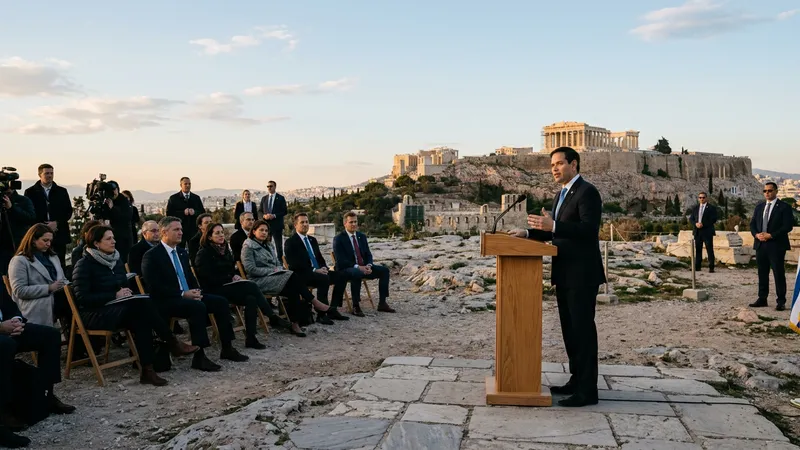
Secretary of State Marco Rubio used an October 7 speech at the Pnyx hill in Athens to cast Iran as a central ideological adversary of the West, calling the Islamic Republic a “cult of death.” The remarks have triggered anger across Iran over the past 48 hours, according to Iranian accounts, and give Washington’s Iran debate a sharper public frame at a moment when backchannel diplomacy already looks politically exposed.
Iran Secretary
The State Department has not only a communications problem with Tehran after the speech. It now has a policy sequencing problem: if Rubio’s language becomes the operating premise for US diplomacy, Congress and allied capitals will read it as a cue that the administration wants pressure to lead and talks to follow, if they happen at all.
Rubio delivered the speech at a site deliberately associated with ancient Athenian democracy, using Greece as a stage for a wider argument about Western political endurance. That setting mattered. In Washington, venue choice is part of foreign policy messaging, and the Pnyx gave Rubio a way to cast Iran not as a narrow nuclear file, but as a civilizational opponent.
The phrase “cult of death” landed in Tehran as more than rhetorical excess. Iranian officials, former diplomats, academics, newspapers and social media users responded angrily, according to the source material, treating the line as an insult to the state and, by extension, to national dignity. That reaction is useful for hard-liners in Tehran, who can frame US diplomacy as hostile regardless of the technical issue on the table.
For the White House, Rubio’s formulation fits a broader Trump administration preference for public clarity over diplomatic ambiguity. President Trump’s first term used sanctions, military deterrence and public pressure to narrow Iran’s room for maneuver. Rubio’s Athens speech suggests the current State Department is willing to speak about Iran in ideological terms rather than confining the dispute to nuclear constraints, missiles, proxies or maritime security.
That distinction matters inside Washington. A nuclear negotiation can be defended as a transactional exercise: limits for sanctions relief, monitoring for access, restraint for incentives. A civilizational contest is harder to compartmentalize, and lawmakers who oppose concessions to Tehran can use Rubio’s own words to argue against narrow bargains.
Congress is central to that dynamic even when it is not formally negotiating. Sanctions legislation, oversight hearings, arms sales approvals and funding decisions all shape the diplomatic space available to the State Department. If lawmakers treat the Athens speech as the administration’s policy baseline, State will face pressure to explain any quiet contact with Iranian representatives as tactical, temporary and tightly bounded.
The Pentagon also has a stake in how the rhetoric is interpreted. US forces in the region operate in a landscape where political language can affect the risk calculus of militias, maritime actors and partner governments. A harder public line from Washington can reassure Israel and Gulf partners, but it can also give Tehran-aligned groups a pretext to test US thresholds if they believe diplomacy has stalled.
The National Security Council’s role is to keep those tracks aligned: public messaging, sanctions policy, military posture and crisis communications. The risk for Washington is not that one speech changes Iran policy by itself. The risk is that a speech becomes a signal others act on before the interagency process has decided how much diplomatic space to preserve.
Tehran’s reaction also reflects internal politics. Iranian officials often use foreign criticism to police domestic debate, especially when the criticism comes from Washington. Former diplomats and academics can differ over tactics, but a direct attack on the Islamic Republic’s identity narrows the public space for anyone arguing that engagement with the United States remains useful.
That is why the backlash matters beyond newspaper headlines and social media anger. If Iranian political actors who favor limited talks are forced to defend national honor first, the practical agenda moves down the list. Regional de-escalation, prisoner issues, nuclear monitoring and financial channels all become harder to discuss publicly.
For US allies, the message is mixed. European governments that still prefer diplomatic openings with Tehran will hear Rubio’s speech as a sign that Washington may not invest much capital in reviving a negotiated framework. Israel and several Gulf capitals may read the same language as evidence that the administration is aligning public rhetoric with a containment-first posture.
Markets would not move on this speech alone without a policy step attached to it. The mechanism to watch is energy risk: if harsher US rhetoric is followed by sanctions enforcement, shipping pressure or escalation around Iranian-linked groups, oil traders and insurers would have clearer reasons to reprice Gulf risk. Without that second step, the speech remains politically important but economically indirect.
The falsifiable test is whether the State Department turns the Athens language into administrative action by November 15, 2026. If Washington designates additional diplomatic, financial or media-linked channels connected to Iran, the speech will look like the public opening of a tighter containment phase; the global effect would run through energy-risk premiums and allied sanctions coordination, the State Department would have less room for deniable mediation, and the wider security industry would prepare for higher demand for Gulf surveillance, missile defense and maritime protection. If instead State Department spokespeople confirm active, unmediated quiet talks with Iranian representatives on regional de-escalation, Rubio’s speech will look more like coercive positioning than a diplomatic cutoff; the global macro effect would be more limited, the department would preserve bargaining flexibility, and the regional defense and energy sectors would face a lower immediate escalation signal.
More stories
- Red Cross says Gaza hostage access involved Haniyeh talks
- Trump urges Zelensky replacement over refinery strikes
- Saudi Arabia suspends Riyadh airport operations after attack
- Kyiv playground blast puts Ukraine air-defense stocks back on Washington’s agenda
- Saudi airport hit in new Houthi attack, officials say
- Houthis claim Riyadh airport strike as injuries reported
- Amazon's October Sale: An Early Stress Test for Q4 Retail
- Solstice Swaps $15B Deal for $500M Buyback After 11% Revenue Pop