Kennedy Center Removes Trump Name After Court Order
The Kennedy Center removed former President Trump's name following a judicial ruling that only Congress can rename the national performing arts landmark.
Lauren Collins ·
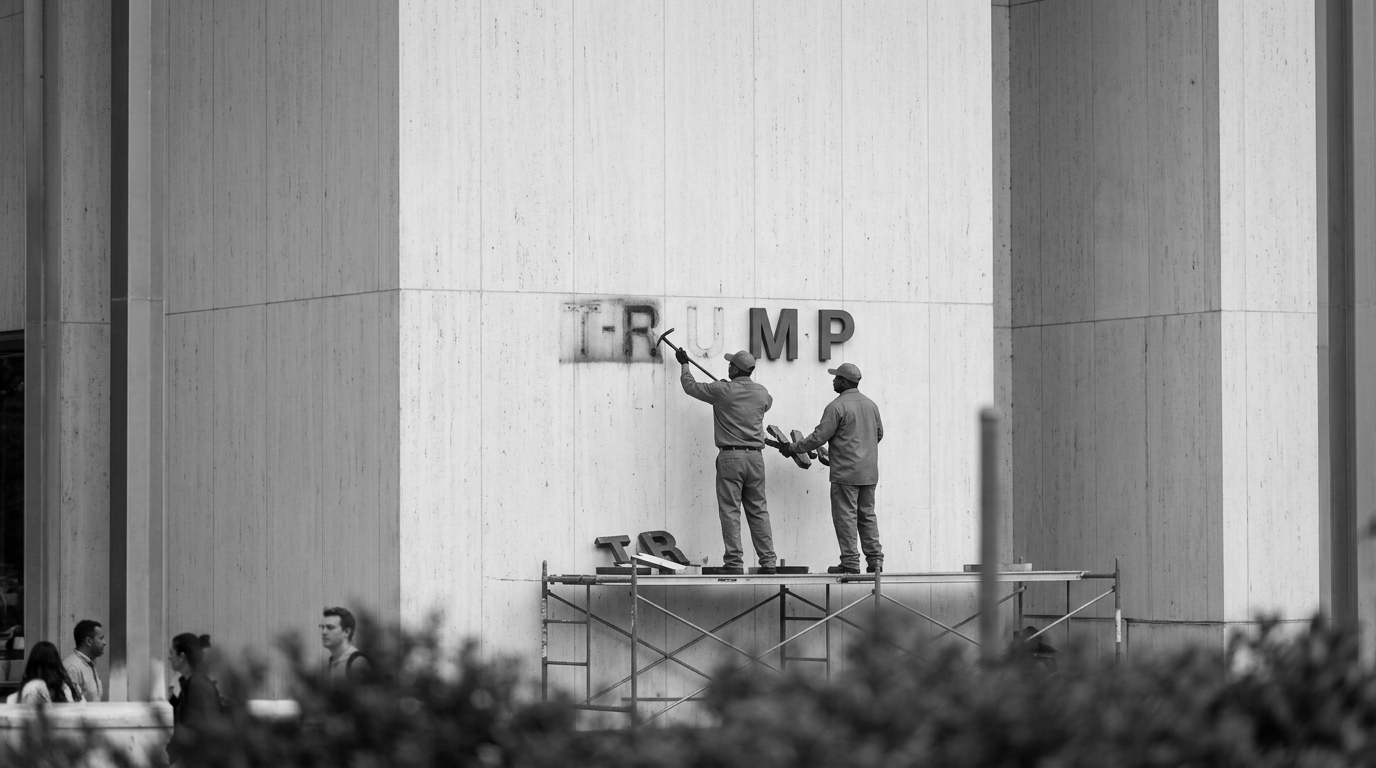
Washington D.C. — Workers removed former President Donald Trump's name from the John F. Kennedy Center for the Performing Arts early Saturday, just under six months after its installation. This action complied with a federal judge's ruling asserting that Congressional approval is necessary for any renaming of the iconic venue.
The operation commenced around 1:20 a.m. EST, mere hours after the Department of Justice (DOJ) indicated it would miss a court-imposed Friday midnight deadline. The DOJ had sought an extension, citing safety concerns due to inclement weather.
Legal Mandate and Missed Deadlines
The directive to remove Trump's name stemmed from a lawsuit filed by Democratic U.S. Representative Joyce Beatty of Ohio. U.S. District Judge Christopher Cooper had previously declined the DOJ's request to pause his order.
The administration appealed this injunction to the U.S. Court of Appeals for the District of Columbia, which additionally rejected the government's plea for a pause on Friday. Congress had initially designated the center as a living memorial to President John F. Kennedy.
Representative Beatty criticized the DOJ's request for an extension, labeling it as "inexcusable" and indicative of a "pattern of non-compliance." Her legal challenge underscored the principle that a national landmark established by Congress requires congressional action for any modification to its official designation.
Institutional Authority and Congressional Prerogative
The Kennedy Center's board, then chaired by Trump, had voted in December to rename the institution as 'The Donald J. Trump and The John F. Kennedy Memorial Center for the Performing Arts.' Workers began affixing Trump s name to the building the following day.
This renaming attempt highlighted a jurisdictional conflict over the center's legal identity. The judicial rulings reinforced Congressional authority over the naming of institutions it establishes, preventing unilateral changes by the executive branch or an appointed board.
The Kennedy Center, opened in 1971, serves as a permanent memorial to President John F. Kennedy, who was assassinated in 1963. Its original charter and subsequent acts of Congress dictate its official name and purpose.
Implications for National Landmarks
The removal of the name underscores a critical legal precedent regarding federal institutions. It reaffirms that statutory designations for national landmarks are not subject to executive whim or board resolutions without legislative endorsement.
This case illustrates the checks and balances inherent in American governance, where judicial review can uphold legislative intent against executive actions. The swift enforcement of the court order, despite the DOJ's eleventh-hour requests, emphasizes the judiciary's role in maintaining legal consistency.
Moving forward, any future attempts to alter the official name of the Kennedy Center would undoubtedly require a vote and passage through both chambers of Congress, ensuring adherence to established legal frameworks for national institutions.